
Selection Guide
Choosing a Jib Crane Mounting for Your Building
Six mounting types exist because the building constrains the crane more often than the load does. Wall, column, free-standing, articulating, mast and portable each solve a different constraint.
Jib cranes are usually specified by capacity, which is the easy part. Capacities across this range run from 250 kg to 20 tons, and almost every workshop lift falls comfortably inside that. The decision that actually determines whether the crane can be installed is the mounting, and it is decided by the building rather than by the load.
Wall and Column Mountings Use No Floor
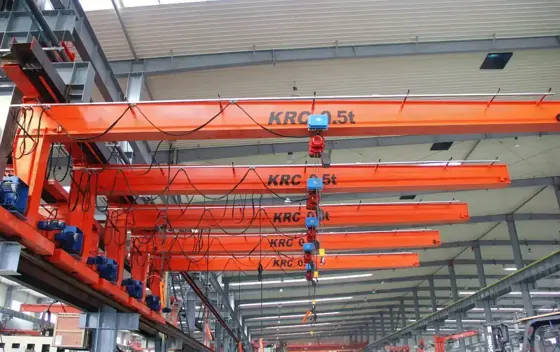
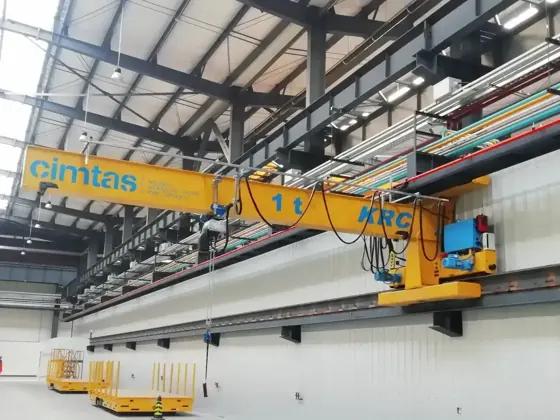
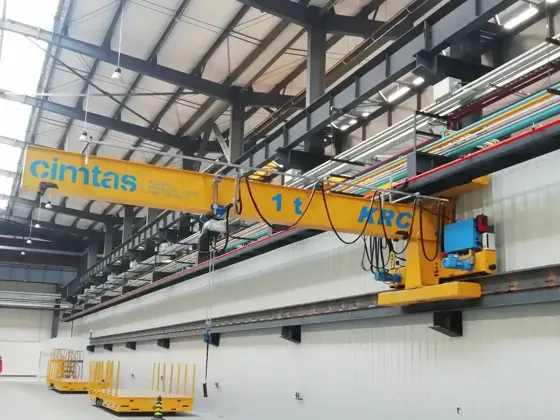
A wall-mounted jib takes no floor area at all, which in a crowded shop is worth more than capacity. A steel tie rod carries the overturning moment back into the wall or column, and a single I-beam boom resists buckling at full reach. The constraint is that the wall or column has to be able to take that moment, which usually means a structural check.
Pillar and Mast Mountings Need No Building
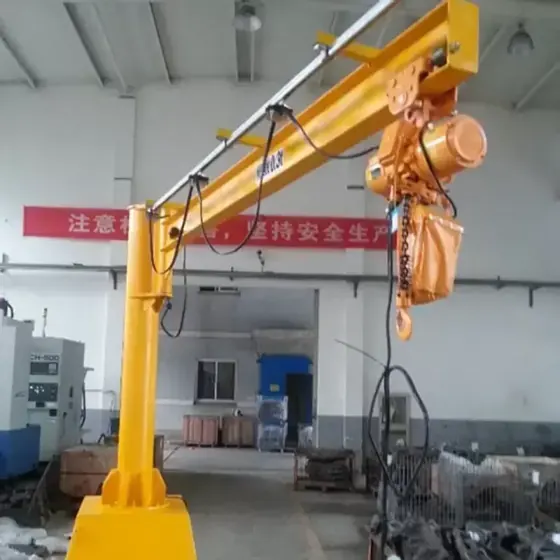
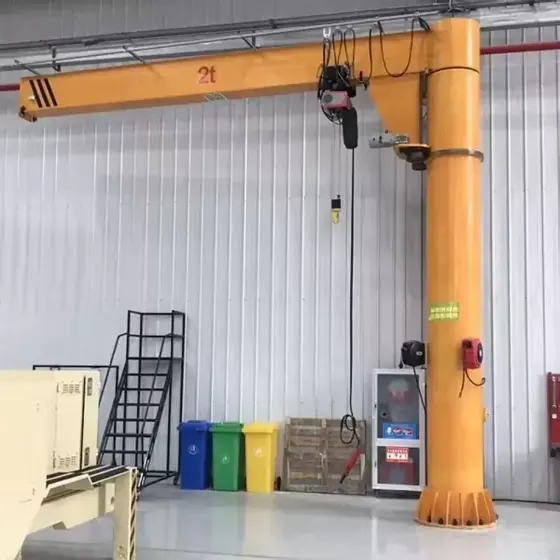
A pillar jib crane is set on the floor without any additional support, which removes the structural survey entirely. It slews 270 degrees, which covers a workstation and its feed and despatch positions, and its simple structure with few parts keeps maintenance low. Mast type mountings work the same way and are specified where no wall or column exists at all.
Portable Mountings Serve Several Positions
A portable jib is lightweight and moves easily, so one crane can serve several temporary lifting points rather than buying one crane per position. On a site where the work moves, that spreads the cost across the whole operation.
Articulating Arms Reach Around Obstacles
An articulating jib has a jointed arm, which gives precise positioning and lets the hook reach around a machine or a column that a straight boom cannot clear.
Slew Range Follows the Mounting
Wall jibs slew 180 degrees, which is all that is available in front of a wall and loses nothing. Pillar jibs slew 270 degrees. Free-standing, mast, portable and davit cranes slew a full 360 degrees. Check the sweep is clear of services, racking, lighting and doors before ordering, because that is the constraint people miss.
Hoist Type Is a Separate Decision
Electric for frequent lifts, manual for occasional ones, pneumatic where an electric hoist is not permitted. All three are available on the 3 to 6 ton range, and wireless remote control is available where operator fatigue on repeated lifts is the issue.
Marine Work Is Different
A davit crane for boat handling uses corrosion resistant materials, anti-sway technology and a variable frequency drive, because a swinging load over water is a hazard rather than an inconvenience. It covers 2.5 to 20 tons with 360 degree slew and radio or push-button control.
What to Send
A photograph of the area, the heaviest routine lift, the radius you need to reach and what the wall, column or floor is made of. Those four settle the mounting, and the mounting settles most of the rest.
FAQ
Questions On This Guide
Will a jib crane replace our overhead crane?
No, it complements it. A jib crane at the busiest workstation takes routine lifts off the bay crane's queue, which is usually where the time is lost.
Do we need to modify the building?
Not with pillar, mast or portable mountings, which are designed to work without building support.
Is the pillar crane certified?
Yes, the pillar jib cranes are CE certified.
What capacity range is available?
250 kg to 2000 kg on the 2 ton range, 0.5 T to 5 T on wall-mounted units, 0.5 t to 6.3 t on pillar cranes, 0.25 to 10 tons on the general range and 2.5 to 20 tons on davit cranes.
Related products
Products Referenced In This Guide
Product groups
Groups This Guide Covers
Jib Cranes
Local lifting from 250 kg to 20 tons, in wall, column, pillar, mast, portable and davit mountings.
Hoists And Lifting Gear
Electric to 50 tons, pneumatic to 25 tons, manual to 5 tons, plus explosion-proof builds.
Overhead Cranes
10 to 200 tons on double beam bridges spanning up to 49 metres, in light and winch builds.
Turn This Into A Specification
Send us the application and we will translate it into a machine, a configuration, a material grade and a delivery plan.