
Design Guide
Balancing a Packaging Line Before You Buy It
A line runs at the speed of its slowest machine, and that machine is rarely the filler. Every speed in this range is published, so the bottleneck can be found with arithmetic.
Packaging lines are bought machine by machine and then run as a chain. The chain moves at the speed of its slowest link, and because every machine is quoted in different units, nobody notices which link that is until the line is installed.
Convert Everything to One Unit
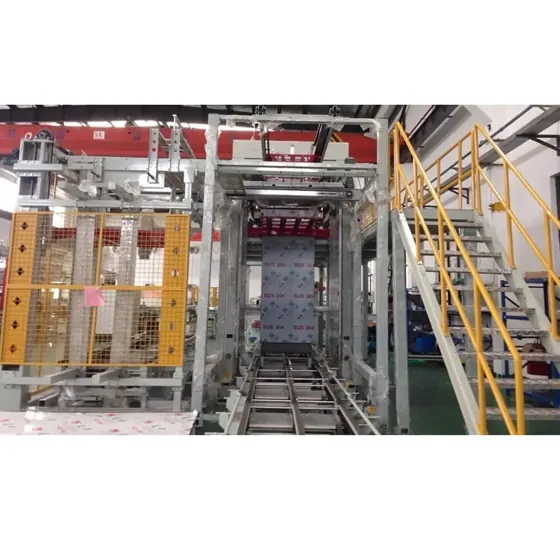
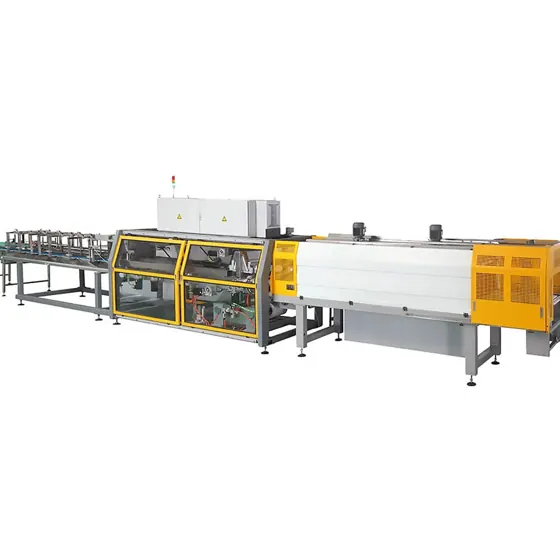
Depalletizing is quoted at 500 to 1200 containers per minute, conveying at 15,000 to 36,000 bottles per hour, labelling at 15,000 to 30,000 BPH, sleeving at 100 to 600 per minute, film wrapping at 25 to 150 per minute, cartoning at 25 to 60 per minute and palletizing at 20 to 80 cartons per minute. Convert all of them to packs per minute at your pack size and the bottleneck becomes obvious on paper.
Start From Sustained Output Not Nameplate
Size the line against what the filler actually achieves across a shift including changeovers and short stops, not against its rated speed. A line balanced against nameplate figures runs permanently starved at one end and blocked at the other.
Accumulation Is What Absorbs Faults
Most line stops are short: a fallen bottle, a label web break, a jammed carton. Accumulation conveyor length between machines is what lets the rest of the line keep running through a thirty second fault. Without it, one small stop empties the line and every machine restarts from cold.
Conveyor Type Follows Container State
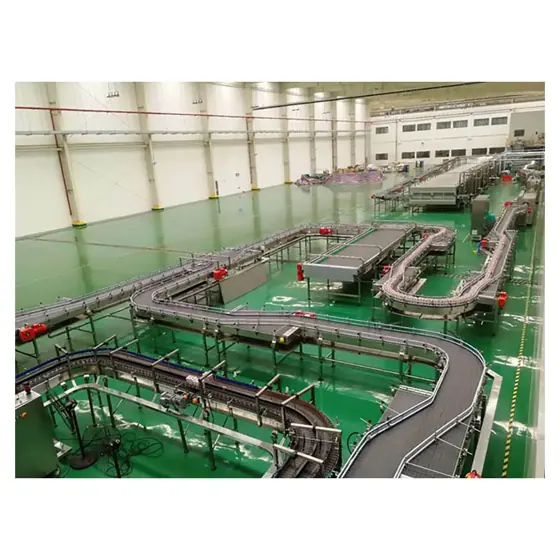
Empty PET bottles are light and unstable on a belt, so air conveying carries them by the neck. Filled containers and packs run on chain plate. Where the line changes level, a spiral conveyor does it in its own footprint instead of consuming metres of floor. Most lines need all three.
Configuration Matters More Than Speed
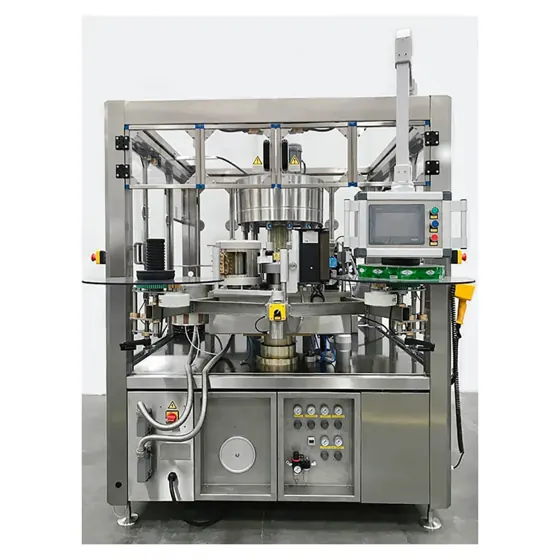
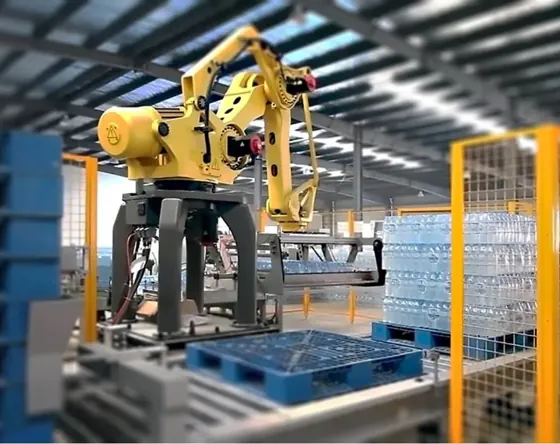
Four labelling configurations exist because label material decides the machine, not bottle count. Three palletizer configurations exist because floor space and format count decide the choice: gantry for consistent high throughput, vertical column where space is tight, robot where formats change often.
Count Your Changeovers
On a multi-format line, changeover time is where available capacity is actually lost. A can filler with quick size changeover and a robot palletizer that changes pattern in software will beat faster machines that take an hour to convert.
Then Buy in Order of Constraint
Every machine in this range has a minimum order of one unit, so a line can be upgraded progressively. Replace the bottleneck first, re-measure, and find the next one. Buying a faster filler when the palletizer is the constraint changes nothing at all.
FAQ
Questions On This Guide
How do we find our current bottleneck?
Convert every machine's rated speed to packs per minute and compare. The lowest figure is the theoretical line speed, and the gap between that and your actual output is accumulation and changeover losses.
Can machine speeds be built to our line?
Yes. Working speed on each machine is built to your requirement within its published range.
How much accumulation do we need?
Enough to cover your typical short stop at line speed. Measure the duration of real stops rather than estimating.
Can we automate one stage at a time?
Yes, and it is usually the right approach. Every machine is sold from one unit.
Related products
Products Referenced In This Guide
Product groups
Groups This Guide Covers
Packaging Machines
Labelling, sleeving, wrapping, cartoning, palletizing and depalletizing at line speed.
Dairy Processing Machinery
Tanks, separation, heat treatment and filling for every stage between the milking parlour and the pallet.
Fruit Processing Machines
Intake to aseptic bag: washing, sorting, destoning, pulping, pressing, drying and filling.
Turn This Into A Specification
Send us the application and we will translate it into a machine, a configuration, a material grade and a delivery plan.