
Dairy Processing Machinery
Separator
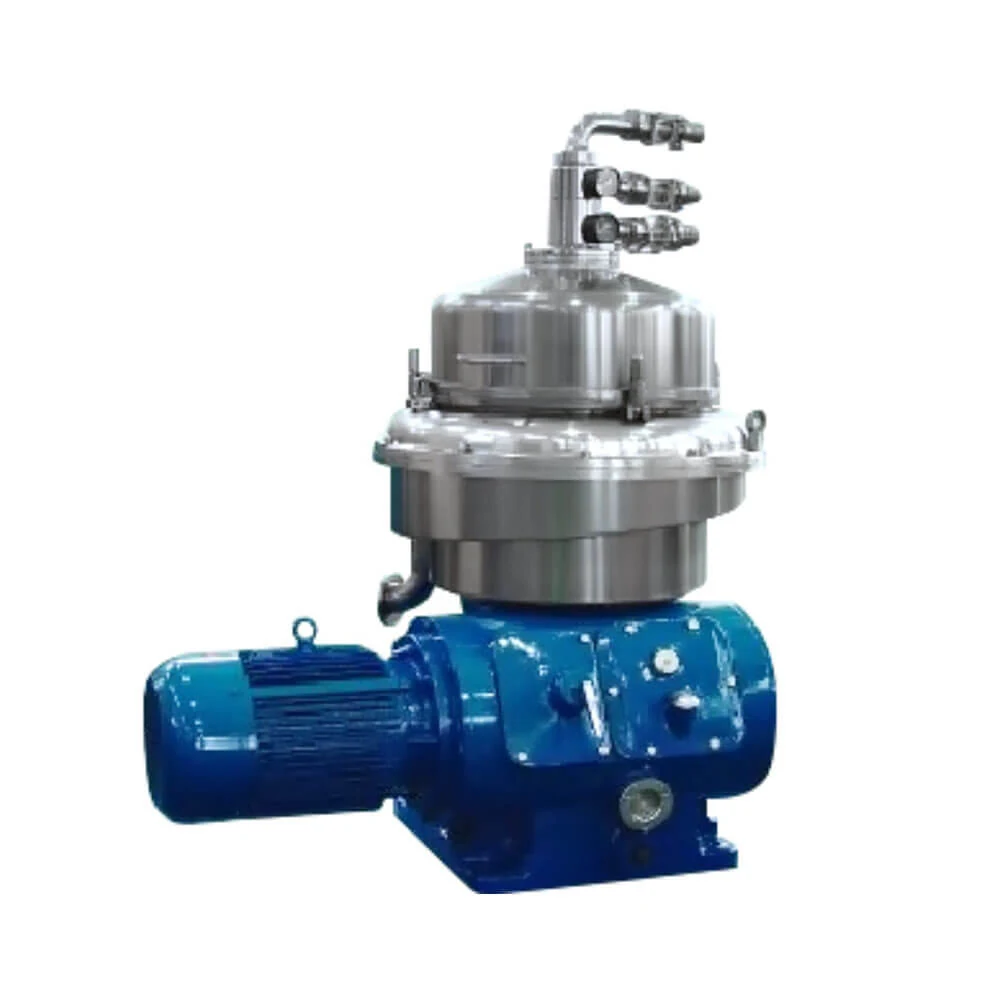
A centrifugal separator handling 1000 L/H to 30,000 L/H in SUS304 or SUS316L, used for dairy purification, milk and fat separation, and for fruit juice, tea drinks, coffee and beer.
Product Overview
A centrifugal separator handling 1000 L/H to 30,000 L/H in SUS304 or SUS316L, used for dairy purification, milk and fat separation, and for fruit juice, tea drinks, coffee and beer. It separates solid particles finer than 1 micron that are highly dispersed in suspension from the liquid phase, without destroying the active ingredients, so nutritional value, freshness and original aroma remain intact. Inlet pressure is 0.05 to 0.1 MPa, outlet pressure 0.1 to 0.4 MPa, and motor power 4 kW to 30 kW.
Key benefits
Why Buyers Choose This Specification
Separation Below One Micron
Particles under 1 micron, highly dispersed in suspension, are exactly what a filter cannot remove without blinding. Centrifugal separation is the process that does.
Active Ingredients Survive the Process
Separation is mechanical, not thermal, so the nutritional value, freshness and original aroma of the product are not damaged the way heat treatment damages them.
Complete Pressure and Power Data
Inlet 0.05-0.1 MPa, outlet 0.1-0.4 MPa and motor 4-30 kW. A separator cannot be integrated into a line without these figures, and they are published.
One Machine Across Five Product Types
Dairy, fruit juice, tea drinks, coffee and beer all use the same separator technology, which simplifies procurement for a mixed plant.
Application scenarios
Where It Is Used
- Purifying raw milk before pasteurisation
- Separating cream from milk to standardise fat
- Clarifying fruit juice before concentration
- Clarifying tea drinks and coffee extracts
- Removing yeast and trub from beer
- Removing fine suspended solids from beverages
Who it is for
The Buyers This Product Suits
Dairy Processors
Purification and fat separation are the two core dairy duties, and both are handled by the same machine.
Juice and Tea Drink Producers
Clarity in a bottled drink is a shelf appearance issue, and centrifugal separation is how it is achieved without filtration aids.
Breweries
Beer is a named application, where separation removes yeast and haze without stripping flavour.
Problems it solves
What It Fixes
Filters Blinding on Fine Solids
Sub-micron particles dispersed in suspension blind a filter quickly. A separator removes them continuously.
Heat Damage From Alternative Processes
Centrifugal separation is mechanical, so aroma and nutritional value are not lost to heat.
Integrating a Separator Into an Existing Line
Published inlet and outlet pressures and motor power make the hydraulic and electrical design straightforward.
Specifications
Published Figures For This Product
Every value below comes from our own product specification. Where a figure is not published we leave it out rather than estimating it.
| Product Model | HTK-FLJ-01 |
|---|---|
| Working Capacity | 1000 L/H to 30,000 L/H, customised |
| Material | SUS304 / SUS316L |
| Separation Limit | Solid particles below 1 micron |
| Inlet Pressure | 0.05 MPa - 0.1 MPa |
| Outlet Pressure | 0.1 MPa - 0.4 MPa |
| Motor Power | 4 kW - 30 kW |
| Applications | Dairy purification, milk and fat separation, fruit juice, tea drinks, coffee, beer |
| Minimum Order | One unit |
| Production Capacity | 50 units per month |
| Grade | SUS304 / SUS316L |
Packing and documents
How It Ships And What Comes With It
Packing And Loading
Shipping volume for this item depends on the configuration and capacity you select, so no fixed container figure is published. Confirm the specification and the destination and a loading plan is issued with the quotation, rather than a figure we cannot support.
Documentation On File
- Dairy and Liquid Processing · Dairy Processing Machinery Specification Sheet53.2 KB
- Catalogue · Full Product Catalogue154.0 KB
Sourcing And Inspection
This product is supplied through TrueGlow Imaging, working with manufacturing partners whose facilities are visited and verified rather than taken on trust. In-process quality control and delivery supervision are available so goods are inspected before the container is sealed. Certifications quoted on this page are those stated on the product specification and belong to that product range rather than to our trading entity, so ask for the certificate covering your specific item.
Handling guide
Getting It Right First Time
Step 1
Confirm the product and the separation duty, since purification and fat standardisation need different bowl configurations.
Step 2
Check the available inlet pressure is within 0.05 to 0.1 MPa.
Step 3
Size the downstream pipework for an outlet pressure of 0.1 to 0.4 MPa.
Step 4
Confirm the electrical supply for a motor between 4 kW and 30 kW.
Step 5
Schedule bowl cleaning and disc stack inspection at the stated intervals.
Comparison
How It Compares In Our Range
Separation against filtration for fine solids.
| Centrifugal Separator | Removes solids below 1 micron continuously, with no filter medium and no consumable cost per litre. |
|---|---|
| Filtration | Simpler and cheaper to install, but blinds on fine dispersed solids and carries a consumable cost. |
FAQ
Separator Questions
What capacity is available?
1000 L/H to 30,000 L/H, customised.
How fine can it separate?
It separates extremely fine solid particles below 1 micron that are highly dispersed in suspension.
What are the pressure requirements?
Inlet pressure 0.05 MPa to 0.1 MPa, outlet pressure 0.1 MPa to 0.4 MPa.
What motor power is required?
4 kW to 30 kW depending on the capacity selected.
Which industries is it for?
Dairy purification and milk and fat separation, plus fruit juice, tea drinks, coffee and beer.
What is the minimum order?
One unit, with a production capacity of 50 units per month.
Related products
Other Products Buyers Look At
Industries
Sectors That Use This Product
Dairy Processing
From the milking parlour to the sealed pack, with the cleaning system that keeps it legal.
Brewing and Beverage
Fermentation, bright tank, pasteurisation and filling for beer water and soft drinks.
Food Packaging Lines
Depalletizing to palletizing, balanced against the filler in the middle.
Further reading
Guides That Cover This Product
Pasteurisation Versus UHT for Liquid Dairy
Three thermal profiles, three different machines and three different distribution models. Which one your plant needs is decided by shelf life and cold chain, not by capacity.
Specifying a CIP System That Actually Cleans
A cleaning cycle that runs without flow cleans nothing and reports success. Conductivity monitoring, flow switches and return pump selection are what make CIP verifiable.
Quote Separator
Send the capacity or size you need, the quantity and the destination, and we will confirm the configuration, the lead time and a loading plan.