
Dairy Processing Machinery
Plate Heat Exchanger
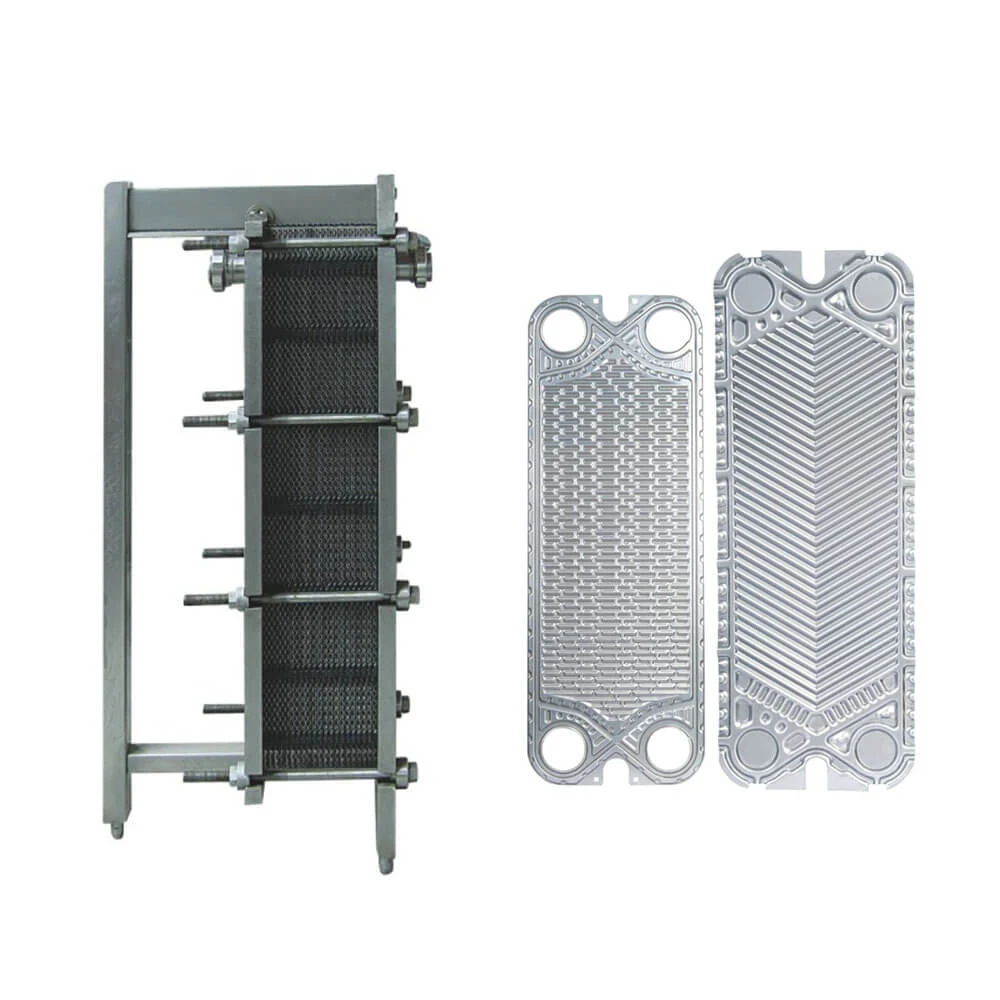
A plate heat exchanger handling 1000 L/H to 15,000 L/H in SUS304 or SUS316L, used on dairy and fruit juice beverage lines to heat or cool product according to the process flow.
Product Overview
A plate heat exchanger handling 1000 L/H to 15,000 L/H in SUS304 or SUS316L, used on dairy and fruit juice beverage lines to heat or cool product according to the process flow. Its compact plate stack gives high heat exchange efficiency with small heat loss, and the pack opens for cleaning and inspection rather than being sealed.
Key benefits
Why Buyers Choose This Specification
Heat Exchange Efficiency in a Small Footprint
A plate pack puts far more surface area into a given volume than a shell and tube exchanger. On a crowded process floor that difference decides whether it fits.
The Pack Opens for Cleaning
Plates can be separated and inspected. On a food product that fouls, that access is what keeps the exchanger performing over years rather than months.
Small Heat Loss
Compact construction means less exposed surface, which means less heat going into the room instead of into the product.
Capacity Selected to the Duty
1000 L/H to 15,000 L/H with different capacities available, so the plate count matches the heat load.
Application scenarios
Where It Is Used
- Heating product ahead of pasteurisation
- Cooling product after heat treatment
- Regenerative heat recovery between product streams
- Chilled water cooling on a dairy line
- Juice heating before filling
- Temperature adjustment between process steps
Who it is for
The Buyers This Product Suits
Dairy Processors
Every dairy line heats and cools product several times, and plate exchangers are the standard equipment for it.
Juice and Beverage Plants
Fruit juice beverage processing is a named application.
Plants Adding Heat Recovery
A regenerative section recovers heat from outgoing product into incoming, which is the main energy saving available on a pasteurisation line.
Problems it solves
What It Fixes
Heat Cost on Every Pasteurisation Cycle
Regenerative heat exchange recovers energy from the hot outgoing stream into the cold incoming one.
Exchangers That Cannot Be Cleaned
A plate pack can be opened, inspected and cleaned rather than only flushed.
Space on a Crowded Process Floor
A compact plate stack gives the same duty in a much smaller footprint than shell and tube.
Specifications
Published Figures For This Product
Every value below comes from our own product specification. Where a figure is not published we leave it out rather than estimating it.
| Product Model | HTK-PHE-01 |
|---|---|
| Working Capacity | 1000 L/H to 15,000 L/H, customised |
| Material | SUS304 / SUS316L |
| Function | Heating or cooling product according to the process flow |
| Characteristics | High heat-exchange efficiency, small heat loss, compact structure |
| Applications | Dairy production lines, fruit juice beverage processing lines |
| Minimum Order | One unit |
| Production Capacity | 100 units per month |
| Grade | SUS304 / SUS316L |
Packing and documents
How It Ships And What Comes With It
Packing And Loading
Shipping volume for this item depends on the configuration and capacity you select, so no fixed container figure is published. Confirm the specification and the destination and a loading plan is issued with the quotation, rather than a figure we cannot support.
Documentation On File
- Dairy and Liquid Processing · Dairy Processing Machinery Specification Sheet53.2 KB
- Catalogue · Full Product Catalogue154.0 KB
Sourcing And Inspection
This product is supplied through TrueGlow Imaging, working with manufacturing partners whose facilities are visited and verified rather than taken on trust. In-process quality control and delivery supervision are available so goods are inspected before the container is sealed. Certifications quoted on this page are those stated on the product specification and belong to that product range rather than to our trading entity, so ask for the certificate covering your specific item.
Handling guide
Getting It Right First Time
Step 1
Specify both duty and the two stream temperatures, since these set the plate count.
Step 2
Choose SUS316L plates for acidic juice and chloride-bearing water.
Step 3
Include a regenerative section where product is both heated and cooled in the same process.
Step 4
Monitor pressure drop across the pack as the indicator of fouling.
Step 5
Replace gaskets on schedule rather than after they leak.
Comparison
How It Compares In Our Range
Plate heat exchangers against tubular equipment.
| Plate Heat Exchanger | 1000 to 15,000 L/H. Highest heat transfer per unit volume and openable for cleaning. Best on thin, low-particulate liquids. |
|---|---|
| Tubular Heat Exchanger | Handles viscous and particulate product that would block a plate gap, at lower heat transfer efficiency. |
FAQ
Plate Heat Exchanger Questions
What capacity is available?
1000 L/H to 15,000 L/H, customised, with different capacities available.
Which materials are used?
SUS304 or SUS316L.
What does it do?
It exchanges heat with the product to heat or cool it according to the process flow.
Is it easy to clean?
Yes, it is designed for easy cleaning and installation, with a compact structure.
Where is it used?
On dairy production lines and fruit juice beverage processing lines.
What is the minimum order?
One unit, with a production capacity of 100 units per month.
Related products
Other Products Buyers Look At
Industries
Sectors That Use This Product
Dairy Processing
From the milking parlour to the sealed pack, with the cleaning system that keeps it legal.
Brewing and Beverage
Fermentation, bright tank, pasteurisation and filling for beer water and soft drinks.
Food Packaging Lines
Depalletizing to palletizing, balanced against the filler in the middle.
Further reading
Guides That Cover This Product
Pasteurisation Versus UHT for Liquid Dairy
Three thermal profiles, three different machines and three different distribution models. Which one your plant needs is decided by shelf life and cold chain, not by capacity.
Specifying a CIP System That Actually Cleans
A cleaning cycle that runs without flow cleans nothing and reports success. Conductivity monitoring, flow switches and return pump selection are what make CIP verifiable.
Quote Plate Heat Exchanger
Send the capacity or size you need, the quantity and the destination, and we will confirm the configuration, the lead time and a loading plan.