
Rubber and Plastic Products
Rubber Rollers
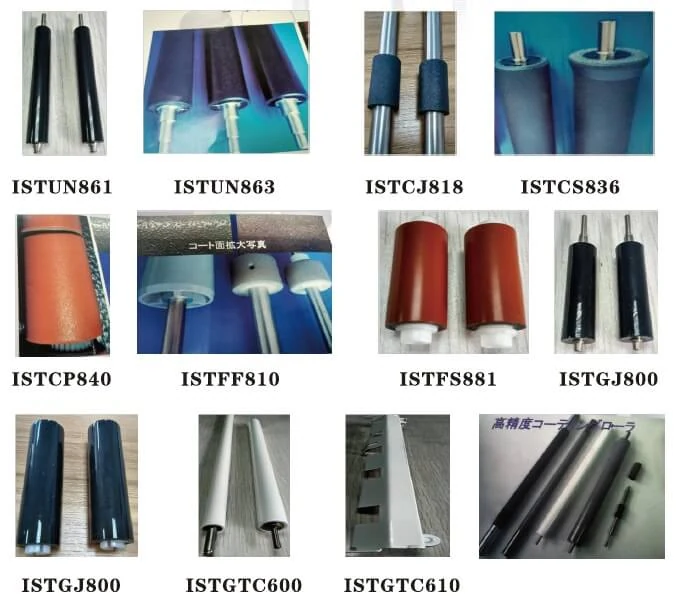
Rubber rollers including printing rollers, paper rollers, paper feed rollers and twist rollers, covered in EPDM, silicone rubber, PU rubber or SBR.
Product Overview
Rubber rollers including printing rollers, paper rollers, paper feed rollers and twist rollers, covered in EPDM, silicone rubber, PU rubber or SBR. The covering material is the specification: it sets grip, chemical resistance and wear life against the substrate the roller touches. Conveyor rollers move products or raw materials, and coating rollers apply coatings or laminates to surfaces. Rollers are tailored to the industry requirement and designed to need minimal maintenance.
Key benefits
Why Buyers Choose This Specification
Four Covering Materials
EPDM for water and chemicals, silicone for heat and release, PU for wear resistance, SBR for economy. The covering, not the core, is what fails first and what should drive the choice.
Built to the Machine
Rollers are tailored to specific industry needs rather than supplied as standard diameters, which matters when the roller has to fit existing bearings and drives.
Low Maintenance by Design
Rollers are designed to require minimal maintenance, which reduces downtime on machines where a roller change stops the whole line.
Covers Printing Feed and Conveying
Printing, paper feed, twist, conveyor and coating rollers all come from one supplier, which suits a plant with several roller-driven machines.
Application scenarios
Where It Is Used
- Printing press rollers
- Paper handling and paper feed rollers
- Twist rollers in web processing
- Conveyor rollers moving products or raw materials
- Coating rollers applying coatings or laminates
- Replacing worn rollers in existing machinery
Who it is for
The Buyers This Product Suits
Printing and Converting Operations
Printing, paper and paper feed rollers are named products, and roller condition directly affects print quality.
Coating and Laminating Plants
Coating rollers apply coatings or laminates to surfaces, where surface finish and hardness decide coating weight.
Maintenance Departments
Recovering an existing roller core is usually cheaper and faster than buying a complete new roller.
Problems it solves
What It Fixes
Roller Covering Failing Against the Substrate
Choosing the covering material from the substrate and chemistry is what sets wear life.
Downtime for Roller Changes
Rollers designed for minimal maintenance reduce the frequency of that intervention.
Standard Rollers That Do Not Fit
Rollers are customised to the machine rather than supplied to fixed dimensions.
Specifications
Published Figures For This Product
Every value below comes from our own product specification. Where a figure is not published we leave it out rather than estimating it.
| Roller Types | Printing, paper, paper feed, twist, conveyor, coating |
|---|---|
| Covering Materials | EPDM, silicone rubber, PU rubber, SBR |
| Conveyor Rollers | Used in conveyor systems to move products or raw materials |
| Coating Rollers | Used to apply coatings or laminates to various surfaces |
| Customisation | Tailored to specific industry needs |
| Maintenance | Designed to require minimal maintenance |
| Grade | EPDM, silicone, PU or SBR |
Packing and documents
How It Ships And What Comes With It
Packing And Loading
Shipping volume for this item depends on the configuration and capacity you select, so no fixed container figure is published. Confirm the specification and the destination and a loading plan is issued with the quotation, rather than a figure we cannot support.
Documentation On File
- Rubber Seals and Plastics · Rubber and Plastic Products Specification Sheet20.1 KB
- Catalogue · Full Product Catalogue154.0 KB
Sourcing And Inspection
This product is supplied through TrueGlow Imaging, working with manufacturing partners whose facilities are visited and verified rather than taken on trust. In-process quality control and delivery supervision are available so goods are inspected before the container is sealed. Certifications quoted on this page are those stated on the product specification and belong to that product range rather than to our trading entity, so ask for the certificate covering your specific item.
Handling guide
Getting It Right First Time
Step 1
Select the covering material from the substrate, the chemistry and the temperature.
Step 2
Specify hardness in Shore A, since it governs nip pressure and contact area.
Step 3
Send the existing roller or its drawing so bearing journals and drive ends match.
Step 4
Confirm surface finish, which matters most on coating and printing rollers.
Step 5
Consider recovering an existing core rather than buying a complete new roller.
Comparison
How It Compares In Our Range
The four covering materials and what each suits.
| EPDM | Water, steam and chemical resistance. Good general covering where oils are absent. |
|---|---|
| Silicone Rubber | Heat resistance and release properties, used where the roller runs hot or must not stick. |
| PU Rubber | Highest abrasion resistance and load capacity, for demanding mechanical duty. |
| SBR | Economical general-purpose covering with good abrasion resistance. |
FAQ
Rubber Rollers Questions
Which roller types do you supply?
Printing rollers, paper rollers, paper feed rollers and twist rollers, plus conveyor and coating rollers.
Which covering materials are available?
EPDM, silicone rubber, PU rubber and SBR.
Can rollers be customised?
Yes. They can be tailored to meet specific industry needs.
What maintenance do they need?
They are designed to require minimal maintenance, which reduces downtime.
Can you recover our existing rollers?
Send the roller or its drawing with the covering requirement and a quotation is prepared.
What do you need to quote?
Roller dimensions, covering material, hardness, surface finish and the application.
Related products
Other Products Buyers Look At
Industries
Sectors That Use This Product
Metal Fabrication and Machine Shops
Custom parts, tooling and the cranes that move them around the shop.
Food Packaging Lines
Depalletizing to palletizing, balanced against the filler in the middle.
Warehousing and Heavy Industry
Lifting from 250 kg to 360 tons, indoors on a runway or outdoors on legs.
Further reading
Guides That Cover This Product
Selecting an O-Ring Material NBR EPDM FKM or FFKM
Almost every seal failure is a material selection error rather than a dimensional one. The fluid and the temperature decide the elastomer, and the size is the easy part.
Quote Rubber Rollers
Send the capacity or size you need, the quantity and the destination, and we will confirm the configuration, the lead time and a loading plan.