Two Reasons to Insulate Busbar
The first is dielectric. Insulating the bar raises the flashover withstand between phases and to earth which is what allows a cubicle to be physically smaller without failing its power frequency withstand type test.
The second is contamination. Bare bar is bridged by small animals, condensation and conductive dust. Insulated bar removes that bridging path entirely and it is one of the highest value retrofits available on an ageing switchboard.
What It Does Not Do
Insulated bar is not touch safe. It is insulation enhancement not a substitute for isolation, earthing and safe working procedures. It also does not change your design clearances by itself — the permitted spacing is set by your design standard and your type test, not by the presence of a tube.
Be careful with any supplier who suggests otherwise.
Selecting the Tube
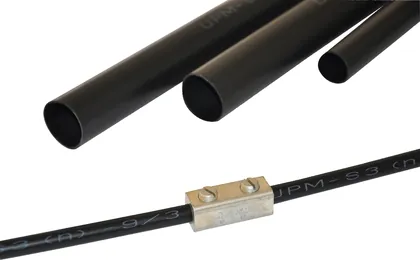
Three decisions: voltage class, fire behaviour, and shrink ratio.
| Voltage Class | Halogen Free | Flame Retardant |
|---|---|---|
| 6 to 24 kV | S1(n)-10 | S1-10 |
| 6 to 36 kV | S1(n)-35 | S1-35 |
| 1 to 35 kV UL 224 recognised | — | S1 |
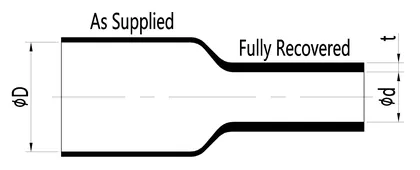
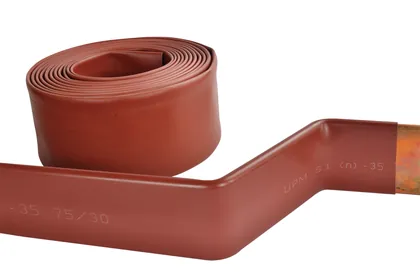
For rectangular bar measure both the perimeter and the diagonal. The tube must clear the diagonal to slide on and must recover onto the perimeter to grip. Deburr every edge first because sharp corners cut a recovering tube.
The Joints Are the Hard Part
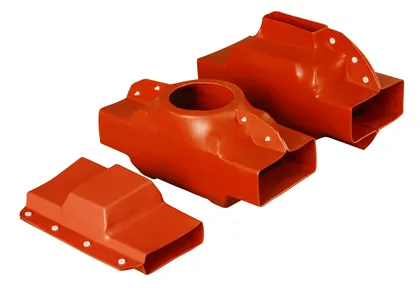
A shrink tube cannot conform to a bolted lap joint. The stepped profile with bolt heads is simply the wrong geometry. Molded covers made to the joint dimensions are the only clean answer.
The second requirement is that maintenance has to be able to open them. Bolted joints need torque checks and thermographic survey and a permanent cover forces maintenance to destroy it. A buckle closure lets the same cover be opened and refitted.
Practical Details That Save Time
- Order tube cut to length and labelled per position so the assembly line never measures
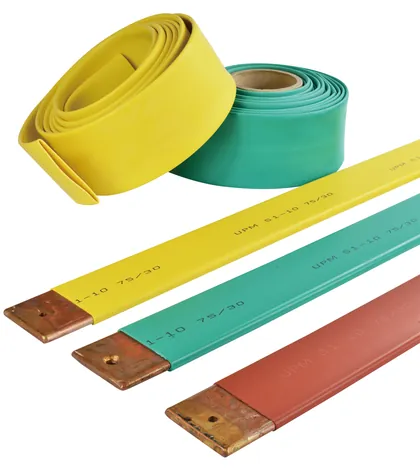
- Allocate phase colours before ordering if you are using the flame retardant grades
- Send the busbar drawing and get tube and covers quoted as one bill of materials
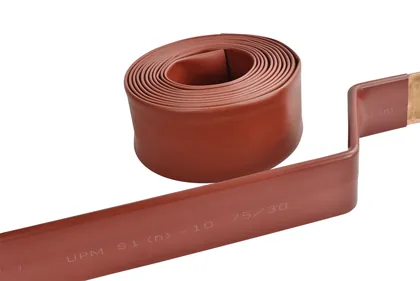
- For an installed conductor that cannot be disconnected use a wrap around cover instead of tube