Stress Control and Insulation Tubes
C106 Tri Layer Heat Shrink Tube for Medium Voltage Joints
Ultra heavy wall tube combining semiconductive screen plastic insulation and a fast recovering elastomeric inner layer
- Operating temperature: -55 to 105°C
- Minimum fully recovery temperature: 150°C
- Voltage class: 6kV ~ 36kV
- Halogen-free, RoHS compliant, Ultra heavy wall
- Semi-conductive / insulation / Elastomeric Insulation Three-layer
- Standard Color: Black (outer layer) / Red (inner layer)
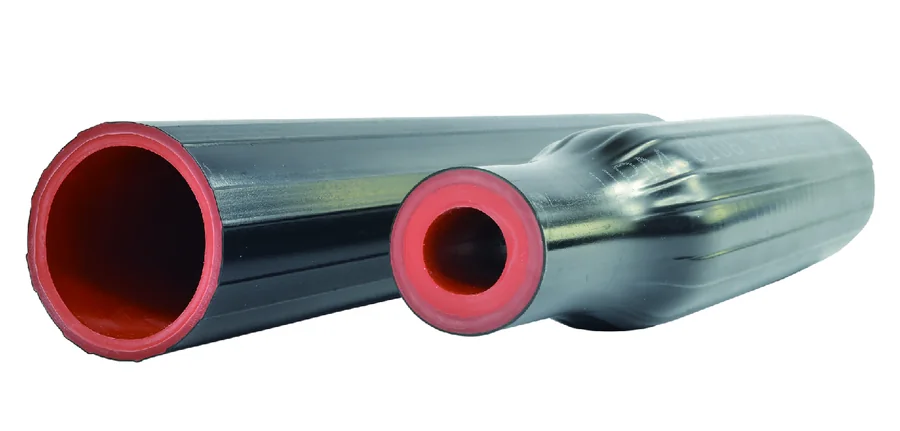
C106 · Stress Control and Insulation Tubes
Product Overview
What C106 Does
Co-extrusion design,semi-conductive/insulation/elastomeric insulation tri-layer heat shrink tube.The elastomeric layer is designed to have a fast shrinkage rate to avoid overheating damage.Suitable for insulation protection of power cable joint under 36kV.
Ultra heavy wall tube combining semiconductive screen plastic insulation and a fast recovering elastomeric inner layer It is manufactured by Dalian United Polymer Material Co., Ltd. in Dalian China where radiation cross linking extrusion and molding are all performed in house under one quality system.
Key Benefits
- The full joint insulation build in a single shrink operation
- An inner elastomeric layer that recovers quickly and conforms tightly to the connector profile
- Middle plastic insulation with dielectric strength of 15 kV/mm or higher and volume resistivity of 1.0×10¹³ Ω·cm or higher
- Outer semiconductive screen at 1.0×10⁴ Ω·cm or below for genuine screen function
- Nine sizes from 35/13 mm to 125/62 mm covering the full MV joint range
Who It Is For
Who Benefits Most from C106
The buyers and site teams this product was designed around
35 kV Joint Kit Manufacturers
At the top of the MV range the joint insulation wall has to be thick and the build has to stay fast.
Utility Jointing Crews on Critical Feeders
Joints on high load feeders where a rebuild means an extended outage.
Contractors Working in Confined Chambers
A single tube that delivers 11 to 14 mm of wall removes several separate shrink operations in a manhole.
Industrial Plants with Heavy Through Fault Duty
Sites where joints are exposed to repeated short circuit forces and thermal cycling.
Problems It Solves
Problems This Product Removes
Every one of these is a failure mode we have seen on real networks
Thick Walls Overheat Before the Outside Recovers
The elastomeric inner layer is formulated for a fast shrinkage rate so the inside conforms before the outer surface takes excessive heat.
Three Separate Tubes Triples the Void Risk
One co extruded wall carrying all three functions removes two manufactured on site interfaces.
35 kV Joints Need Real Insulation Thickness
Recovered wall from 11 to 14 mm delivers the insulation build that a 26/35 kV joint requires.
Elastomeric Layers Usually Mean Weak Mechanical Properties
The inner elastomeric layer holds tensile strength of 6 MPa or above and elongation of 270 percent or above while still shrinking quickly.
Application Scenarios
Where It Is Used
26/35 kV Straight Through Joints
The primary insulation build in a 35 kV joint kit.
15 kV Heavy Duty Joints
Feeder joints where extra insulation margin is specified.
Transition Joints Between Cable Types
Joining paper insulated and XLPE cable where insulation thickness differs.
Repair Joints on Damaged Feeders
Emergency rebuild where installation time matters.
Offshore and Marine Cable Joints
Joints exposed to moisture and mechanical movement.
Technical Data
Specifications and Dimensions
Test methods and requirements taken directly from the manufacturing specification
Technical Data
| Property | Test Method | Requirement |
|---|---|---|
| Outer Layer (Semi-Conductive, Black) | ||
| Tensile Strength | ASTM D2671 | ≥12 MPa |
| Ultimate Elongation | ASTM D2671 | ≥270% |
| Heat Aging (158°C/168h) Tensile Strength Ultimate Elongation | ASTM D2671 | ≥10 MPa ≥250% |
| Water absorption (23°C/24h) | ASTM D2671 | ≤0.5% |
| Low-temperature flexibility (-40°C/4h) | ASTM D2671 | No cracking |
| Heat shock (200°C/4h) | ASTM D2671 | No dripping or flowing |
| Volume resistivity | ASTM D2671 | ≤1.0×10⁴ Ω·cm |
| Middle Layer (Plastic Insulation, red) | ||
| Tensile Strength | ASTM D2671 | ≥12 MPa |
| Ultimate Elongation | ASTM D2671 | ≥350% |
| Heat Aging (136°C/168h) Tensile Strength Ultimate Elongation | ASTM D2671 | ≥10 MPa ≥270% |
| Water absorption (23°C/24h) | ASTM D2671 | ≤0.5% |
| Low-temperature flexibility (-40°C/4h) | ASTM D2671 | No cracking |
| Heat shock (200°C/4h) | ASTM D2671 | No dripping or flowing |
| Dielectric strength | ASTM D2671 | ≥15 kV/mm |
| Volume resistivity | ASTM D2671 | ≥1.0×10¹³ Ω·cm |
| Inner Layer (/Elastomeric Insulation, red) | ||
| Tensile Strength | ASTM D2671 | ≥6 MPa |
| Ultimate Elongation | ASTM D2671 | ≥270% |
| Heat Aging (136°C/168h) Tensile Strength Ultimate Elongation | ASTM D2671 | ≥4.2 MPa ≥200% |
| Water absorption (23°C/24h) | ASTM D2671 | ≤0.5% |
| Low-temperature flexibility (-40°C/4h) | ASTM D2671 | No cracking |
| Heat shock (200°C/4h) | ASTM D2671 | No dripping or flowing |
| Dielectric strength | ASTM D2671 | ≥15 kV/mm |
| Volume resistivity | ASTM D2671 | ≥1.0×10¹³ Ω·cm |
| Note: Use standard samples for testing |
Dimensions
| Size C106 | As supplied(mm) Inner diameter D (min.) | After recovered (mm) Inner diameter d (max.) | Wall thickness t (nom.) | Standard length (m/pcs) |
|---|---|---|---|---|
| 35/13 | 35 | 13 | 11 | ≤1.22 |
| 45/17 | 45 | 17 | 12 | ≤1.22 |
| 50/21 | 50 | 21 | 12 | ≤1.22 |
| 63/26 | 63 | 26 | 12.5 | ≤1.22 |
| 75/34 | 75 | 34 | 12.5 | ≤1.22 |
| 85/34 | 85 | 34 | 12.5 | ≤1.22 |
| 95/42 | 95 | 42 | 13.5 | ≤1.22 |
| 110/52 | 110 | 52 | 13.5 | ≤1.22 |
| 125/62 | 125 | 62 | 14 | ≤1.22 |
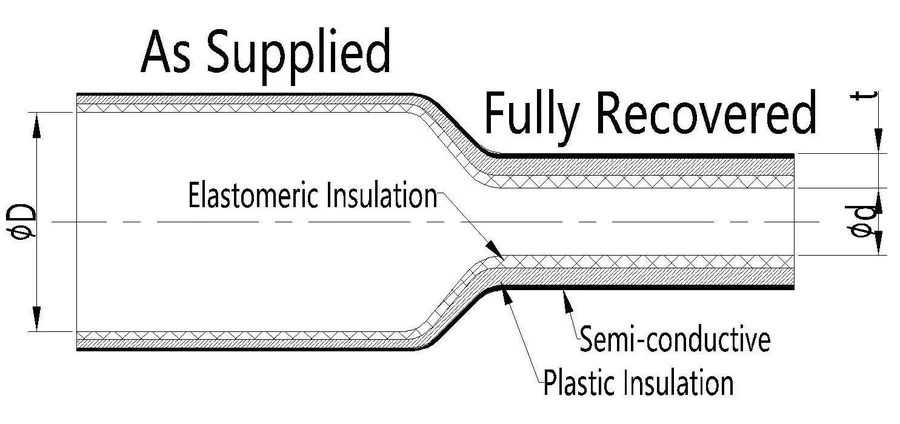
CROSS REFERENCE · Tyco-Raychem: ERIT/ERIC/ERIH
Manufacturing and Quality
How It Is Made and Checked
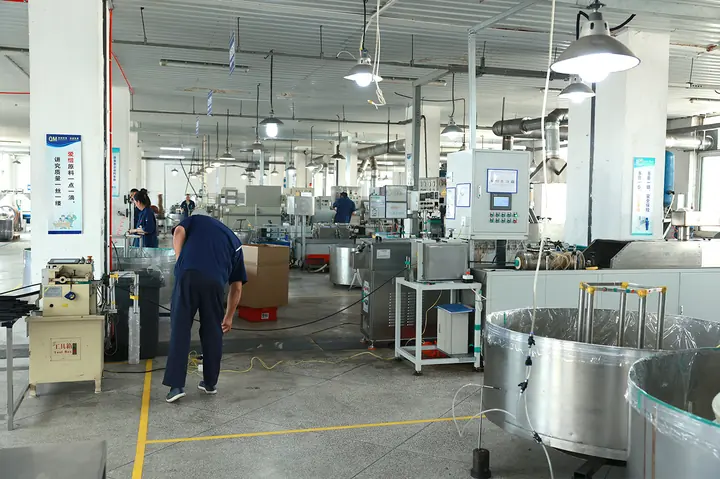
Compounding extrusion radiation cross linking expansion and test all under one roof in Dalian
-
01
Compounding
Base polyolefin antioxidants flame retardants and functional fillers are mixed to a recipe held under our own formulation control rather than bought as a masterbatch.
-
02
Extrusion
The compound is extruded to the required wall and diameter. Co extruded products form two or three layers in a single pass so no interface can trap air.
-
03
Radiation Cross Linking
Electron beam irradiation creates the cross linked network that gives the material its shape memory. This step is what makes the product heat shrinkable.
-
04
Expansion
The cross linked part is heated expanded to its supplied diameter and cooled under tension so the expanded shape is locked in until heat is applied again.
-
05
Test and Inspection
More than 90 percent of product performance tests are carried out in our own laboratory including tensile elongation heat aging dielectric strength and tracking resistance.
-
06
Packing and Traceability
Each batch carries a production record so a delivered part can be traced back to its compound lot and process parameters.
Certification
ISO 9001:2015
Quality management system
IATF 16949:2016
Automotive quality management
ISO 14001:2015
Environmental management
ISO 45001:2018
Occupational health and safety
GJB 9001C-2017
Defence quality management
UL 224 E341796
Extruded insulating tubing
CE / RoHS
European conformity and restricted substances
CCS / ABS / DNV
Marine classification society approvals
Comparison
How C106 Compares
An honest comparison so you can rule this product in or out quickly
| Product | Layers | Recovered Wall | Recovery Temperature |
|---|---|---|---|
| C105 | Semiconductive and insulation | 5 to 6.3 mm | 135 °C |
| C106 | Semiconductive insulation and elastomeric | 11 to 14 mm | 150 °C |
| C107 | Plastic and elastomeric insulation | See datasheet | 150 °C |
Use Guide
How to Select and Install C106
The sequence our engineers walk customers through on every first installation
-
01
Park the Tube Early
Slide the tube onto the cable before the connector is crimped. An 11 to 14 mm wall tube cannot be fitted after the joint is made.
-
02
Check Size Against the Connector
Supplied diameter D must clear the connector. Recovered diameter d must be smaller than the cable core so the tube grips.
-
03
Centre and Mark
Mark equal overlap on both sides of the connector before applying heat.
-
04
Heat Patiently from the Centre
Full recovery needs 150 °C. Work outward from the centre with a broad soft flame and keep it moving. A thick wall takes several minutes.
-
05
Watch the Inner Layer Conform
The elastomeric inner layer shrinks first and pulls tight against the connector shoulders which is what removes voids.
-
06
Restore Screen and Seal
Apply braid springs and an outer adhesive lined tube to complete the joint.
FAQ
C106 Frequently Asked Questions
The questions buyers ask before they place an order
Why does C106 need three layers
What is the advantage of the elastomeric inner layer
Is C106 equivalent to Raychem ERIT ERIC and ERIH
What is the maximum recovered wall thickness
Can it be used at 6 kV
How long is each piece
Still need an answer ask our engineers on WhatsApp
Related
Related Products
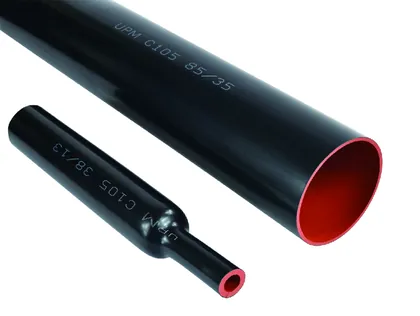
C105 Double Layer Tube
Co extruded heavy wall tube that restores insulation and the outer semiconductive screen in one operation up to 36 kV
VIEW DETAILS
C107 Insulation Tube
Ultra heavy wall insulation for joints where the cable screen is restored separately from 6 kV to 36 kV
VIEW DETAILS
C102-35 Stress Control
The 36 kV stress control layer with a dielectric constant of 25 to 50 for 26/35 kV terminations and joints
VIEW DETAILS
MV Kits 26/35 kV
The highest voltage class in the range covering 26/35 (40.5) kV single core and three core cable to 630 mm²
VIEW DETAILSGet a Quotation for C106
Send us the voltage class conductor size and quantity and we will return a part number a price and a lead time. No form to fill in.