Busbar Insulation and Covers
S1(n)-10 Halogen Free Busbar Insulation Heat Shrink Tube 6 to 24 kV
Halogen free red tubing that insulates round and rectangular copper or aluminium busbar inside 6 to 24 kV switchgear
- Operating temperature: -40 to 105°C
- Minimum full recovery temperature: 125°C
- Voltage class: 6kV to 24kV
- Halogen-free, RoHS compliant
- Shrink ratio: 2:1 & 2.5:1
- Standard Color: Red
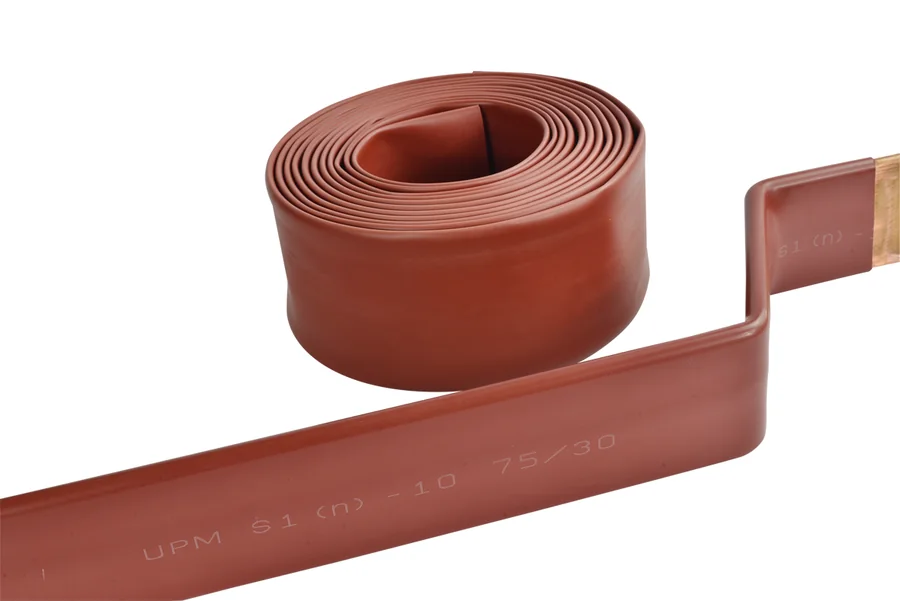
S1(n)-10 · Busbar Insulation and Covers
Product Overview
What S1(n)-10 Does
Halogen-free and environmentally friendly polyolefin material, can be applied in 6kV to 24kV power switchgear, providing insulation enhancement, protection against flashover or accidental discharge. Especially suitable for switchgear with limited space, it can be used for circular and rectangular copper or aluminum busbars.
Halogen free red tubing that insulates round and rectangular copper or aluminium busbar inside 6 to 24 kV switchgear It is manufactured by Dalian United Polymer Material Co., Ltd. in Dalian China where radiation cross linking extrusion and molding are all performed in house under one quality system.
Key Benefits
- Insulation enhancement that protects against flashover and accidental discharge
- Works on round and rectangular copper and aluminium busbar without special preparation
- Halogen free and RoHS compliant for data centres hospitals and public buildings
- 2:1 and 2.5:1 ratios so a single size covers a range of bar sections
- Especially suited to switchgear with limited internal space
Who It Is For
Who Benefits Most from S1(n)-10
The buyers and site teams this product was designed around
Switchgear Manufacturers
Insulating busbar raises the internal clearance rating and lets a compact cubicle meet its withstand specification.
Substation Retrofit Contractors
Adding busbar insulation to existing switchgear that has suffered animal or condensation faults.
Data Centre and Hospital MV Rooms
Halogen free is specified because a switchgear fire must not release corrosive gas into the building.
Utility Maintenance Teams
Reinsulating busbar during a planned switchgear overhaul.
Problems It Solves
Problems This Product Removes
Every one of these is a failure mode we have seen on real networks
Small Animals and Condensation Cause Phase to Phase Faults
A rat or a lizard bridging bare busbar destroys a switchboard. Insulated busbar removes the bridging path.
Compact Switchgear Has Insufficient Air Clearance
Insulating the busbar lets a designer keep the cubicle small without failing the power frequency withstand test.
Dust and Pollution Build a Leakage Path
An insulated surface resists creepage far better than bare metal with a dust film.
Halogenated Insulation Is Not Acceptable in Occupied Buildings
S1(n)-10 is halogen free and RoHS compliant.
Application Scenarios
Where It Is Used
Switchgear Main Busbar
Insulating the main bar run inside a 24 kV cubicle.
Riser and Dropper Bars
Insulating vertical connections between busbar and circuit breaker.
Transformer Connection Bars
Insulating the bar between a transformer and its switchgear.
Capacitor Bank Connections
Insulating bar in banks where clearances are tight.
Retrofit After an Animal Fault
Reinsulating a switchboard after a bridging failure.
Technical Data
Specifications and Dimensions
Test methods and requirements taken directly from the manufacturing specification
Technical Data
| Property | Test Method | Requirement |
|---|---|---|
| Specific gravity | ASTM D2671 | 1.0~1.2 |
| Thermal endurance | IEC 216 | ≥105°C |
| Tensile Strength | ASTM D2671 | ≥14 MPa |
| Ultimate Elongation | ASTM D2671 | ≥400% |
| Heat Aging (136°C/168h) Tensile Strength Ultimate Elongation | ASTM D2671 | ≥12 MPa ≥300% |
| Long-term Heat Aging (100°C/3000h) Ultimate Elongation | IEC 60684-2 | ≥175% |
| Fluid resistance (23°C/168h) Tensile Strength Ultimate Elongation | IEC 60684-2 | ≥8 MPa ≥250% |
| Water absorption (23°C/24h) | ASTM D2671 | ≤1.0% |
| Low-temperature flexibility (-40°C/4h) | ASTM D2671 | No cracking |
| Heat shock (200°C/4h) | ASTM D2671 | No cracking, dripping or flowing |
| Dielectric strength | ASTM D2671 | ≥16 kV/mm |
| Volume resistivity | ASTM D2671 | ≥1.0×10¹³Ω·cm |
| Tracking and erosion resistance | ASTM D2303 | After 1hr at 2.5kV, and 1hr at 2.75kV, No burn penetration, no sustained burning |
| Color fastness to light | IEC 60684-3-283 | Color stability, no change |
| Copper corrosion (150°C/168h) | IEC 60684-3-283 | No corrosion |
Dimensions
| Size S1(n)-10 | As supplied (mm) Inner diameter D (min.) | After recovered (mm) Inner diameter d (max.) | Wall thickness t (nom.) | Standard length (m) |
|---|---|---|---|---|
| 25/10 | 25 | 10 | 2.5 | 25 |
| 30/12 | 30 | 12 | 2.7 | 20 |
| 40/16 | 40 | 16 | 2.7 | 20 |
| 50/20 | 50 | 20 | 2.7 | 20 |
| 65/25 | 65 | 25 | 2.9 | 20 |
| 75/30 | 75 | 30 | 2.9 | 20 |
| 85/35 | 85 | 35 | 2.9 | 20 |
| 100/40 | 100 | 40 | 2.9 | 20 |
| 120/50 | 120 | 50 | 2.9 | 20 |
| 150/60 | 150 | 60 | 3.0 | 20 |
| 175/75 | 175 | 75 | 3.0 | 20 |
| Products Slection | ||||
| Bus Bar Size (mm) | Single Layer Bus Bar | Double Layer Bus Bar | ||
| 20×3, 25×3 | Φ25/10 | Φ30/12 | ||
| 30×3, 30×4 | Φ30/12 | Φ40/16 | ||
| 30×10, 40×4 | Φ40/16 | Φ50/20 | ||
| 40×10, 50×5, 50×6 | Φ50/20 | Φ65/25 (Φ75/30) | ||
| 50×8, 50×10, 60×6, 60×8 | Φ65/25 (Φ75/30) | Φ75/30(Φ85/35) | ||
| 60×10, 80×6, 80×8, 80×10 | Φ75/30(Φ85/35) | Φ100/40(Φ120/50) | ||
| 100×8, 100×10, 100×12 | Φ100/40(Φ120/50) | Φ120/50 | ||
| 150×12, 150×15 | Φ150/60 | Φ175/75 |
CROSS REFERENCE · Tyco-Raychem: BPTM
Manufacturing and Quality
How It Is Made and Checked
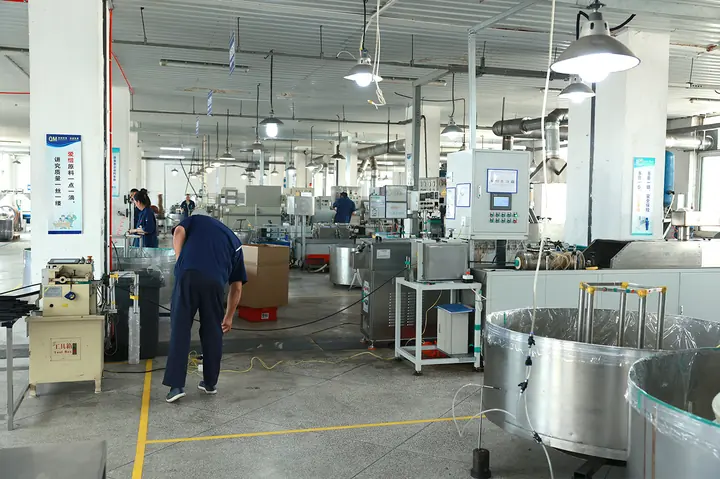
Compounding extrusion radiation cross linking expansion and test all under one roof in Dalian
-
01
Compounding
Base polyolefin antioxidants flame retardants and functional fillers are mixed to a recipe held under our own formulation control rather than bought as a masterbatch.
-
02
Extrusion
The compound is extruded to the required wall and diameter. Co extruded products form two or three layers in a single pass so no interface can trap air.
-
03
Radiation Cross Linking
Electron beam irradiation creates the cross linked network that gives the material its shape memory. This step is what makes the product heat shrinkable.
-
04
Expansion
The cross linked part is heated expanded to its supplied diameter and cooled under tension so the expanded shape is locked in until heat is applied again.
-
05
Test and Inspection
More than 90 percent of product performance tests are carried out in our own laboratory including tensile elongation heat aging dielectric strength and tracking resistance.
-
06
Packing and Traceability
Each batch carries a production record so a delivered part can be traced back to its compound lot and process parameters.
Certification
ISO 9001:2015
Quality management system
IATF 16949:2016
Automotive quality management
ISO 14001:2015
Environmental management
ISO 45001:2018
Occupational health and safety
GJB 9001C-2017
Defence quality management
UL 224 E341796
Extruded insulating tubing
CE / RoHS
European conformity and restricted substances
CCS / ABS / DNV
Marine classification society approvals
Comparison
How S1(n)-10 Compares
An honest comparison so you can rule this product in or out quickly
| Voltage Class | Halogen Free Grade | Flame Retardant Grade |
|---|---|---|
| 6 to 24 kV | S1(n)-10 | S1-10 |
| 6 to 36 kV | S1(n)-35 | S1-35 |
| 1 to 35 kV general | — | S1 |
Use Guide
How to Select and Install S1(n)-10
The sequence our engineers walk customers through on every first installation
-
01
Measure the Bar Section
For rectangular bar measure the perimeter and the diagonal. The tube must slide over the diagonal and recover onto the perimeter.
-
02
Choose the Shrink Ratio
2:1 suits a bar close to the tube size. 2.5:1 suits a bar that needs a larger entry diameter such as one with a joint or bolt head.
-
03
Deburr the Bar
Sharp edges cut the tube during recovery. Break every edge before fitting.
-
04
Clean the Surface
Remove oil oxide and machining residue so the tube sits directly on clean metal.
-
05
Shrink from the Middle Out
On a long bar work from the centre toward each end so air escapes at both ends.
-
06
Insulate Joints Separately
Bolted lap joints are covered by S1-B molded covers because a tube cannot conform to a lap joint profile.
FAQ
S1(n)-10 Frequently Asked Questions
The questions buyers ask before they place an order
Does insulating busbar let me reduce phase spacing
Can it be used on rectangular bar
What is the difference between S1(n)-10 and S1-10
What about the bolted joints between bars
Is red the only colour
What temperature does the bar reach in service
Still need an answer ask our engineers on WhatsApp
Related
Related Products
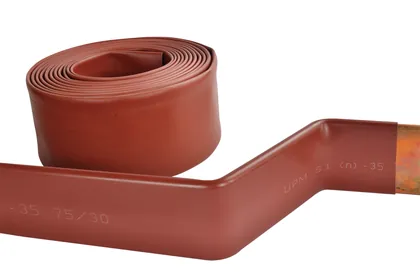
S1(n)-35 Busbar HF 36 kV
The 36 kV halogen free busbar grade for switchgear where clearance is tight and smoke toxicity is regulated
VIEW DETAILS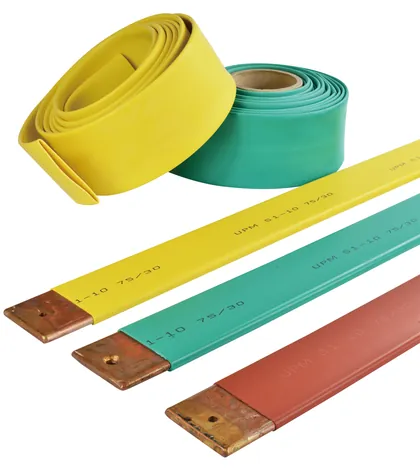
S1-10 Busbar FR 24 kV
Flame retardant busbar insulation available in red yellow green and blue for phase identification up to 24 kV
VIEW DETAILS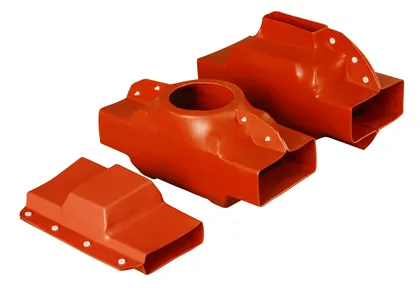
S1-B Lap Joint Cover
Molded clip open covers that insulate bolted busbar joints and still allow inspection without damaging the connection
VIEW DETAILS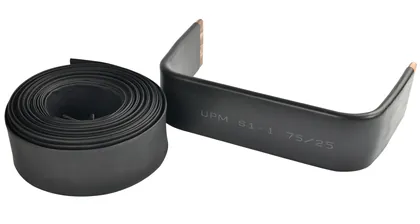
S1 Busbar Tube
The general purpose busbar insulation family covering 1 kV to 35 kV with UL 224 recognition under file E341796
VIEW DETAILSGet a Quotation for S1(n)-10
Send us the voltage class conductor size and quantity and we will return a part number a price and a lead time. No form to fill in.