The Two Numbers on Every Datasheet
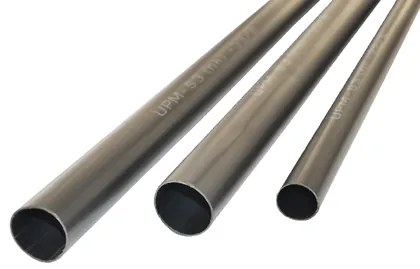
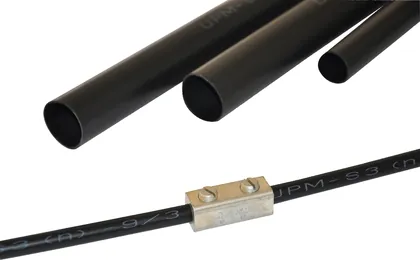
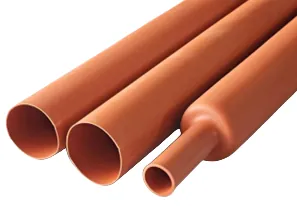
Every heat shrink tube is described by two diameters. D is the supplied inner diameter — the size the tube is as it comes off the reel. d is the fully recovered inner diameter — the smallest size the tube will shrink down to if nothing stops it.
The rule is simple and it has two halves. D must be larger than the biggest thing the tube has to slide over. d must be smaller than the smallest thing the tube has to grip.
If either half fails the tube is the wrong size. A tube that will not slide on is obvious. A tube whose recovered diameter is too large never grips and that failure is not obvious until the joint is in service.
Choosing the Ratio
Shrink ratio is simply D divided by d. A 2:1 tube halves its diameter. A 4:1 tube quarters it.
| Ratio | Use When | Typical Products |
|---|---|---|
| 2:1 | Close fit with a small step | S1 busbar tubes |
| 2.5:1 | Moderate step such as a bar with a joint | S1 family C102 |
| 3:1 | Connector on a smaller cable | S3 family T1 |
| 4:1 | Large step or an unknown range of sizes | S3 family T1 |
Do Not Forget Wall Thickness
Recovered wall thickness t is quoted alongside D and d. It matters for two reasons: it determines the mechanical protection the tube gives, and on insulating products it converts directly into dielectric withstand.
Recovered wall also affects fit. A heavy wall tube recovering onto a small diameter has a lot of material to accommodate which is why heavy wall products list a narrower usable range than their nominal ratio suggests.
Length Allowance
A recovering tube shortens slightly as well as narrowing. Longitudinal change is small on most products but it is not zero, so cut with an allowance rather than exactly to the marked length.
Allow at least 25 mm of overlap onto sound material at each end of a repair or a joint. That overlap is what the adhesive bonds to and it is not the place to economise.
Single Wall or Adhesive Lined
- Adhesive lined dual wall wherever water must be excluded — buried joints marine positions cable jacket repair
- Single wall where the tube is one layer inside a multi layer build or inside a dry enclosure
- Adhesive needs a clean lightly abraded surface — a glossy jacket must be keyed first
- A continuous adhesive bead at both ends is the check that the seal is complete