Three Ways to Grade an Electric Field
There are three practical approaches to controlling the field at a cable screen cut back and each has a different physical mechanism.
| Method | Mechanism | Where It Is Used |
|---|---|---|
| Capacitive grading | High dielectric constant material spreads the equipotential lines | Most heat shrink terminations |
| Resistive grading | Non linear resistance falls as local field rises | Composite and adhesive layers |
| Geometric grading | A cone shape physically increases the distance the field crosses | Cold shrink and older designs |
Capacitive Grading with High Permittivity Material
This is what C102 does. The material has a dielectric constant of 10 to 25 at 24 kV class or 25 to 50 at 36 kV class, far above the cable insulation. That difference redistributes the equipotential lines so the field spreads along the layer instead of concentrating at the screen edge.
The advantage is that it is compact and completely repeatable because the material is extruded to a controlled geometry. The disadvantage is that the grading is fixed by the material properties rather than responding to the actual local field.
Resistive Grading with Zinc Oxide
Zinc oxide is a non linear resistive filler. Its resistivity falls sharply as the local electric field rises which means a zinc oxide loaded layer automatically grades harder where the field is highest.
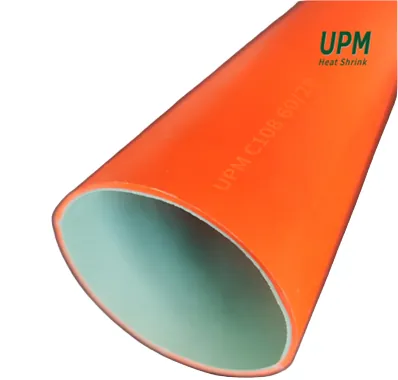
That self adjusting behaviour is why C108 uses a zinc oxide stress control sealant as its inner layer. It also lets one product combine stress control and sealing which reduces the part count in a termination.
Geometric Grading with a Stress Cone
A stress cone works by physically extending the distance the field has to cross using a conical profile of semiconductive material. It is effective and it is the traditional approach but it needs length and it needs accurate placement.
In a crowded cable box or a ring main unit compartment that length is often not available which is one of the main reasons heat shrink terminations displaced cone based designs in distribution networks.
Which One Should You Specify
For most distribution terminations a high permittivity heat shrink layer is the right answer because it is compact repeatable and inexpensive. Where part count matters more than voltage reach a zinc oxide composite tube up to 24 kV removes a whole step from the build.
- Up to 24 kV where part count matters — C108 composite tube
- 6 to 24 kV standard build — C102-10 with C101 insulation over it
- 26 to 36 kV — C102-35 with C101 or a kit insulation build