What Actually Happens at an Open Cable End
Water at a cut cable end does not stay at the cut end. Capillary action draws it along the conductor strands and along the interface between the insulation and the screen. It travels metres, sometimes tens of metres, and it does it slowly enough that nobody sees it happening.
The damage is invisible until the cable fails a test or fails in service. By then the affected length has to be cut back and nobody knows exactly how far the water travelled.
When a Cap Is Needed
- Every cut end on a drum before it leaves the cable works
- Every part drum returned to store after a length is taken off
- Any cable pulled into a duct and left before jointing — including overnight
- Cable stored outdoors on a drum for any length of time
- Communication cable and industrial cabling pipeline as well as power cable
Why Tape and Plastic Bags Do Not Work
A taped end pulled through a duct is stripped off by the first bend. A plastic bag traps condensation inside itself and holds it against the cable. Neither survives a winter on an outdoor drum.
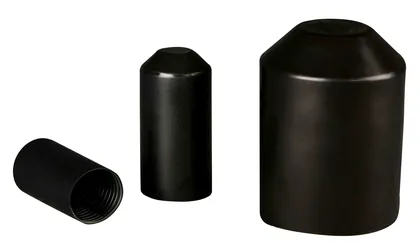
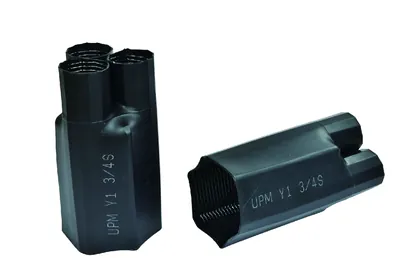
A shrunk adhesive lined cap bonds to the outer sheath and to the exposed core ends and it survives the duct pull that removes everything else.
Fitting a Cap
- Select by outer diameter — supplied inner diameter must clear the cable and recovered diameter must be smaller than the sheath
- Cut the cable end square so the cap seats fully and the adhesive has a clean face
- Clean and lightly abrade the last 100 mm of sheath
- Push the cap fully home until the cable end touches the inside of the dome
- Heat from the closed dome backward so air is expelled at the open end
- Confirm a continuous ring of adhesive at the open end
The Inflatable Option
For cable systems that are pressure tested or nitrogen filled an inflatable seal version is available. Tell us the application and the test pressure and we will confirm the correct part.
Caps are not removable by design. A shrunk adhesive lined cap is cut off when the cable is used, because a removable cap is a cap that will eventually be left loose.