
- Home
- Products
- Device Assembly Systems
- Safety Device Assembly Systems
DK-04 · Device Assembly Systems
Safety Device Assembly Systems
Assembly and test systems for devices where every unit must be proved before it ships
Overview
What This Machine Does
A safety device is only worth what its worst unit will do. That makes assembly and verification inseparable: the system that builds the device also has to prove that each one functions, and produce the record that says so.
Delkotech builds assembly systems for this class of product, designed to operate in mass production and to be validated to current regulatory standards. Each station's behaviour is written down before it is coded, and the failure cases are tested as deliberately as the pass case.
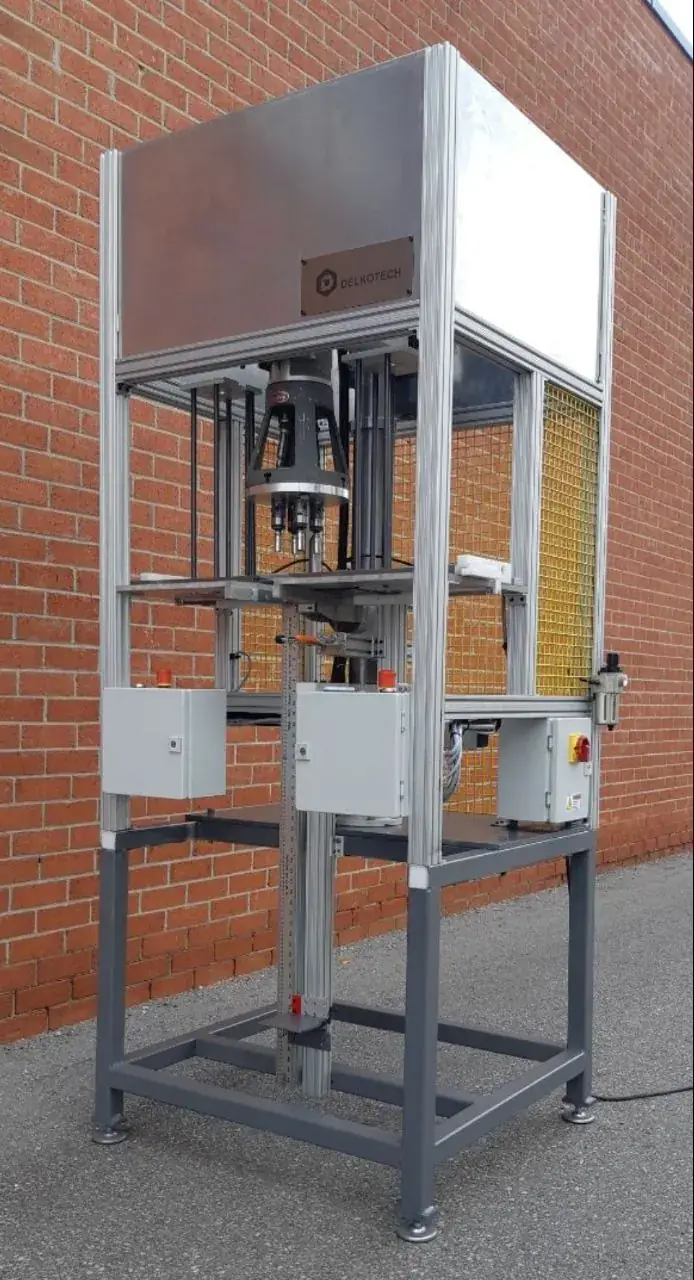
The machine pictured here was built at the Vaughan facility. Frame, stations and controls are configured to the device and the test regime it requires.
From the original specification: Safety device assembly systems are listed among Delkotech's services.
Key Benefits
What It Changes on Your Floor
Assembly and verification in one system
The device is built and proved in the same controlled sequence, so an untested unit cannot leave the cell.
Documented behaviour
The sequence of operation is written before the code, so what the machine does and what the paperwork claims agree.
Failure cases actually tested
Known bad conditions are introduced during build to prove the system detects them.
Record per unit
Each device carries its own build and test record, which is what a field question needs.
Designed for validation
Built to operate in mass production and able to be validated to current regulatory standards.
Application Scenarios
Where It Is Used
Safety component assembly
Building devices whose function is protective and therefore must be individually proved.
Functional test stations
Confirming the assembled device performs as specified before release.
Assembly with traceability
Tying components, process values and test results to a unit identifier.
Reject containment
Separating failed units automatically so they cannot re-enter the flow.
Who It Is For
Plants That Ask for This Machine
- Manufacturers of protective and safety critical devices
- Producers who must show that every unit was tested, not a sample
- Plants moving a manually assembled device into validated production
- Quality groups who need the machine documentation to survive an audit
Problems It Solves
Sample testing is not enough
For a protective device, a sampling plan leaves untested units in the field. Automated test per unit closes that.
Assembly and test are separate
When testing happens later and elsewhere, an untested unit can escape. One system removes the gap.
Undocumented equipment
A machine nobody can describe cannot be validated, which becomes a finding rather than an engineering problem.
Rejects rejoining the flow
A failed unit set aside on a bench eventually gets picked up. Automatic containment prevents it.
Technical Features
How It Is Built
Station based assembly
Each operation as a defined station with its own verification.
Functional test in cycle
The device is tested as part of the build sequence, not afterwards.
Automatic reject containment
Failed units separated into a controlled location.
Unit level traceability
Component, process and test data tied to the unit identifier.
Written sequence of operation
Machine behaviour documented before coding and verified against the document.
Validation ready documentation
Drawings, sequence and test records supplied with the machine.
Specifications
Specification Sheet
Delkotech builds to order, so dimensional and performance values are set against your part at design review, then measured and recorded before shipment. Values not yet fixed for your project are marked TBC rather than guessed.
| System type | Multi station device assembly and functional test system |
|---|---|
| Station count | Specified per device and cycle |
| Verification | Functional test per unit within the build sequence |
| Reject handling | Automatic containment of failed units |
| Traceability | Per unit record of components, process values and test results |
| Cycle time | TBC - confirmed at design review |
| Test parameters | TBC - confirmed at design review |
| Footprint | TBC - confirmed at design review |
| Control platform | PLC with HMI, platform agreed with the customer |
| Documentation | Sequence of operation, as built drawings, test records |
| Validation | Designed to be validated to current regulatory standards |
| Electrical supply | TBC - confirmed at design review |
| Compressed air | TBC - confirmed at design review |
| Built at | Delkotech facility, Vaughan, Ontario, Canada |
| Structure | Welded and machined steel framing with machined mounting surfaces |
|---|---|
| Nests and tooling | Part specific locating elements with non marking contact faces |
| Handles | Assembled devices and their components as specified |
| Enclosures | Panel and guarding materials specified for the production environment |
Manufacturing Process
From Enquiry to Commissioned Machine
Device and test study
The device, its assembly steps and the test that proves it are reviewed together.
Sequence of operation
Written and agreed before design proceeds.
Design
Stations, tooling, controls and safety designed as one package.
Build
Manufactured and assembled at the Vaughan facility.
Verification proving
Known bad units introduced to confirm every failure mode is detected.
Installation and validation support
Installed and supported through your validation protocols.
Quality Control
What Is Checked Before It Ships
- Sequence of operation verified step by step against the written document
- Every failure mode tested with deliberately faulty units
- Test repeatability confirmed with reference units
- Traceability record checked end to end for a full batch
- Safety functions verified and recorded before shipment
Certifications
Compliance Position
Equipment is designed to operate in mass production and to be validated to current regulatory standards, and is supplied with documentation supporting validation. Delkotech does not certify the customer's device. Project specific certification requirements are agreed at contract stage and listed as TBC.
Customization Options
- Station count and cycle set to your volume
- Test regime built to your device specification
- Traceability structure matched to your unit identifier scheme
- Manual, semi-automatic or fully automatic loading
- Data output to your quality systems
- Support through your validation protocols
Comparison
Compared With the Alternatives
| Manual assembly with separate test | Flexible, but it allows an untested unit to escape and produces records that are only as good as the paperwork discipline. |
|---|---|
| Assembly automation without test | Faster, but for a protective device the test is the point. Separating them reintroduces the gap. |
| Buying a standard assembly platform | Economical when the device matches the platform. Safety devices rarely do, and the adaptation usually costs the saving. |
Use Guide
Running It Well
Never bypass a failed test
The containment exists because a failed unit that rejoins the flow is the worst outcome the system can produce.
Run reference units on a schedule
Known good and known bad reference units confirm the test is still discriminating.
Keep the sequence of operation current
Any approved change should be reflected in the document, because that document is what validation references.
Re-verify after maintenance
Work that touches the test circuit should be followed by a reference unit check before production restarts.
Questions
Safety Device Assembly Systems Questions
Does the system test every unit?
That is the design intent for this class of equipment. Functional test sits inside the build sequence so a unit cannot complete the cycle without being tested.
Will it support our validation?
The equipment is designed to be validated to current regulatory standards and is supplied with the sequence of operation, as built drawings and test records. Execution of the validation is normally done with your quality group against your protocols.
What happens to a failed unit?
It is contained automatically in a controlled location rather than being set aside for manual handling, so it cannot re-enter the flow.
Can we trace an individual unit later?
Yes, where the device carries an identifier. Components, process values and test results are tied to that identifier and made available to your quality systems.
How do you prove the test actually catches failures?
During build we introduce deliberately faulty units for every failure mode we are asked to detect, and record the result. Passing good units proves very little on its own.
What do you need from us to quote?
The device drawing, sample units including known bad ones, the test specification and your volume.
Related
Related Equipment
Device Assembly Systems
Combination Device Assembly
Multi station systems that bring several assembly processes into one controlled cycle
View equipment
Device Assembly Systems
Diagnostic Device Automation
Automated assembly and inspection for diagnostic devices with a record for every unit
View equipmentSheet Metal Automation
Place Processing Automation Machines
Stations that position the part and perform the operation in one controlled cycle
View equipmentTalk to an engineer
Get a Quotation for This Machine
Send the part drawing, the operation and the rate you need. You will get a concept and a defined scope, not a brochure.