
- Home
- Products
- CNC Assembly Machines
- Multi Spindle Screw Machines
DK-02 · CNC Assembly Machines
Multi Spindle Screw Machines
Drive every fastener in a pattern in one stroke with torque controlled at each spindle
Overview
What This Machine Does
When an assembly needs eight or twelve fasteners in a fixed pattern, driving them one at a time is slow and produces twelve independent chances to cross thread or under torque. A multi spindle head drives them together, in one positioned stroke, with each spindle controlled individually.
Delkotech builds multi spindle heads for the fastener pattern the customer runs, mounted on a machine that locates the assembly first. The picture on this page shows a multi spindle press head working over a stack of aluminium panels at the Vaughan facility.
Because each spindle reports its own result, the machine can pass or fail the assembly on the fastening itself rather than on a downstream inspection.
From the original specification: Multi spindle screw machines are listed among Delkotech's services, and a multi spindle post screw railing machine appears among delivered projects.
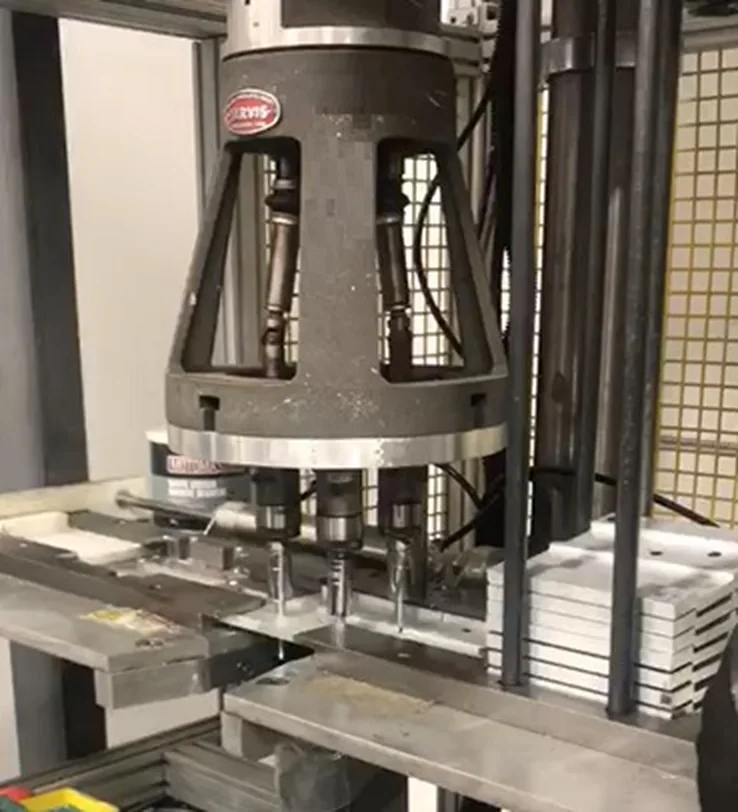
Key Benefits
What It Changes on Your Floor
Whole pattern in one cycle
Cycle time stops scaling with fastener count, which is what makes a dense pattern economic to automate.
Torque controlled per spindle
Each fastener is driven to its own target, so a single bad thread is identified instead of averaged away.
Assembly level pass or fail
The part is judged on whether every spindle achieved its target, in cycle, not at a later inspection.
No cross threading from a rushed operator
Engagement is controlled by the machine, which removes the failure mode that hand driving produces under time pressure.
Repeatable clamp load
Consistent torque means consistent clamp load, which is what the joint design assumed in the first place.
Application Scenarios
Where It Is Used
Post and railing fastening
Driving the repeating fastener pattern on railing posts and rail sections.
Panel and cover assembly
Fastening covers, plates and closures with a fixed hole pattern.
Bracket and frame assembly
Attaching brackets where several fasteners must be driven to the same specification.
Sub-assembly stations in a line
Sitting as one station in a cell, sharing controls and guarding.
Who It Is For
Plants That Ask for This Machine
- Assemblers driving repetitive dense fastener patterns by hand tool
- Railing and profile fabricators fastening posts in a repeating pitch
- Manufacturers who need torque evidence per fastener, not per batch
- Plants where fastening is the bottleneck in an otherwise automated cell
Problems It Solves
Cycle time scales with fastener count
Twelve fasteners driven sequentially is twelve cycles. A multi spindle head makes it one.
Inconsistent torque
A hand tool result depends on approach angle, tool condition and how the shift is going. A controlled spindle does not.
Cross threading
Rushed manual engagement is the usual cause. Machine controlled engagement removes it.
No fastening record
Without per spindle data, a field failure has no history to look at.
Technical Features
How It Is Built
Multi spindle head
Spindle positions matched to your fastener pattern, with pitch set at build.
Individual torque control
Each spindle driven and monitored to its own target.
Positioned stroke
The head approaches on a controlled stroke so engagement is consistent across all spindles.
Assembly location
Part nest and clamping hold the assembly on its datum before the head descends.
Per spindle results
Pass and fail reported per spindle and available to your plant systems.
Fastener feeding
Automatic feeding can be included where the fastener and volume suit it.
Specifications
Specification Sheet
Delkotech builds to order, so dimensional and performance values are set against your part at design review, then measured and recorded before shipment. Values not yet fixed for your project are marked TBC rather than guessed.
| Machine type | Multi spindle fastening machine, press mounted head |
|---|---|
| Spindle count | Set to the fastener pattern, specified per order |
| Spindle pitch | Matched to the customer pattern at build |
| Torque range | TBC - confirmed at design review |
| Torque accuracy | TBC - confirmed at design review |
| Cycle time | TBC - confirmed at design review |
| Stroke | TBC - confirmed at design review |
| Fastener size range | TBC - confirmed at design review |
| Torque monitoring | Per spindle, with pass and fail per fastener |
| Data output | Per spindle results available to plant systems |
| Control platform | PLC with HMI, platform agreed with the customer |
| Guarding | Guarded stroke area with controlled initiation |
| Electrical supply | TBC - confirmed at design review |
| Compressed air | TBC - confirmed at design review |
| Built at | Delkotech facility, Vaughan, Ontario, Canada |
| Handles | Aluminium and steel panels, extrusions, posts and formed assemblies |
|---|---|
| Structure | Welded and machined steel press frame |
| Spindle tooling | Hardened bits and sockets selected for the fastener drive type |
| Nest | Part specific locating elements with non marking contact faces where needed |
Manufacturing Process
From Enquiry to Commissioned Machine
Pattern and fastener study
Fastener type, size, target torque and pattern pitch are taken from your specification and sample assemblies.
Head configuration
Spindle count and pitch set, and accessibility checked against the assembly.
Design and build
Machine designed and built at the Vaughan facility.
Torque proving
Spindles calibrated and proved against your target on real assemblies.
Capability run
A continuous run confirms repeatability before shipment.
Installation and training
Installed, interfaced and handed over with torque records.
Quality Control
What Is Checked Before It Ships
- Each spindle calibrated against a reference torque transducer and recorded
- Sample assemblies fastened and audited against the target
- Fail cases deliberately induced to confirm the machine detects them
- Repeatability confirmed over a continuous run
- Guarding and initiation circuit verified before shipment
Certifications
Compliance Position
Built to be validated to current regulatory standards. Torque acceptance criteria are set against the customer specification. Calibration certificates for the reference equipment are supplied with the handover records. Project specific third party certificates are TBC until contract stage.
Customization Options
- Spindle count and pitch set to your pattern
- Automatic fastener feeding where volume justifies it
- Fixed pitch head or adjustable arrangement for a part family
- Per spindle data output to your plant systems
- Manual load station or integration into a cell
- Combined fastening and checking in one station
Comparison
Compared With the Alternatives
| Hand held torque tool | Flexible and cheap, but slow on dense patterns and dependent on the operator for engagement and approach. |
|---|---|
| Single spindle automatic driver | Good torque control at lower cost, but cycle time still scales with fastener count. |
| Riveting or clinching | Faster per joint and with no fastener cost, but the joint is permanent. Screws stay the right answer when the assembly has to come apart. |
Use Guide
Running It Well
Seat the assembly before cycling
The nest checks seating. If the head will not descend, the part is not located, and that is the machine doing its job.
Check bit condition on a schedule
Worn drive bits are the most common cause of a torque result drifting across a shift.
Keep the fastener supply consistent
A change of fastener supplier changes the friction, and therefore the torque needed for the same clamp load.
Use the per spindle data
A single spindle failing repeatedly is usually a mechanical issue at that position, not a torque setting problem.
Questions
Multi Spindle Screw Machines Questions
How many spindles can the head carry?
Spindle count is set to your fastener pattern. Send the assembly drawing with the hole pattern and fastener specification and we will confirm what the head can carry at that pitch.
Can the spindle pitch be adjusted for different products?
An adjustable arrangement is possible for a defined family. Where the patterns are very different, a changeable head is usually more reliable than a mechanism that adjusts.
What torque accuracy do you achieve?
Accuracy is specified against your requirement at design review, then verified against a reference transducer and recorded before shipment. We do not publish a general figure because it depends on the drive and fastener selected.
Does it detect a cross threaded fastener?
Each spindle is monitored individually, so a fastener that does not reach its target within the expected envelope is reported as a fail at that position.
Can we get the torque data out?
Yes. Per spindle results can be made available to your plant systems. The format is agreed with your IT group before software is written.
Will it feed the fasteners automatically?
Automatic feeding can be included where the fastener geometry and volume suit it. For mixed low volume work, operator loading into the nest is often the more reliable choice.
Related
Related Equipment
CNC Assembly Machines
CNC Guard Rail Assembly Machines
Index and fasten long rail assemblies to a programmed pattern instead of by hand marking
View equipment
Sheet Metal Automation
Clinching Machine
Cold forming press that joins sheet metal without heat consumables or surface damage
View equipment
CNC Assembly Machines
CNC Custom Automation Equipment
Purpose built CNC machines designed around your part when no catalogue machine fits
View equipmentTalk to an engineer
Get a Quotation for This Machine
Send the part drawing, the operation and the rate you need. You will get a concept and a defined scope, not a brochure.