
- Home
- Knowledge Centre
- Gantry or Robot for Pick and Place
Comparison Guide
Gantry or Robot for Pick and Place
How to choose between a gantry and an articulated robot for a handling application
Introduction
Most handling enquiries arrive already framed as a robot project, because that is the word everyone knows. For a lot of applications a gantry is faster, stiffer and cheaper, and for others a robot is the only thing that will work. The decision comes down to four questions, and they are worth answering before a supplier is selected.
All Articles
Does the orientation change?
If the part is picked flat and placed flat, a gantry can do it with three simple axes. If the part has to be rotated, tilted or approached from a changing angle, that is what an articulated arm is for.
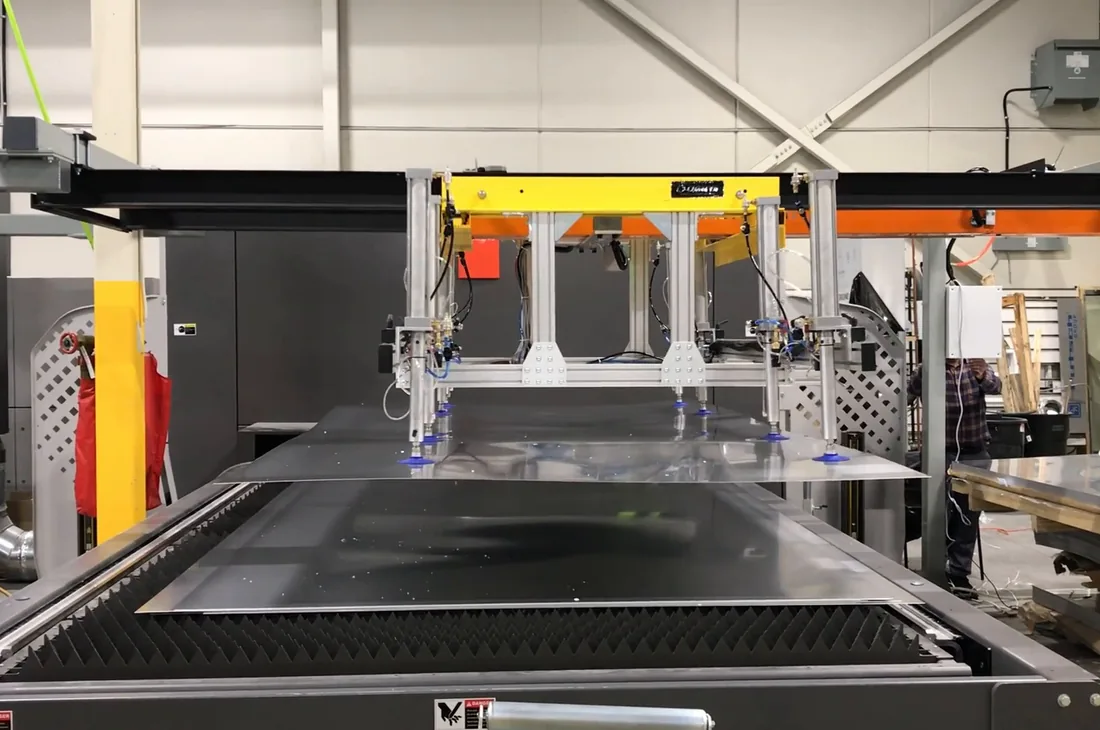
Straight transfers of large flat blanks are the classic gantry application. Once the move involves reorienting the part in space, the gantry starts needing extra axes and the cost advantage goes away.
How big and how heavy is the part?
A gantry carries load between two supported rails, so span and payload scale reasonably well. A robot cantilevers everything from its base, so payload at full reach falls off quickly.
For a large sheet metal blank, a gantry is usually the stiffer and less expensive structure. For a small part moved close to the base, the robot is more compact and more flexible.
What does the floor space allow?
A gantry occupies the volume above the working area, which is often space that is otherwise wasted. It keeps the floor free underneath.
A robot needs a footprint on the floor plus a guarded working envelope around it. In a crowded plant, that envelope is frequently the constraint that decides the question.
How likely is the application to change?
A gantry is optimised for the move it was designed for. Changing that move usually means mechanical work.
A robot is reprogrammable within its envelope. If you expect the part or the sequence to change, that flexibility has real value and is worth paying for.
A practical way to decide
Write down the actual move: pick point, place point, orientation change, part mass, cycle time and available space. If the move is a straight transfer of a large flat part inside a fixed layout, start with a gantry.
If orientation changes, if the part family is varied, or if you expect the application to be reused for something else in three years, start with a robot. Either way, the tooling and part presentation will cost more than you expect, and that is true of both.
Takeaways
The Short Version
- Gantries win on span, stiffness and cost for straight transfers of large flat parts
- Robots win when orientation changes or the application is likely to be reused
- Floor space and the guarded envelope often decide the question before technical merit does
- Tooling and part presentation dominate the cost of either approach
Related
Equipment Discussed
Sheet Metal Automation
Automatic Sheet Metal Pick and Place Machine
Vacuum gantry de-stacker that feeds blanks to a laser or press without manual lifting
View equipmentRobotics and Motion
Robotic Motion Assembly
Robot assembly cells delivered complete with tooling presentation guarding and controls
View equipmentQuestions
Questions About This Article
What is the short answer?
Gantries win on span, stiffness and cost for straight transfers of large flat parts.
Does this apply to equipment we already own?
Most of it does. The engineering described here is not specific to Delkotech machines, although where our equipment is relevant we link to it.
Who should read this?
Engineering, maintenance and production people who have to specify, buy or live with the equipment. It is written to be useful on the floor rather than in a brochure.
Can Delkotech advise on our specific case?
Yes. Email [email protected] with the part, the operation and what is going wrong, and you will get an engineer's answer rather than a sales response.
Talk to an engineer
Ask About Your Own Application
Send the part and the problem. You will get an engineer's answer, including when the answer is that automation is not the right call.