
Client Background
Railing fabrication operation producing repeat post and rail assemblies
Project Challenge
Each post carried a repeating fastener pattern that was being driven by hand tool. Cycle time scaled with fastener count, torque varied with the operator and the hour, and a cross threaded fastener was only found at final assembly.
Customer Pain Points
- Cycle time proportional to the number of fasteners
- Torque varying between operators and across a shift
- Cross threading under time pressure
- No evidence that each fastener reached its target
- Fastening as the bottleneck in an otherwise fast process
Our Solution
What We Built
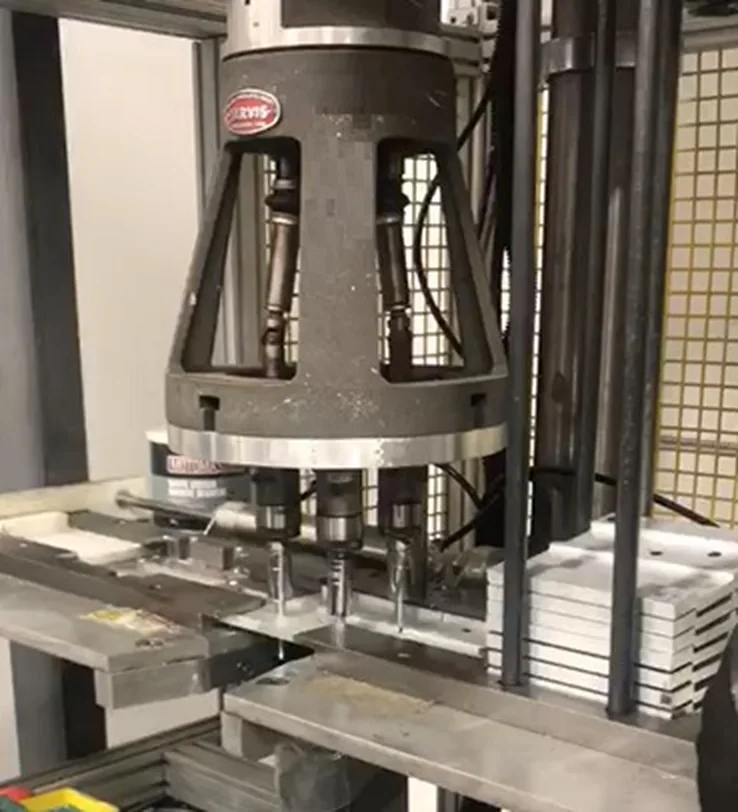
A multi spindle head with spindle positions matched to the post fastener pattern, mounted on a press that locates the assembly before the head descends. Every fastener in the pattern is driven in one positioned stroke, with each spindle monitored to its own torque target so a single bad thread is identified rather than averaged into a batch result.
Manufacturing Process
How the Machine Was Built
Pattern and fastener study
Fastener type, size, target torque and pattern pitch taken from the customer specification and sample assemblies.
Head configuration
Spindle count and pitch set, and accessibility checked against the assembly.
Design and build
Machine designed and built at the Vaughan facility.
Torque proving
Spindles calibrated against a reference transducer and proved on real assemblies.
Capability run
Continuous run to confirm repeatability before shipment.
Installation
Installed, interfaced and handed over with torque records.
Supply Chain Coordination
Sourcing and Build
Spindle drives, torque monitoring and drive tooling are selected against the fastener specification. The reference transducer used for calibration is supplied with its certificate as part of the handover records.
Quality Control
Checked Before Shipment
- Each spindle calibrated against a reference torque transducer and recorded
- Sample assemblies fastened and audited against the target
- Fail cases deliberately induced to confirm detection
- Repeatability confirmed over a continuous run
- Guarding and initiation circuit verified before shipment
Final Result
What the Machine Does Now
The whole fastener pattern is driven in one cycle with a recorded result per spindle. Fastening stopped being the constraint on the cell, and a failed fastener is now identified at the station instead of at final assembly.
Customer Benefit
Why It Mattered
Consistent clamp load across every fastener, and torque evidence per position rather than a batch level assumption.
Project volumes, cycle figures and customer identity are not published. Torque specifications and sample work can be discussed on request.
Related
Equipment Used
CNC Assembly Machines
Multi Spindle Screw Machines
Drive every fastener in a pattern in one stroke with torque controlled at each spindle
View equipmentCNC Assembly Machines
CNC Guard Rail Assembly Machines
Index and fasten long rail assemblies to a programmed pattern instead of by hand marking
View equipment
CNC Assembly Machines
CNC Custom Automation Equipment
Purpose built CNC machines designed around your part when no catalogue machine fits
View equipmentRelated
Related Reading
Process Guide
Clinching Riveting and Spot Welding Compared
Choosing a sheet metal joining method when the panel is already finished
Read the articleBuying Guide
Why a Sequence of Operation Comes Before the Code
The single document that determines whether a custom machine project goes well
Read the articleQuestions
About This Project
Can you tell us who the customer was?
Project volumes, cycle figures and customer identity are not published. Torque specifications and sample work can be discussed on request.
Could you build the same machine for us?
Not identically, and that is the point. The machine was designed around one customer's part, rate and floor space. The same approach applied to your part produces a different machine.
How long did the project take?
Project duration depends on scope and the build schedule at the time. We are happy to give you a realistic schedule for your own requirement once the scope is defined.
What was proved before the machine shipped?
The checks listed in the quality control section of this page, run at the Vaughan facility. Customer witnessed try out before shipment can be arranged.
How do we start a similar project?
Email [email protected] with the part drawing, the operation and the rate. That is enough for a concept and a defined scope.
Talk to an engineer
Have a Similar Operation
Send the part and describe the step. We will tell you what the same approach would look like applied to your line.