Temperature Changes The Whole Specification
A standard water pump is rated to around 80 degrees Celsius. Above that, seal faces, elastomers, bearing lubrication and expansion all become design questions rather than catalogue selections.
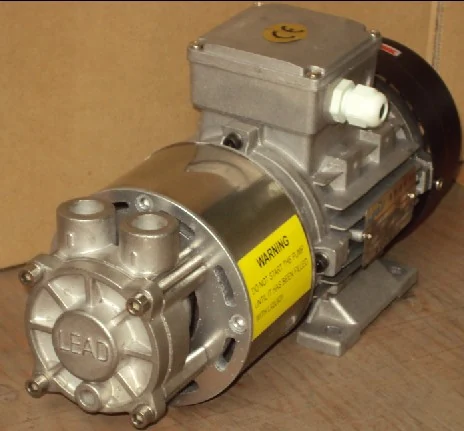
Our high temperature and hot water models carry their own ratings, and the magnetic drive heat transfer line is rated to 350 degrees Celsius for hot oil duty.
See the Hot Oil Pump specification →
Seal Free Or Sealed
On hot oil the decision usually goes to a magnetic drive, because there is no shaft through the housing and therefore no seal to degrade and no leak path on a line where a leak can ignite.
- Magnetic drive for hot oil and for circuits that run unattended
- Sealed centrifugal where the temperature is within the rating and the fluid is water based
- Whatever the choice, state the fluid and the working temperature, not just the flow
See the SKWS High Temperature Centrifugal Pump specification →
Size On Circuit Resistance
Head for a closed circuit is the resistance of the loop, not a static lift. Heat exchangers, control valves and long small bore runs dominate that figure.
Oversizing leads to a throttled valve and wasted power. Undersizing leads to poor heat transfer at the consumer, which looks like a heater problem and is not.
| 90 W build | 8 m head, 10 L per minute |
|---|---|
| 180 W build | 20 m head, 30 L per minute |
| 370 W build | 35 m head, 30 L per minute |
| 500 W build | 40 m head, 30 L per minute |
| Speeds | 1400 and 2800 rpm |
Protect Against Dry Running
Heat transfer pumps are intended for hot water and hot oil without solids and with low corrosiveness. They are not intended to run dry: without liquid there is nothing to lubricate the internals.
Design venting and level protection into the circuit so the pump is never asked to start against an empty line.
Commissioning Checks Worth Doing
Fill and vent fully before the first start, then bring the temperature up gradually rather than in one step. Check flow and the temperature difference across the consumer once the circuit is hot.
Record those figures. When performance drifts later, the original numbers are what tell you whether the pump, the fluid or the exchanger has changed.