
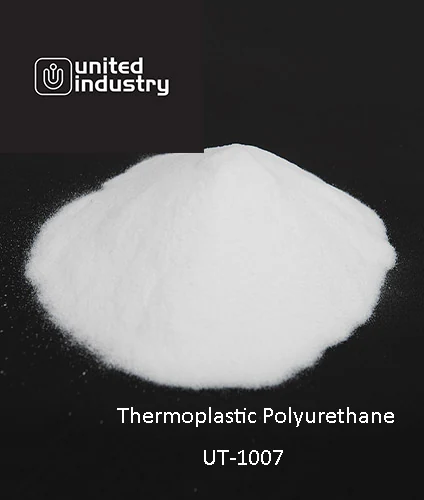
Thermoplastic Polyurethane Powder UT-1007
Soft low melting TPU powder for screen heat transfer printing and shoe material
| Material | Polyester based thermoplastic polyurethane |
|---|---|
| Character | White powder |
| Flow Beginning Temperature | 95 C |
| Melting Range | 100-125 C |
What This Grade Is Built For
UT-1007 is a polyester based thermoplastic polyurethane hot melt adhesive powder with a low melting point and a soft grade. Flow begins at 95 C and the melting range is 100-125 C, which is low enough to press on temperature sensitive fabrics and coated leather. It bonds well to PVC, PU, fabric and genuine leather, and is used in screen heat transfer printing and in shoe material work.
Key Benefits
- Flow beginning temperature 95 C — the lowest press temperature of our TPU powders
- Soft grade, so the transfer moves with the garment instead of stiffening it
- Good adhesion to PVC, PU, fabric and genuine leather without a primer
- Four particle fractions from 0-80 to 200-500 micron for different mesh counts
- One grade serves both transfer printing and shoe material bonding
Buyers Who Specify This Grade
- Screen transfer printers producing plastisol and PU transfers
- Shoe material converters bonding PU and PVC to textile
- Printers working on heat sensitive fabrics where 130 C is already too hot
What It Fixes On The Line
- High melting powders scorch or shrink thin synthetic fabric
- Hard transfers crack at the first stretch
- Poor adhesion to PU and PVC coatings without a primer step
Application Scenarios
- Screen heat transfer printing on garments
- Transfer printing on stretch fabric and sportswear
- Shoe material bonding
- Bonding to PVC and PU coated substrates
How It Behaves In Process
- Polyester based thermoplastic polyurethane
- White powder
- Flow beginning temperature 95 C
- Melting range 100-125 C
- Density 1.2 g/cm3
- MFR 20 g/10 min at 150 C and 2.16 kg
What It Is Made Of
Polyester based thermoplastic polyurethane elastomer.
Customisation
- Particle fractions can be cut to requirement where none of the four standard ranges fits the mesh.
Published Data For Thermoplastic Polyurethane Powder UT-1007
Only values published for this grade are listed. Where a value is grade specific rather than fixed, the data sheet issued with your quotation carries it.
| Material | Polyester based thermoplastic polyurethane |
|---|---|
| Character | White powder |
| Flow Beginning Temperature | 95 C |
| Melting Range | 100-125 C |
| Density | 1.2 g/cm3 |
| MFR (150 C, 2.16 kg) | 20 g/10 min |
| Particle Size | 0-80, 80-180, 100-300, 200-500 micron |
How This Grade Is Applied
Step 01
Print the base paste or ink on the transfer paper
Step 02
Scatter or screen UT-1007 onto the wet print
Step 03
Remove the excess powder and cure or dry the transfer
Step 04
Heat press onto the garment at a temperature above the melting range
Quality Control
Melting range, MFR and particle size distribution are the control values for each batch; data sheets are supplied on request.
Use Guide
- Select the fraction to suit the mesh: fine fractions for fine screens, coarse for heavier deposits
- Press above 125 C so the whole melting range is passed, then confirm by a wash test
- Keep the powder sealed; damp TPU powder clumps and blocks the screen
- Check hand feel on the finished garment, not on the transfer paper
How It Compares With The Alternatives
| Compared with | What changes |
|---|---|
| UT-1290 TPU powder | UT-1290 begins to flow at 100 C instead of 95 C and is specified for better colour fastness. UT-1007 presses cooler and also covers shoe material work. |
| Polyamide hot melt powder | Polyamide gives higher bond strength but is far stiffer. Choose TPU when the fabric stretches. |
| Copolyester (PES) powder | PES is the wash resistance choice where elasticity is not required; TPU is the elasticity and hand feel choice. |
Application Notes Featuring This Grade
Related Products
 Thermoplastic Polyurethane Hot Melt Adhesives
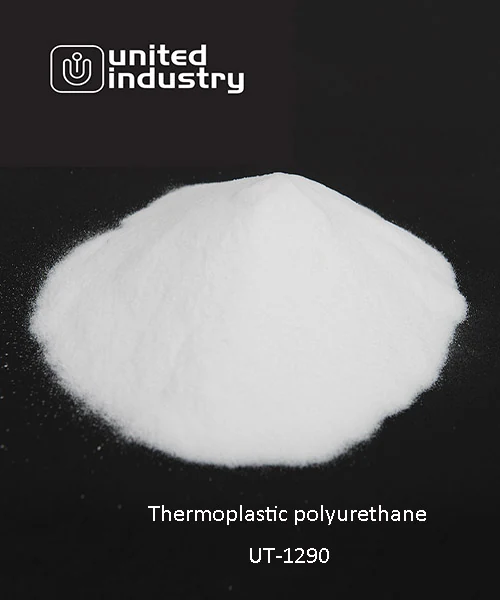
Thermoplastic Polyurethane Powder UT-1290
Aliphatic polyester TPU powder for high elasticity transfers with better colour fastness
View Grade Data
Thermoplastic Polyurethane Hot Melt Adhesives
Thermoplastic Polyurethane Powder UT-1290
Aliphatic polyester TPU powder for high elasticity transfers with better colour fastness
View Grade Data
 Polyamide (PA) Hot Melt Adhesives
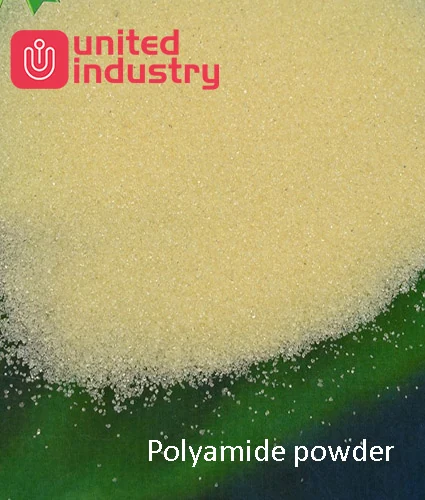
Polyamide Hot Melt Powder
High strength polyamide powder for textile lamination and shoe fabric bonding
View Grade Data
Polyamide (PA) Hot Melt Adhesives
Polyamide Hot Melt Powder
High strength polyamide powder for textile lamination and shoe fabric bonding
View Grade Data
 Hot Melt Adhesives
Thermoplastic Polyurethane Resin
TPU resin raw material from 72A to 93A hardness for shoe material and compounding
View Grade Data
Hot Melt Adhesives
Thermoplastic Polyurethane Resin
TPU resin raw material from 72A to 93A hardness for shoe material and compounding
View Grade DataGuides That Explain This Grade
How To Choose Hot Melt Powder Particle Size
Particle size decides whether powder passes your mesh cleanly and how much adhesive ends up on the substrate. Pick the fraction before you pick anything else.
Process GuideTime Temperature And Pressure In Heat Transfer Printing
Three key components decide every heat press result. Every heat transfer material has its own instructions for all three, and most failures are one of them being wrong.
Thermoplastic Polyurethane Powder UT-1007 FAQ
What is the difference between UT-1007 and UT-1290
UT-1007 flows from 95 C and is the softer, lower temperature grade that also covers shoe material. UT-1290 flows from 100 C and is specified where colour fastness and elasticity for high quality products come first.
Which particle size do I need for screen printing
Fine fractions such as 0-80 micron suit fine mesh and thin deposits, 80-180 and 100-300 micron are the common transfer fractions, 200-500 micron is for heavy deposits. Tell us your mesh and we will point to the fraction.
Does it bond to genuine leather
Yes. Good adhesion strength to PVC, PU, fabric and genuine leather is one of the defining properties of this grade.
What press temperature should I start from
Above the 100-125 C melting range. Exact time, temperature and pressure are set from a trial on your substrate.
Is a technical data sheet available
Yes, by email.
Request Data Or A Sample Of Thermoplastic Polyurethane Powder UT-1007
Data sheets are grade specific and issued by email. Tell us the substrates and your process temperature limit and the right sheet comes back with the quotation.