
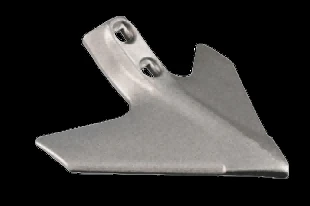
What This Part Is And Why It Is Made This Way
Agricultural parts work in soil and moisture under impact loading, and they are bought against a machine price that leaves no room for over engineering. The process has to deliver strength at a fixed cost per part.
Agricultural forgings are produced by closed die forging in carbon and alloy steel grades, in weights from 0.2 kg to 100 kg.
What You Get From This Route
Closed die forging gives a fixed, predictable cost per part at volume.
Grain flow improves impact resistance in soil engaging positions.
Capacity planned around seasonal production peaks.
Application Scenarios
- Tillage and soil engaging components
- Harvesting machinery parts
- Transmission and linkage forgings
- Implement connection hardware
Who It Is For
- Agricultural machinery manufacturers
- Implement makers with seasonal build programmes
- Aftermarket suppliers of wear and replacement parts
Technical Features
- Closed die forging 0.2 kg - 100 kg
- Carbon steel C22E / C35E / C45E / C55E
- Alloy steel 16MnCr5, 20MnCr5, 42CrMo4
- High batch, high precision, complex shape capability
What Buyers Run Into Without This Specification
- Demand doubles for three months and the supplier cannot flex.
- Impact loading breaks cast or fabricated equivalents.
- Cost per part is fixed by the machine price and cannot absorb machining.
Published Material Weight And Process Data
Figures below are the published capability for precision forging. Part specific values — tolerance on individual features, finish, packing — are confirmed at drawing review and marked TBC until then.
| Closed Die Forging | Equipment 300 T - 8000 T; product weight 0.2 kg - 100 kg |
|---|---|
| Rolled Ring Forging | Maximum diameter 9000 mm; ring, cone and cylinder shapes |
| Open Die Forging | No die cost, short development cycle, flexible size selection for large forgings |
| Carbon Steel | C22E / 20, C35E / 35, C45E / 45, C55E / 55 |
| Alloy Steel | 16MnCr5, 20MnCr5, 42CrMo4 / 42CrMo, 34CrNiMo6, 25CrMo4 / 25CrMo, 41Cr4 / 40Cr, 18CrNiMo7-6 |
| Stainless Steel | 1.4301 / 304, 1.4401 / 316, 1.4542 / 17-4PH, 1.4021 / 20Cr13, 1.4057 / 30Cr13 |
| Certificates | Production partners can support IATF 16949:2016 and ISO 9001:2015 |
| Part Specific Tolerance | TBC — confirmed against the customer drawing |
| Minimum Order Quantity | TBC — depends on the process route selected |
| Lead Time | TBC — confirmed with the production base at quotation |
How The Part Is Made And Checked
- CMM — Zeiss and Hexagon three coordinate measurement of critical dimensions and assembly positions.
- 3D Scan — Complex surfaces, contours and sample development stage dimensional verification.
- Mechanical — Tensile, hardness, -60 °C impact, metallographic and chemical composition testing.
- NDT — UT, MT, PT and RT non destructive testing.
- Ring Check — Leak testing, roughness, inner diameter and roundness related checks.
Quality management is based on ISO 9001 and covers supplier management, raw material inspection, production process control and final inspection. Inspection results are archived and traceable.
Options And Alternatives
Parts are produced to the customer drawing rather than to a fixed catalogue item, so material grade, machining scope, surface treatment and packing are all specified per order. Machining, dimensional control, surface treatment and necessary pre-assembly can be added to the same supply route.
Where another process family would suit the part better — for example a forging in place of a casting for a shock loaded connector — that comparison is raised during drawing review rather than after tooling is committed.
How To Specify This Part
Share the seasonal build plan when you enquire. Forging capacity is booked in advance, so a production plan shared early is the practical way to protect delivery through a seasonal peak.
- Send the drawing with material, quantity, quality standard and target delivery date.
- State the inspection class and the zones it applies to, rather than a general note.
- Confirm the packing requirement and the lifting equipment available at the destination.
Related Guides
Other Parts In This Range
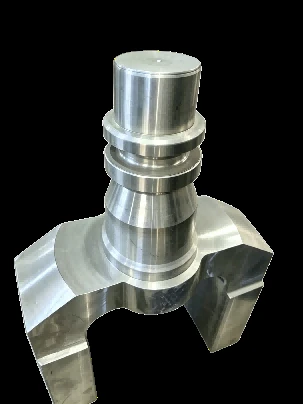
Precision Die Forged Shafts
Die forged shafts from 0.2 kg to 100 kg
View specifications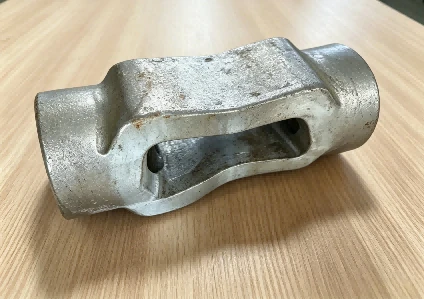
Closed Die Forged Connectors
High volume forged connection parts
View specifications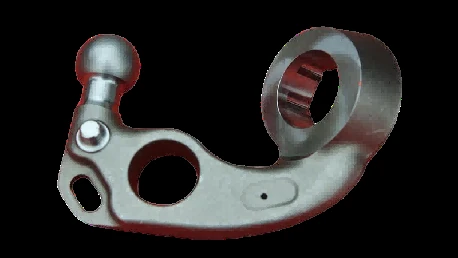
High Strength Connection and Lifting Components
Rated lifting and connection hardware
View specifications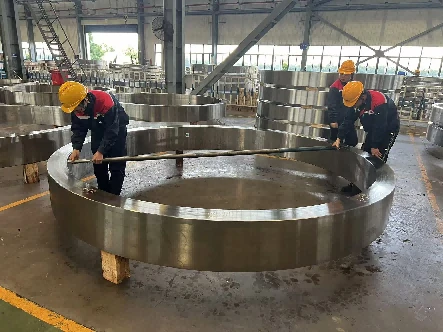
Rolled Ring Forgings
Seamless rings to 9000 mm diameter
View specificationsAgricultural Machinery Forgings — Frequently Asked Questions
Can you handle seasonal volume peaks?
Seasonal planning is handled as part of the project management stage. Please state the expected build programme on the enquiry so capacity can be planned.
Which materials suit soil engaging parts?
Carbon steels C45E and C55E and alloy steels such as 42CrMo4 are available, selected against the wear and impact requirement on the drawing.
What do you need to prepare a quotation?
Drawings, material, quantity, quality standard and target delivery date.
Which inspection is included?
The inspection scope is agreed during drawing review. Leak testing, roughness, inner diameter and roundness related checks.
Get A Quotation For Agricultural Machinery Forgings
Send the drawing and the application. We will confirm the process route, the production base and the inspection scope before quoting.