
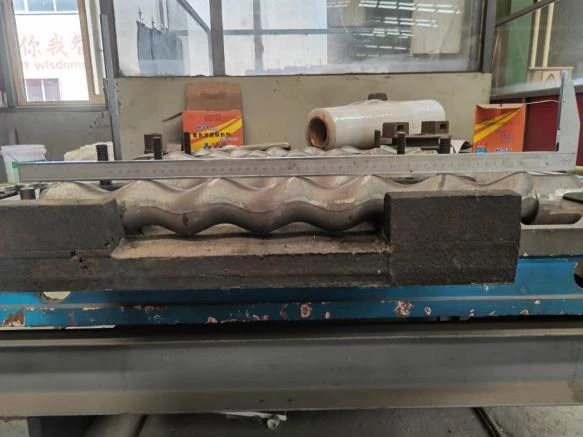
How to Specify a Screw Pump Rotor That Lasts
Rotor life depends on hardness, helical profile and arc surface finish. Each is measurable, and each is routinely left off the enquiry.
A progressive cavity pump wears at the interface between a hard rotor and a soft stator. Everything that determines rotor life is measurable, which means everything that determines rotor life can and should be written on the order.
The Heat Treatment Sequence Matters
Rotors are annealed to 20-35 HRC before machining, which is what makes the helical profile machinable at all.
After machining they are quenched at about 1020 °C and reach 59-63 HRC. A rotor that is easy to machine and never properly quenched will wear out quickly, and nothing in its appearance will reveal that.
The Full Process Route
The production route is shell moulding, grinding, welding, machining, quenching, polishing, inspection and packing.
Each of those steps can be skipped by a supplier cutting cost, and polishing is usually the first to go — which directly shortens stator life.
The Four Inspection Items to Ask For
Head multi diameter visual inspection.
Casting deformation evaluation.
Key helical diameter measurement.
Arc surface roughness testing.
Asking for these four values to be reported with each delivery turns rotor life from an argument into a trend.
Standard Series and Custom Rotors
D series, 2L6 series and 2L8 series rotors can be supplied, along with rotors customised to the customer drawing.
Where a rotor family is being sourced, keeping the whole family on one process route gives far more consistent test bench results than splitting sizes across suppliers.
Process Families Covered In This Guide
Continue Reading
Casting or Forging How to Choose for a Load Bearing Part
The decision between a casting and a forging is usually made on shape complexity and load type rather than on price. This guide sets out the practical criteria.
Material GuideChoosing Heat Resistant Alloys for Grate Bars and Furnace Castings
Grate bars are consumables, so the alloy decides the operating budget. This guide explains the grades Eurona works with and how the working condition narrows the choice.
Process GuideSelecting an Aluminium Casting Process by Batch Size and Wall Thickness
Four aluminium casting routes with very different cycle times, tolerances and tooling costs. The published figures make the choice straightforward once batch size is known.
Buying GuideWhat NDT and Quality Documents to Specify on a Casting Order
Most acceptance disputes come from an inspection scope that was never agreed. This guide covers what to specify and when to specify it.
Buying GuideA Four Stage Process for Sourcing Machinery Parts From China
The stages an overseas parts order actually passes through, and the decisions that belong in each one.
Questions On This Topic
What final hardness should a rotor reach?
59-63 HRC after quenching at about 1020 °C, having been annealed to 20-35 HRC for machining.
Which rotor series are available?
D series, 2L6 series, 2L8 series and rotors customised to drawing.
Apply This To Your Own Part
Send the drawing and the duty. The drawing review will confirm the process route, the material and the inspection scope before anything is quoted.