
Casting or Forging How to Choose for a Load Bearing Part
The decision between a casting and a forging is usually made on shape complexity and load type rather than on price. This guide sets out the practical criteria.
Buyers often ask which is better, a casting or a forging. The honest answer is that they solve different problems, and the wrong choice is expensive in both directions — an over specified forging wastes money, an under specified casting fails in service.
Why Forging Changes the Material Not Just the Shape
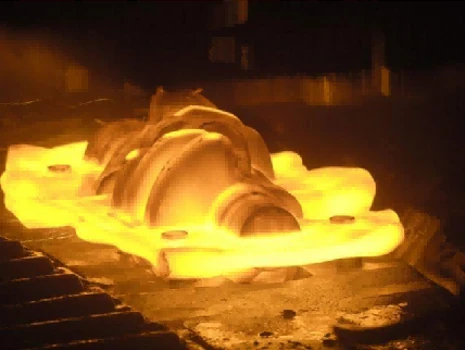
Forging deforms the metal while it is hot, which forms a continuous metal flow line through the part. That flow line follows the contour of the component, so the grain runs along the load path instead of being cut across by machining.
The practical result is higher strength, better reliability and longer service life than a casting of the same grade and the same shape. This is why shafts, lifting components and safety critical connectors are normally forged.
Where Casting Wins
Casting places metal exactly where the design needs it, including internal passages and cavities that no forging die can form. For a complex shape, casting is usually the only economical route.
Precision casting narrows the traditional gap. The silica sol lost wax process holds CT5 to CT9 with a surface of Ra 3.2 to Ra 6.3, which means many features need no machining at all.
Casting also scales down: precision casting covers 0.01 kg to 300 kg, far below the practical minimum for most closed die forging work.
Practical Selection Criteria
Load type — steady loads favour casting; shock, fatigue and rated lifting loads favour forging.
Shape — internal cavities and free form surfaces favour casting; simple solid sections favour forging.
Quantity — closed die forging needs volume to amortise tooling, while open die forging has no die cost at all and suits large or one off parts.
Size — closed die forging covers 0.2 kg to 100 kg, rolled rings reach 9000 mm diameter, and steel castings run from 50 kg to 20 tonnes.
A Middle Path That Is Often Overlooked
Open die forging deserves more attention than it gets. It carries no die cost, has a short development cycle and allows flexible size selection, which makes it a sensible route for large forgings and for low volumes that could never justify a closed die.
For rings specifically, roll forging removes the weld seam entirely — a difference that matters far more in cyclic duty than any grade change.
Process Families Covered In This Guide
Precision Forging
Closed die forging on 300 T - 8000 T presses, rolled rings up to 9000 mm diameter and open die forging for large parts.
RelatedPrecision Casting
Silica sol lost wax and quick-drying investment casting from 0.01 kg to 300 kg, holding CT5 - CT9 and Ra 3.2 - Ra 6.3.
RelatedSteel Castings and Forgings
Heavy load and high strength steel parts from 50 kg to 50 tonnes, covered by melting records, heat treatment, NDT and full quality documents.
Continue Reading
Choosing Heat Resistant Alloys for Grate Bars and Furnace Castings
Grate bars are consumables, so the alloy decides the operating budget. This guide explains the grades Eurona works with and how the working condition narrows the choice.
Process GuideSelecting an Aluminium Casting Process by Batch Size and Wall Thickness
Four aluminium casting routes with very different cycle times, tolerances and tooling costs. The published figures make the choice straightforward once batch size is known.
Buying GuideWhat NDT and Quality Documents to Specify on a Casting Order
Most acceptance disputes come from an inspection scope that was never agreed. This guide covers what to specify and when to specify it.
Product GuideHow to Specify a Screw Pump Rotor That Lasts
Rotor life depends on hardness, helical profile and arc surface finish. Each is measurable, and each is routinely left off the enquiry.
Buying GuideA Four Stage Process for Sourcing Machinery Parts From China
The stages an overseas parts order actually passes through, and the decisions that belong in each one.
Questions On This Topic
Is a forging always stronger than a casting?
In the same grade and the same shape, forging generally gives higher strength and longer service life because of the continuous metal flow line. A well designed casting in a higher grade can still outperform a poor forging.
Can one part be partly cast and partly forged?
Not as a single piece, but assemblies frequently combine both. The process route for each component is selected during drawing review.
Apply This To Your Own Part
Send the drawing and the duty. The drawing review will confirm the process route, the material and the inspection scope before anything is quoted.