
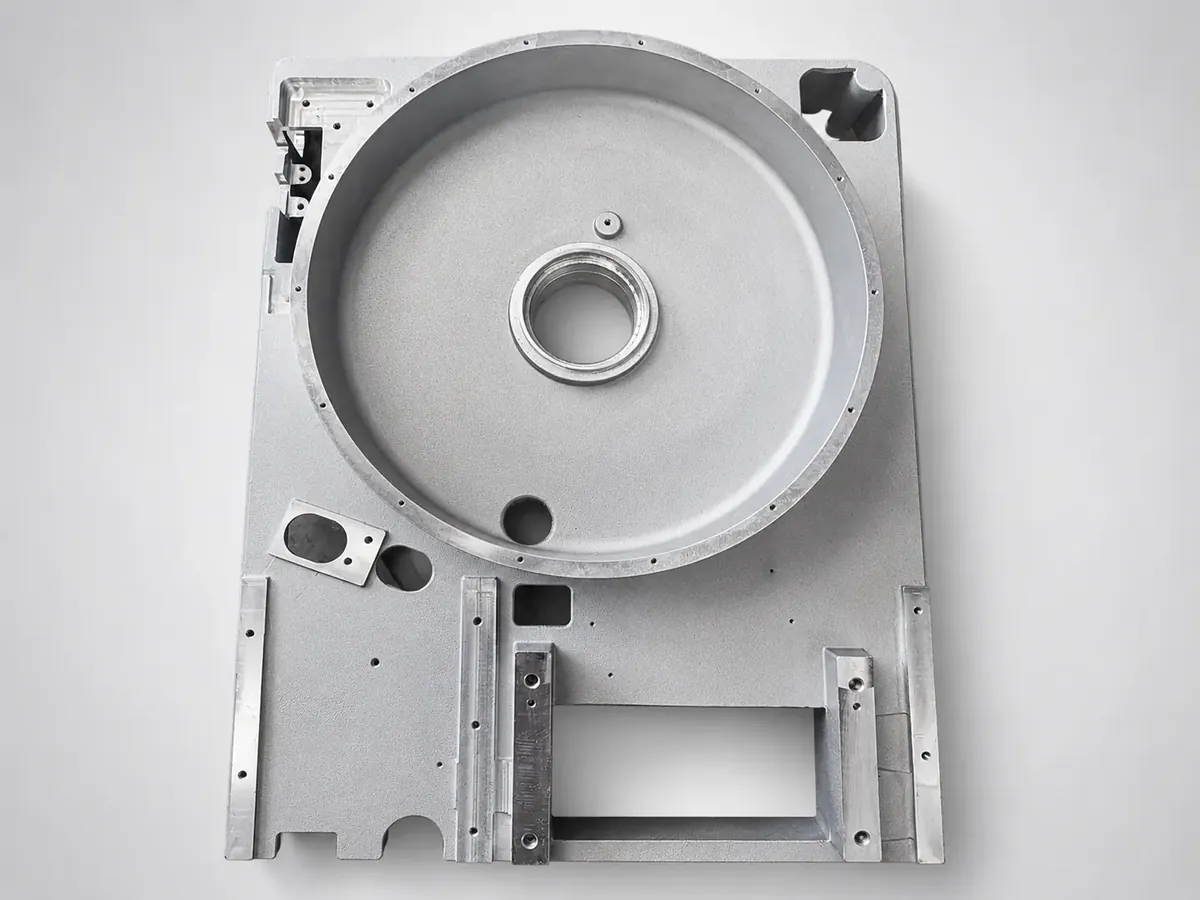
Selecting an Aluminium Casting Process by Batch Size and Wall Thickness
Four aluminium casting routes with very different cycle times, tolerances and tooling costs. The published figures make the choice straightforward once batch size is known.
Aluminium casting quotations vary wildly between suppliers, and the reason is usually that each supplier has quoted the process they happen to own. Comparing the published process figures side by side makes the correct route obvious.
The Four Routes and Their Numbers
High pressure die casting: 15-60 seconds per part, minimum wall 0.8 mm, tolerance CT4-CT6, roughness Ra 3.2-6.3 μm, batch 1,000-100,000 pieces.
Gravity die casting: 5-15 minutes per part, minimum wall 3 mm, tolerance CT7-CT8, roughness Ra 6.3-12.5 μm, batch 500-20,000 pieces.
Low pressure metal die casting: 3-8 minutes per part, minimum wall 2.5 mm, tolerance CT7-CT8, roughness Ra 6.3-12.5 μm, batch 100-10,000 pieces.
Sand casting and low pressure sand: 2-48 hours per part, minimum wall 3-6 mm, tolerance CT10-CT11, roughness Ra 12.5-25 μm, batch 1-1,000 pieces.
Read the Batch Column First
The batch ranges do most of the selection work. An order of 300 pieces sits in the low pressure or gravity range; an order of 50,000 sits in high pressure; an order of 20 sits in sand.
Choosing a process outside its batch range is what produces those quotations where the tooling costs more than the parts.
Then Check the Minimum Wall
If the design has a 1 mm wall, only high pressure die casting can fill it, and that in turn fixes the batch size that makes economic sense.
If the design has a 5 mm wall and a low quantity, sand casting is adequate and no tooling investment is needed.
Do Not Forget What Happens After Casting
Secondary operations are frequently where the real cost sits: machining and forming, welding, extrusion, forging and CNC machining, followed by painting, coating or anodising.
Inspection should be specified at the same time. X-ray screens internal defects and shrinkage risk, pressure testing covers housings and sealing critical products, CMM covers critical dimensions, spectrum analysis confirms composition and film thickness testing confirms the coating.
Process Families Covered In This Guide
Continue Reading
Casting or Forging How to Choose for a Load Bearing Part
The decision between a casting and a forging is usually made on shape complexity and load type rather than on price. This guide sets out the practical criteria.
Material GuideChoosing Heat Resistant Alloys for Grate Bars and Furnace Castings
Grate bars are consumables, so the alloy decides the operating budget. This guide explains the grades Eurona works with and how the working condition narrows the choice.
Buying GuideWhat NDT and Quality Documents to Specify on a Casting Order
Most acceptance disputes come from an inspection scope that was never agreed. This guide covers what to specify and when to specify it.
Product GuideHow to Specify a Screw Pump Rotor That Lasts
Rotor life depends on hardness, helical profile and arc surface finish. Each is measurable, and each is routinely left off the enquiry.
Buying GuideA Four Stage Process for Sourcing Machinery Parts From China
The stages an overseas parts order actually passes through, and the decisions that belong in each one.
Questions On This Topic
Which route gives the best pressure tightness?
Low pressure metal die casting is normally proposed where sealing performance and strength requirements are higher. Pressure testing is used to verify housings and sealing critical products.
Which aluminium grades are available?
ADC12, A380, EN AC-42100 (A356), EN AC-43000 (AlSi10Mg), EN AC-46000 and EN AC-46100, in F, T4 or T6 condition.
Apply This To Your Own Part
Send the drawing and the duty. The drawing review will confirm the process route, the material and the inspection scope before anything is quoted.