
What NDT and Quality Documents to Specify on a Casting Order
Most acceptance disputes come from an inspection scope that was never agreed. This guide covers what to specify and when to specify it.
Inspection arguments almost never start at inspection. They start at the quotation, when the scope was described as to be inspected according to standard and nobody asked which standard, which zones or which acceptance class.
Agree the Scope Before the Mould Is Made
The quality route runs from supplier management through raw material inspection and production process control to final inspection and delivery documents, under a system based on ISO 9001.
The point of agreeing the scope early is that inspection class changes the casting method. A zone requiring a high NDT class needs different feeding and different risers, which is a design decision, not a final check.
Which Methods Cover What
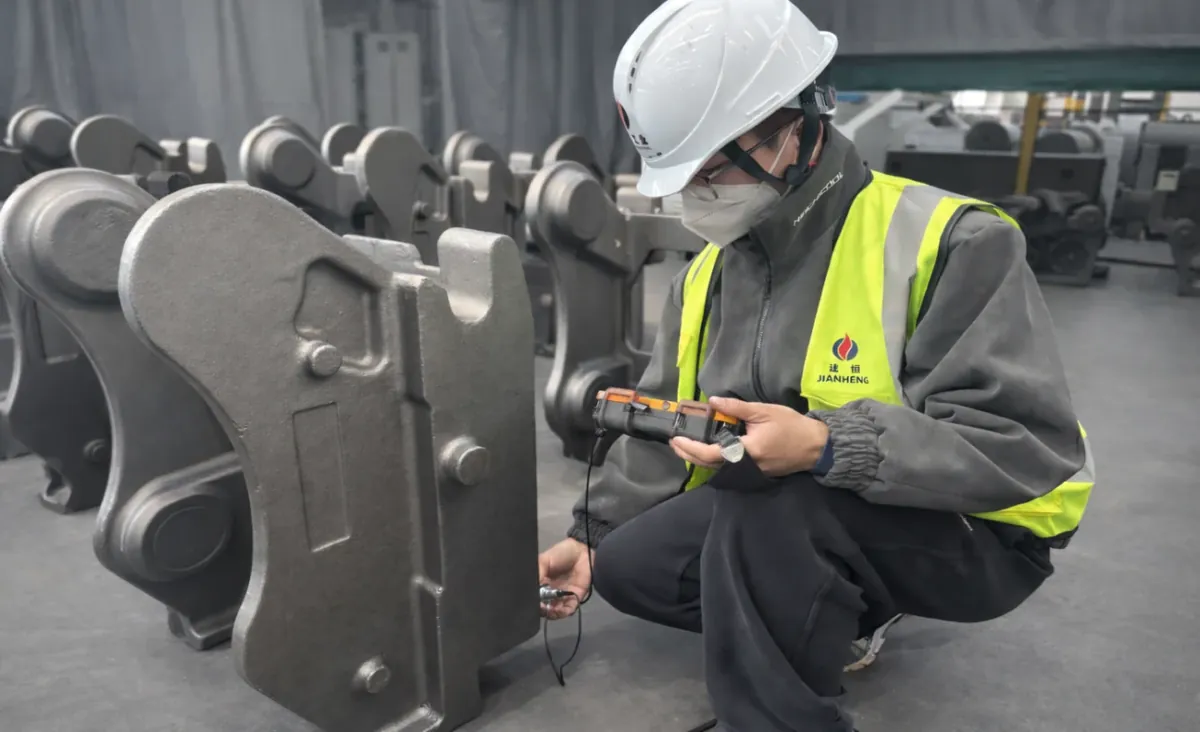
UT — ultrasonic testing for internal soundness in heavy sections. The method of choice for large steel castings and forgings.
MT — magnetic particle testing for surface and near surface indications on ferromagnetic materials.
PT — penetrant testing for surface breaking indications, including on stainless and non magnetic grades.
RT — radiographic testing, used with forged parts and where an internal image is required.
For high alloy parts the inspection list also covers dimensions, flatness, assembly clearance, 3D scanning, hardness, chemical composition and tensile testing.
Say Where and How Much
An NDT requirement without a zone map means either the whole part is inspected to the highest class, which is expensive, or the supplier interprets it, which is unpredictable.
Mark the load carrying zones and assign a class to each. This single drawing note removes most acceptance risk at very little cost.
Documents That Travel With the Goods
Single part certificates and traceable quality documents are supported for steel castings and forgings. Inspection results are archived so they remain traceable and auditable after delivery.
For precision forging the production base can support IATF 16949:2016 and ISO 9001:2015. If a system certificate is a requirement on your side, confirm it at the sourcing stage rather than at the audit.
Process Families Covered In This Guide
Steel Castings and Forgings
Heavy load and high strength steel parts from 50 kg to 50 tonnes, covered by melting records, heat treatment, NDT and full quality documents.
RelatedPrecision Forging
Closed die forging on 300 T - 8000 T presses, rolled rings up to 9000 mm diameter and open die forging for large parts.
RelatedHigh Alloy Parts
Stainless and heat resistant components for food machinery, incineration grate bars, screw pump rotors and biomass furnaces.
Continue Reading
Casting or Forging How to Choose for a Load Bearing Part
The decision between a casting and a forging is usually made on shape complexity and load type rather than on price. This guide sets out the practical criteria.
Material GuideChoosing Heat Resistant Alloys for Grate Bars and Furnace Castings
Grate bars are consumables, so the alloy decides the operating budget. This guide explains the grades Eurona works with and how the working condition narrows the choice.
Process GuideSelecting an Aluminium Casting Process by Batch Size and Wall Thickness
Four aluminium casting routes with very different cycle times, tolerances and tooling costs. The published figures make the choice straightforward once batch size is known.
Product GuideHow to Specify a Screw Pump Rotor That Lasts
Rotor life depends on hardness, helical profile and arc surface finish. Each is measurable, and each is routinely left off the enquiry.
Buying GuideA Four Stage Process for Sourcing Machinery Parts From China
The stages an overseas parts order actually passes through, and the decisions that belong in each one.
Questions On This Topic
Which NDT methods are available?
UT, MT and PT are available across the business, and UT, MT, PT and RT for precision forging parts.
Are inspection records kept after delivery?
Yes. Inspection results are archived and remain traceable and auditable.
Apply This To Your Own Part
Send the drawing and the duty. The drawing review will confirm the process route, the material and the inspection scope before anything is quoted.