The men's hair replacement market is one of the most discreet but consistently growing segments in personal care. Salons, hair-loss clinics, and online specialty retailers serve a customer base that needs reliable supply of hair systems — toupees, hairpieces, mens lace front systems — at consistent quality, reasonable price, and short replacement cycles. The supply base for these products is concentrated in specialty Chinese manufacturers, with Qingdao and Xuchang being the two main production clusters. HairNotion is a Qingdao-based specialist focused on men's hair systems with stock-and-customize capability — base type, hair density, length, color, and hairline pattern can all be selected from catalogue or fully customized.
This guide explains how to specify a men's hair system for wholesale supply, what each base material does, the realistic price points across quality tiers, and the documentation salons need for client confidence and re-order velocity.
Product range — actual catalogue images
The product images below are hosted on the manufacturer's official website (hairnotion.com) and link directly to the manufacturer's catalogue. Click any image to view the full specification page in a new tab.
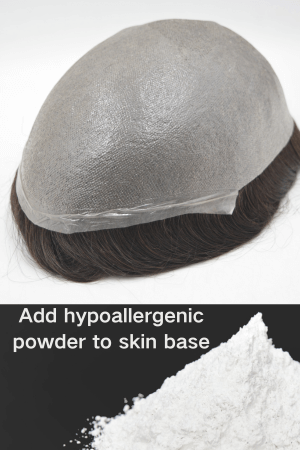
Ultra-thin skin hair system for men — hypoallergenic poly base with knotted hair.
View on supplier site →
Stock men's hair system — French lace base, pre-cut, ready-ship from inventory.
View on supplier site →

Hair system base types — choosing the right material
The "base" is the foundation material that holds the hair and attaches to the wearer's scalp. Base type determines comfort, durability, appearance, and price. The five common base types:
| Base type | Construction | Service life | FOB China unit | Best for |
|---|---|---|---|---|
| Skin (poly) — ultra-thin | 0.03-0.06mm polyurethane film, V-looped hair | 1-2 months | USD 28-55 | Most natural appearance; entry market |
| Skin (poly) — standard | 0.08-0.12mm polyurethane, knotted or V-looped | 3-5 months | USD 35-65 | Daily wear, balanced cost & life |
| French lace — invisible knot | Soft French lace, single-knotted hair | 2-4 months | USD 45-85 | Most realistic frontal hairline |
| Mono top with PU perimeter | Monofilament center + polyurethane edge | 4-7 months | USD 55-110 | Durability + scalp visibility |
| Full lace | French or Swiss lace throughout | 1-3 months | USD 60-120 | Premium retail, breathable in heat |
| Combo (lace front + skin back) | Lace at hairline, skin or mono at crown | 3-5 months | USD 50-95 | Best of both — most popular wholesale spec |
Hair specifications that matter
The hair on the system is as important as the base. Key specifications:
| Specification | Options | Wholesale impact |
|---|---|---|
| Hair source | Indian Remy, Chinese Remy, European, Synthetic | European hair: 4-8× cost. Chinese Remy: best value for daily wear. |
| Hair texture | Straight, body wave, slight wave, curly | Slight wave most popular for men (natural look) |
| Hair density | Light (80%), Medium (100%), Medium-Heavy (120%), Heavy (130-140%) | Medium-Heavy is the wholesale sweet spot |
| Hair length | 4", 6", 8", 10", 12" available | 6"-8" covers 80% of men's market |
| Color match | 30+ stock colors + custom mix; bleach knots option | Black, dark brown, salt-and-pepper most-ordered |
| Hairline style | Freestyle, A-shape, M-shape, widow's peak | Freestyle is most flexible for end-customer |
| Cap construction | Stretch elastic, freestyle, or measured-to-customer | Stretch elastic for stock; custom for premium |
Stock-and-ship vs custom-order economics
Most Chinese hair-system manufacturers operate on a hybrid model: a stock catalogue of common specs (typical: 15-30 SKUs in 8-12 colors) ships within 24-72 hours; custom orders are made-to-spec with 25-40 day lead time.
| Order type | MOQ | Discount tier | Lead time | Best for |
|---|---|---|---|---|
| Single retail order | 1 pc | List price | 1-3 days | End customer / small salon |
| Wholesale stock pack | 10-30 pcs mixed | 15-25% off | 3-7 days | Salon chain, online retailer |
| Custom-spec wholesale | 20-50 pcs same spec | 25-35% off | 25-40 days | Branded reseller, specialty clinic |
| Private label container | 200-500 pcs | 40-55% off | 40-60 days | Brand wholesaler, distributor |
Pricing brackets — what you should pay
| Quality tier | Hair grade | Base type | FOB China per unit | Typical retail markup |
|---|---|---|---|---|
| Premium | European hair, double-drawn | Lace front + mono crown, hand-tied | USD 180-350 | 3-5× → USD 600-1,500 |
| High-mid | Indian Remy, single-drawn | Combo lace + skin | USD 75-140 | 3-4× → USD 250-500 |
| Standard wholesale | Chinese Remy | Skin or French lace | USD 35-75 | 3-5× → USD 120-350 |
| Budget | Non-Remy hair, processed | Skin (thin poly) | USD 18-40 | 2.5-4× → USD 60-150 |
Hypoallergenic and skin-sensitivity considerations
Why hypoallergenic-grade matters for wholesale
Hair systems contact the scalp daily, often with adhesive. Skin sensitivity issues (contact dermatitis, irritation) are the #1 reason for end-customer dissatisfaction and product returns. Premium-tier manufacturers add hypoallergenic powder layer to skin-base products to neutralize potential contact reactions. For wholesale buyers, specifying "hypoallergenic-treated" material adds USD 2-5 per unit to FOB cost but reduces field returns by 30-50%.
Other anti-irritation features:
- Bleached knots — chemical bleaching of knot pigment to make tied hair invisible at scalp
- Pre-treated hair — silicone-coated hair to reduce tangling and shedding
- PU edge — polyurethane perimeter for adhesive contact (less skin contact than full poly)
- Breathable lace — Swiss lace allows scalp ventilation, reducing sweat-related irritation
Packaging and presentation
Packaging directly affects salon-customer experience and is a meaningful differentiator at wholesale level:
- Standard wholesale — clear poly bag with paper insert showing spec card
- Branded wholesale — printed cardboard sleeve with brand logo, spec card, and care instructions
- Premium retail packaging — magnetic-close presentation box, internal foam holder, branded care kit (small bottle of cleansing solution + soft brush)
- Private label retail — fully customized box, logo, label, instruction insert in customer language
FOB cost addition for branded packaging is typically USD 2-4 per unit; for premium presentation box, USD 5-12 per unit. For most wholesale buyers, branded sleeve packaging is the sweet spot — adds enough perceived value to support 20%+ retail markup increase without significant cost.
Order workflow — wholesale procurement
- Initial inquiry — provide target spec mix (base type, density, length, color) and target order quantity
- Catalogue review + sample order — supplier sends digital catalogue + 2-5 stock-spec samples by air courier (USD 30-80 per sample for Chinese Remy)
- Sample evaluation — fit test on actual customer or salon model, color match check, hair shedding check after first wash
- First wholesale order — 30-50 pcs mixed across 4-8 SKUs, typically air freight or LCL sea freight depending on quantity
- Series replenishment — establish weekly or bi-weekly replenishment based on actual sell-through; most successful retailers maintain rolling stock of 4-6 weeks of demand