weisourcing.com / products / Autocraft / Garage Equipment & Lifts

Garage Equipment & Vehicle Lifts from China — A Wholesale Buyer's Guide

A practical sourcing guide for garage equipment and vehicle lifts from China — written for auto service equipment distributors, dealership service department procurement, tire-center chains, mechanical workshop owners, fleet service operators, and automotive service equipment franchise operations. Real product images from autocraftek.com covering two-post vehicle lifts (asymmetric and symmetric, clear-floor designs, electric-lock variants, 3.5-5.5 ton capacity), four-post lifts (storage and service, 4-7 ton capacity), scissor lifts (in-ground and surface, including wheel alignment configurations), mid-rise lifts, heavy-duty truck lifts (15-50 ton), motorcycle and marine lifts, tire changing machinery (motorcycle through agricultural, 56" capacity), wheel balancers (manual through premium computerized), 3D camera wheel alignment systems, CCD alignment, alignment turntables and turn plates, brake and suspension testers, vehicle diagnostic equipment, emissions testers, and complete workshop packages. Lift selection by vehicle type, space requirements, certifications (ALI Gold Label, ANSI/ALI ALCTV, BS EN 1493, ISO 11062), and the procurement workflow for workshop equipment.

Manufacturer: Autocraft (autocraftek.com)
Category: Auto Parts & Aftermarket
Reading time: 15 min

Garage equipment, vehicle lifts, tire-changing machinery, wheel balancers, and automotive service infrastructure represent a multi-billion-dollar global B2B equipment category. Demand drivers include: (1) new auto service center openings driven by global vehicle population growth; (2) replacement cycles in existing workshops (typical lift service life 15-25 years); (3) tire center expansion driven by SUV/light truck growth; (4) dealership service department upgrades; (5) commercial fleet service operations expansion. China is the dominant global producer of garage equipment with comprehensive coverage from economy through premium tiers, supplying every major Western auto service equipment brand through both private-label and OEM arrangements.

This guide covers the Autocraft product family — two-post lifts (clear-floor and asymmetric, single and dual-side locks, 3.5-5.5 ton capacity), four-post lifts (4-7 ton capacity for storage and service), scissor lifts (in-ground and surface, including wheel alignment configurations), mid-rise lifts, motorcycle lifts, tire changing machines (motorcycle, car, truck, agricultural), wheel balancers (manual and computerized), wheel alignment systems (3D camera-based), diagnostic equipment, and complete workshop packages. Real product images linking back to the supplier's catalog at autocraftek.com.

Product range — actual catalogue images

The product images below are hosted on the manufacturer's official website (autocraftek.com) and link directly to the manufacturer's catalogue. Click any image to view the full specification page in a new tab.
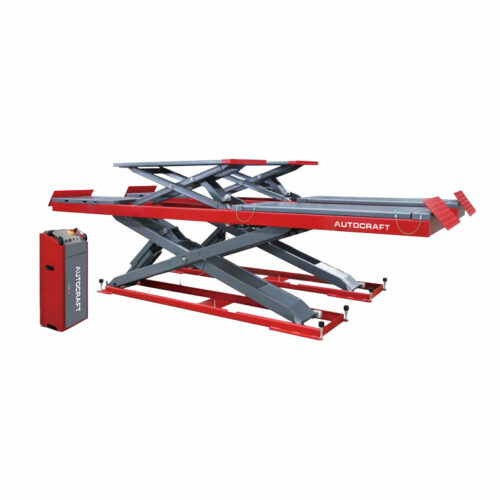
AUTOCRAFT ASL50 in-ground scissor lift — wheel alignment lift with 5-ton capacity for premium auto service centers.

AUTOCRAFT ASL50 in-ground scissor lift — wheel alignment lift with 5-ton capacity for premium auto service centers.

View on supplier site →
AUTOCRAFT AFL40 four-post lift — 4-ton capacity vehicle storage and inspection lift with safety lock system.

AUTOCRAFT AFL40 four-post lift — 4-ton capacity vehicle storage and inspection lift with safety lock system.

View on supplier site →
AUTOCRAFT ATL40CS two-post lift — clear-floor design with single-side electric lock for unobstructed work area.

AUTOCRAFT ATL40CS two-post lift — clear-floor design with single-side electric lock for unobstructed work area.

View on supplier site →

Vehicle lift categories

Lift typeCapacityCommon applicationsFOB China typical price
Two-post asymmetric (clear floor)3,500-5,500 kgGeneral auto service, ride-on accessUSD 1,800-4,500
Two-post symmetric (overhead beam)3,500-5,500 kgHeavy-duty service, structural ceilingUSD 1,500-3,800
Two-post clear-floor electric-lock4,000-5,500 kgPremium auto service, unobstructed workspaceUSD 2,500-5,500
Four-post storage lift4,000-7,000 kgVehicle storage, light service, dealershipUSD 3,500-8,500
Four-post service lift (heavy-duty)4,500-7,500 kgCommercial vehicle, truck serviceUSD 4,800-15,000
Mid-rise scissor lift2,500-4,500 kgTire changes, brake service, light maintenanceUSD 2,500-5,500
Full-rise scissor (surface)3,500-5,500 kgStandard service in low-ceiling shopsUSD 3,500-8,500
Full-rise scissor (in-ground)3,500-5,500 kgPremium service, wheel alignmentUSD 5,500-15,000
Wheel alignment lift (4-post)5,500-7,000 kgAlignment shops; specialized 4-post with rotating turntablesUSD 6,500-18,000
Heavy-duty truck lift (4-post or column)15,000-50,000 kgTruck service, bus service, heavy commercialUSD 18,000-95,000
Motorcycle lift500-1,500 kgMotorcycle service shopsUSD 380-1,800
Boat / pontoon lift2,000-5,500 kgMarine service centersUSD 2,500-9,500

Tire equipment overview

Equipment typeTypical specificationsFOB China typical price
Motorcycle tire changerManual or semi-automatic; 8"-21" rimUSD 280-850
Standard car tire changer (semi-auto)10"-22" rim; tubeless and tube; manual leverUSD 580-1,800
Premium car tire changer (full-auto)10"-26" rim; leverless head; touchless operationUSD 2,500-6,500
Heavy-duty truck tire changer14"-26" rim, large bus/truckUSD 2,800-9,500
Agricultural tire changerUp to 56" rim; agricultural and earthmoverUSD 4,500-22,000
Manual wheel balancer (static)Basic balancing for small wheelsUSD 180-450
Computerized wheel balancer (LED)10"-24" rim; manual data inputUSD 420-1,200
Premium computerized balancer10"-26" rim; auto data measurement; sonar/laserUSD 1,800-5,500
Heavy-duty truck wheel balancer14"-26" rim; bus and truckUSD 1,500-4,500
Tire inflation cabinetSafety cage for high-pressure tire inflationUSD 380-1,200

Wheel alignment & diagnostic equipment

EquipmentTechnologyApplicationFOB China typical price
3D camera alignment systemCamera-based; mounts on aligners; PC-controlledPremium alignment shops; faster setup vs traditionalUSD 8,500-28,000
Traditional CCD alignmentWheel-mounted sensors; cabinet-mounted target boardStandard alignment shops; cost-effectiveUSD 3,500-12,000
Wheel alignment turn plates (mechanical)Manual setup; accommodate caster/camber adjustmentWheel alignment work; basic shopsUSD 380-1,200 per pair
Alignment turntables (mechanical)Reduce friction during alignment; precise turningPremium alignment shopsUSD 850-2,800 per pair
Brake tester (roller dyno)Vehicle drives onto rollers; measures brake force per wheelBrake testing, inspection centersUSD 4,500-22,000
Suspension testerVibrates wheel and measures dampingSuspension diagnosisUSD 3,500-15,000
Vehicle diagnostic scan toolOBD-II reader; can read manufacturer codesRepair workshops; ECU programmingUSD 380-3,500
Emissions tester (4-gas)Measures HC, CO, CO2, O2Emissions testing centersUSD 2,800-9,500
Wheel toe & camber gaugeMechanical gauges; portableQuick checks, light serviceUSD 380-1,200

Complete workshop packages

Workshop typeEquipment listFOB China typical price
Basic 2-bay quick service2 × two-post lifts + tire changer + balancer + air compressor + basic toolsUSD 12,000-22,000
Mid-size service center (4-bay)4 lifts + tire equipment + alignment + basic diagnostic + toolsUSD 35,000-65,000
Premium service centerMultiple lifts + 3D alignment + diagnostic suite + brake/suspension testerUSD 75,000-180,000
Truck/commercial workshopHeavy-duty lifts + truck tire equipment + truck alignment + diagnosticUSD 50,000-150,000
Tire-only specialty shop2-3 mid-rise lifts + multiple tire changers + balancers + storageUSD 25,000-55,000
Dealership service department10-20 lifts + alignment + diagnostic suite + specialty toolsUSD 150,000-500,000

Vehicle lift safety is critical — verify certifications

Vehicle lifts are life-safety equipment. Lift failure can cause fatal accidents. Verification standards: (1) ALI (Automotive Lift Institute) Gold Label certification — voluntary US certification; premium installations require; (2) ANSI/ALI ALCTV — American National Standard for vehicle lift safety; (3) BS EN 1493 — European standard for vehicle lifts; (4) ISO 11062 — international vehicle lift standard. Certification matters because: (1) Insurance and liability — installations using non-certified lifts may not be insurable; (2) Safety record — certified lifts go through rigorous testing including overload, fatigue, and failure-mode analysis; (3) Worker protection — OSHA (US), HSE (UK), equivalent regulations require certified lifts in commercial workshops.

PROCUREMENT VERIFICATION: (1) Request specific certification certificates with lab name and certificate number; (2) Verify certifications haven't lapsed (annual surveillance audits required); (3) Check structural design documentation; (4) Verify load testing per ANSI/ALI ALCTV at minimum 1.25x rated capacity. Reputable suppliers like Autocraft maintain current certifications and provide complete documentation for installation. Buying uncertified lifts to save 20-30% creates massive long-term liability that destroys business viability.

Pricing brackets — wholesale

Order tierEquipment quantityDiscountContainer utilizationLead time
Single workshop setup1-5 major pieces of equipmentList price20' or 40' partial25-45 days
Multi-workshop / chain10-30 lifts + tire equipment5-12%1-2 × 40' containers40-65 days
Regional distributor50-200 lifts annually + equipment12-22%Multiple 40HQ containers50-90 days
National distributor / brand reseller500+ lifts annually20-30% frameworkRegular containers, predictable schedule60-120 days
Private label / OEMCustom volume per SKUCustom OEM pricingCustom branding/packaging60-120 days first batch

Order workflow — workshop equipment procurement

  1. Workshop assessment — define workshop type, expected service throughput, available space (length, width, ceiling height); equipment must fit physical constraints
  2. Equipment specification — match capacity to expected work (typical car service: 3.5-4 ton lifts; commercial service: 5.5+ ton; truck service: 15+ ton)
  3. Certification verification — verify ALI Gold Label (US), CE + BS EN 1493 (EU), or local equivalent certifications for lifts
  4. Sample order — for premium installations, single sample lift first to verify build quality, paint finish, mechanical operation; typical 30-45 days delivery for sample
  5. Site preparation — concrete pad specifications (typical 6"+ thick reinforced for two-post lifts; deeper for four-post and in-ground); electrical service (220V/3-phase typical); hydraulic considerations
  6. Production order — typical 30% deposit to start production, 65% before shipment, 5% after commissioning
  7. Pre-shipment inspection — third-party inspection or buyer site visit; verify equipment matches specification; verify packaging adequate for shipping
  8. Installation and commissioning — supplier installation supervisor recommended for first installation; typical 7-21 days on-site for full workshop setup
  9. Operator training — workshop staff training on safe lift operation, daily inspection, maintenance procedures
  10. Ongoing maintenance — quarterly/annual inspection per manufacturer recommendation; replacement parts inventory; supplier technical support relationship

Autocraft on weisourcing.com

View the full supplier profile, certifications, contact details, and complete product catalogue.

Manufacturer · Auto Parts & Aftermarket

Autocraft

autocraftek.com

Autocraft (China) — manufacturer of garage equipment and automotive service infrastructure. Vehicle lifts: two-post lifts asymmetric and symmetric (3.5-5.5 ton capacity, clear-floor and overhead-beam, single and dual-side electric locks), four-post lifts (4-7 ton storage and service), surface scissor lifts (mid-rise 2.5-4.5 ton, full-rise 3.5-5.5 ton), in-ground scissor lifts for wheel alignment, premium 4-post alignment lifts with rotating turntables (5.5-7 ton), heavy-duty truck lifts (15-50 ton capacity), motorcycle lifts (500-1,500 kg), marine boat lifts. Tire equipment: motorcycle tire changers, standard car tire changers (semi-auto manual lever, premium full-auto leverless touchless), heavy-duty truck tire changers, agricultural tire changers (up to 56" rim), tire inflation cabinets. Wheel balancers: manual static, computerized LED, premium with sonar/laser auto-measurement, heavy-duty truck balancers. Wheel alignment: 3D camera systems with PC software, traditional CCD systems, alignment turn plates and turntables. Diagnostic equipment: brake testers (roller dyno), suspension testers, vehicle scan tools, emissions testers (4-gas HC/CO/CO2/O2). Material: steel construction with welded structural elements, hydraulic systems with Yuken/Vickers hydraulic components, automotive-grade paint finish. Certifications: ALI Gold Label (US), ANSI/ALI ALCTV, BS EN 1493 (EU), ISO 11062, CE marking, FCC. Documentation packages for major export markets included.

View full profile →

Frequently asked questions

What's the difference between symmetric and asymmetric two-post lifts?
Two different two-post lift configurations with different application strengths. SYMMETRIC TWO-POST LIFT — posts are positioned with arms equally distributed; vehicle weight evenly distributed between posts. Properties: (1) BALANCED LIFTING — vehicle weight evenly distributed; (2) DOOR ACCESS limited (driver door may be hard to open with vehicle on lift); (3) GENERALLY HEAVIER DUTY — designed for trucks and larger vehicles; (4) LOWER COST per ton capacity. Best for: commercial vehicle service, trucks, large vehicles where door access matters less. Cost: USD 1,500-3,800. ASYMMETRIC TWO-POST LIFT — posts angled 30 degrees toward back of vehicle; arms slightly longer at back. Properties: (1) BETTER DOOR ACCESS — driver can open door without hitting post; technician access from sides; (2) SLIGHTLY LESS BALANCED — but acceptable for car-sized vehicles; (3) STANDARD CAPACITY 3.5-4 tons. Best for: general auto service, daily driver vehicles, dealership service departments where door access matters. Cost: USD 1,800-4,500. CLEAR-FLOOR DESIGNS — both can be designed without floor crossbeam (overhead cable/equalizing tube instead) for unobstructed work area. Premium electric-lock versions add USD 600-1,200 over standard. SELECTION RULE: (1) General auto service / car-dominant → asymmetric; (2) Commercial vehicles / trucks → symmetric; (3) Premium service center → asymmetric clear-floor electric-lock; (4) Tire-focused operation → consider mid-rise scissor instead.
How do I size a vehicle lift for my workshop?
Lift sizing depends on vehicle types serviced, available space, and workshop type. CAPACITY REQUIREMENTS: (1) ECONOMY CARS — 3,500 kg minimum (typical car weight 1,500-2,000 kg, but standard practice 1.75x safety factor); (2) STANDARD CARS / SMALL SUVs — 4,000-4,500 kg recommended; (3) LARGE SUVs / PICKUPS — 5,500 kg recommended; (4) COMMERCIAL VANS / LIGHT TRUCKS — 5,500-7,500 kg; (5) MEDIUM TRUCKS — 15,000-25,000 kg; (6) HEAVY TRUCKS / BUSES — 30,000-50,000 kg. SPACE REQUIREMENTS: (1) TWO-POST LIFT — minimum 4m × 6m floor space; 5.5m ceiling height; (2) FOUR-POST LIFT — minimum 5m × 7m floor space; 4.5m ceiling height (less than 2-post due to lower lift height); (3) IN-GROUND SCISSOR — minimum 3m × 5m floor space; ceiling height not critical (lift goes down rather than up); (4) ALIGNMENT 4-POST — minimum 5m × 8m floor space; needs precise level concrete. CONCRETE FOUNDATION: (1) Standard two-post: 6" reinforced concrete minimum, typically 8" for premium; (2) Four-post: 6" concrete; (3) In-ground scissor: 12-18" deep concrete pit required (significant construction project); (4) Always verify with manufacturer specifications. ELECTRICAL: typical 220V single-phase or 380V/415V three-phase; 3-5 HP motor; 16-32 amp circuit. OPERATIONAL CONSIDERATIONS: (1) Throughput — for high-volume service, asymmetric clear-floor lifts speed work; (2) Floor utilization — four-post lifts have larger footprint but can store vehicles; (3) Worker safety — adequate clearance for tools, parts, worker movement. Reputable suppliers like Autocraft can provide application-specific recommendations.
What's involved in setting up a tire-and-alignment workshop from scratch?
Tire-and-alignment workshop setup is a structured project with predictable phases. EQUIPMENT LIST FOR BASIC TIRE-AND-ALIGNMENT: (1) 2-3 vehicle lifts (mid-rise scissor or two-post); (2) Premium car tire changer; (3) Computerized wheel balancer; (4) 3D camera alignment system OR CCD alignment (depending on premium tier); (5) Alignment turntables; (6) Tire inflation cabinet; (7) Air compressor (5 HP minimum); (8) Tire storage racks (200-500 tire capacity); (9) Hand tools, sockets, torque wrenches; (10) Diagnostic scan tool (optional). TYPICAL COST: USD 35,000-85,000 from Chinese supplier; USD 75,000-180,000 from Western brands. SPACE REQUIREMENTS: minimum 200 m² for basic tire/alignment shop; 300-500 m² for premium installation including waiting area and tire storage. PERMITTING: (1) Local business license; (2) Environmental permits (waste oil, tire disposal); (3) Building permits if construction needed; (4) Worker safety inspections. SETUP TIMELINE: (1) Site selection and lease: 2-4 weeks; (2) Equipment ordering and shipping: 6-12 weeks; (3) Site preparation: 4-8 weeks (concrete work, electrical, plumbing); (4) Equipment installation: 2-4 weeks; (5) Operator training: 1-2 weeks; (6) Soft opening and ramp-up: 4-12 weeks. ECONOMIC ANALYSIS: typical tire/alignment shop in suburban location can process 8-15 vehicles per day at USD 50-200 average ticket; gross revenue USD 400-3,000 per day; gross margin 40-60% (parts + labor); requires steady customer flow to be profitable. SUPPLIER SUPPORT: (1) Installation supervision (typical 7-14 days included with equipment order); (2) Operator training (1 week typical); (3) Parts and warranty support; (4) Long-term technical support relationship. Reputable suppliers like Autocraft can provide complete workshop packages with installation support.
What's the typical service life and maintenance schedule for garage equipment?
Component lifespans vary by equipment type. VEHICLE LIFTS: typical 15-25 year service life with proper maintenance; primary failure modes: (1) HYDRAULIC SEAL FAILURE — replace seal kit at 8-15 years; (2) CABLE/CHAIN WEAR — inspect annually, replace at 20-30% wear; (3) BEARING WEAR in moving joints — replace at signs of wear; (4) STRUCTURAL FATIGUE — inspect welds for cracks; lifts with significant overload risk premature failure. TIRE CHANGERS: typical 10-15 year service life; failure modes include: (1) Bead breaker hydraulic seal failure; (2) Turntable bearing wear; (3) Drive motor brushes/bearings; (4) Pneumatic valve failures. WHEEL BALANCERS: typical 10-20 year life; primary failures: (1) Sensor calibration drift (re-calibrate annually); (2) Drive motor bearings; (3) Display electronics aging; (4) Software obsolescence (calibration cards, computer compatibility). ALIGNMENT SYSTEMS: typical 5-10 years before significant upgrade needed; failure modes: (1) Camera/sensor degradation; (2) Software obsolescence; (3) Computer hardware aging (Windows version compatibility). MAINTENANCE SCHEDULE: (1) DAILY — visual inspection, function checks before each use; (2) WEEKLY — clean equipment, check fluid levels (hydraulic, etc.); (3) MONTHLY — lubricate moving parts, check pneumatic system, inspect cables/chains; (4) QUARTERLY — comprehensive operational inspection; (5) ANNUALLY — full service including hydraulic fluid replacement, seal inspection, electrical inspection, calibration verification; (6) AT 5-YEAR MARK — major service event including hydraulic seal kit replacement on lifts; (7) AT 10-15 YEAR MARK — major component replacement consideration. PREVENTIVE MAINTENANCE COST: typical 3-7% of equipment value per year for well-run shop. CRITICAL SAFETY INSPECTIONS: (1) Annual third-party inspection for lifts required in many jurisdictions; (2) ALI Gold Label maintenance required for certification retention; (3) Document all inspections and repairs.
How do I source equipment for a dealership service department?
Dealership service department procurement is sophisticated and typically requires multi-supplier strategy. EQUIPMENT NEEDS: (1) 8-15 vehicle lifts per service department; (2) Multiple tire equipment positions; (3) Premium alignment system (typically 3D); (4) Brake tester, diagnostic equipment, emissions tester; (5) Specialty equipment per vehicle brand (programming tools, special service tools); (6) Lift bays often number 1.5x maximum daily throughput. BRAND CONSIDERATIONS: (1) Many auto manufacturers specify specific equipment brands or types for warranty compliance (e.g., specific lift brand for safety, specific diagnostic tool for warranty repairs); (2) Premium auto dealers (Mercedes, BMW, Audi, Lexus) often require premium European or Japanese equipment for brand consistency; (3) Mass-market dealers (Toyota, Honda, Hyundai) more flexible on equipment brand. SOURCING STRATEGY: (1) Primary equipment (lifts, tire equipment) from premium tier — often Chinese supplier via private label or direct Western brand; (2) Specialty equipment (brand-specific tools) from official OEM channels; (3) Consumables (filters, oil, parts) from multiple suppliers with rotation. CONTRACT STRUCTURE: (1) Typical 5-10 year equipment service relationship; (2) Service and maintenance included in some packages; (3) Trade-in / upgrade options at 5-10 year mark; (4) Training included for equipment-specific operation. PROCUREMENT TIMELINE: (1) Equipment specification and bidding: 8-16 weeks; (2) Order placement to delivery: 12-20 weeks; (3) Installation: 8-16 weeks (typical for full service department); (4) Operator training and ramp-up: 4-8 weeks. CAPITAL REQUIREMENTS: typical mid-size dealer service department investment USD 250,000-800,000 in equipment alone; premium brand dealers USD 500,000-2,000,000+. ROI CONSIDERATION: properly-equipped service department generates 30-40% of dealer revenue and 50-60% of dealer profit; equipment investment pays back through service efficiency and labor productivity. Reputable Chinese suppliers like Autocraft compete for dealer business through equipment quality, certifications, and competitive pricing.
What's the global market for Chinese-made garage equipment, and what brands compete?
Major Western brands and Chinese alternatives compete in different market segments. TIER-1 WESTERN BRANDS: (1) ROTARY LIFT (USA) — premium US brand, dominates premium independent service; (2) BENDPAK / RANGER PRODUCTS (USA-China) — premium independent and dealer; (3) HUNTER ENGINEERING (USA) — dominant in alignment; premium pricing; (4) HOFMANN (Italy) — premium European, dealer-focused; (5) BUTLER ENGINEERING (Italy) — premium Italian; (6) RAVAGLIOLI (Italy) — premium Italian, automotive focus; (7) JOHN BEAN (USA) — alignment specialist; (8) NEXION GROUP (Italy) — owns several premium brands. TIER-2 BRANDS: (1) ATLAS (USA-China assembly) — mid-tier; (2) CHALLENGER (USA) — mid-tier; (3) WHEELTRONIC — mid-tier; (4) MEUMAC and others — regional mid-tier players. CHINESE MANUFACTURERS competing in Western markets: (1) AUTOCRAFT — direct Chinese brand offering full product range; (2) PEAK / BIDU / various Chinese factories supplying private-label and OEM to Tier-2 Western brands; (3) Many Western "American" or "Italian" brands actually manufacture in China through OEM arrangements with quality similar to Chinese direct brands. PROCUREMENT VALUE: (1) Direct Chinese sourcing typically saves 40-60% vs Tier-1 Western brand retail; (2) Quality of premium Chinese suppliers comparable to mainstream Western brands; (3) Premium Tier-1 (Rotary, Hunter) retain advantage in dealership relationships, warranty enforcement, and brand prestige. PROCUREMENT STRATEGY: (1) Dealership service requiring brand prestige → Tier-1 Western; (2) Independent service shop value-driven → premium Chinese direct or private label; (3) New shop on tight budget → mid-tier Chinese direct; (4) Equipment for specific regulatory market → verify supplier has relevant certifications.
⚠ Important Disclaimer

Source: Product images on this page are hosted on the manufacturer's official website (autocraftek.com) and link directly back to that website. All product information was summarised from the supplier's public catalogue.

Brand mentions and trademark compliance: References to Tier-1 garage equipment brands (Rotary Lift, BendPak, Ranger Products, Hunter Engineering, Hofmann, Butler Engineering, Ravaglioli, John Bean, Nexion Group, Atlas) are made for the sole purpose of describing functional benchmarks. Autocraft is not authorized by, affiliated with, or endorsed by any of these brand owners. Products are aftermarket-fit cross-reference manufactured under Autocraft's own brand or buyer-private-label only.

Safety-critical equipment: Vehicle lifts are life-safety equipment. Lift failure can cause fatal accidents to workers under vehicles. Verify ALI Gold Label (US), BS EN 1493 (EU), or equivalent certifications before commercial installation. Use certified installers and follow all manufacturer installation procedures.

Installation requirements: Vehicle lifts require specific concrete foundation specifications (typically 6"+ reinforced concrete for two-post lifts; deeper for four-post and in-ground). Site preparation must precede equipment installation. Improper foundation can cause catastrophic lift failure.

Worker safety: OSHA (USA), HSE (UK), and equivalent international regulations require certified vehicle lifts in commercial workshops. Verify equipment compliance with destination market regulations before commercial sale.

Pricing & specifications: All price ranges and tier definitions reflect general market observation. Garage equipment pricing varies with raw material costs (steel) and shipping. Confirm current pricing, MOQ, lead time, and certification scope directly with the supplier.

No middleman role: Weisourcing provides supplier discovery and editorial content. All transactions occur directly between buyer and supplier through the contact channels published on the supplier's official website.