weisourcing.com / products / MIC Valve / Industrial Valves

Industrial Valves from China — Gate, Globe, Ball, Butterfly & Check Wholesale Buyer's Guide

A practical sourcing guide for industrial valves from China — written for water-utility wholesalers, HVAC contractors, fire-protection equipment dealers, plumbing distributors, and industrial MRO suppliers. Real product images from micvalve.com covering gate valves (rising and non-rising stem, resilient-seated drinking water), globe valves, ball valves (2-piece and 3-piece), butterfly valves (concentric, eccentric / double-offset, triple-offset), check valves (wafer dual-plate, swing, ball-type), knife-gate, air-release / vacuum, foot, and accessories. Body material selection (ductile iron, WCB carbon steel, 304/316 stainless, bronze, lead-free brass, duplex), end-connection types (flanged EN/ASME, wafer, threaded, welded), pressure-rating selection for water utility, drinking-water certifications (NSF 61, WRAS, KIWA, ACS), and the procurement workflow that establishes valve distribution profitably.

Manufacturer: MIC Valve (micvalve.com)
Category: Valves, Hoses & Fluid Control
Reading time: 14 min

Industrial valves are an essential category in any fluid-handling system — water utility, HVAC, fire-protection, oil-and-gas, chemical processing, food-and-beverage, mining, marine, and general industrial. The category divides into roughly six functional families — gate, globe, ball, butterfly, check, and specialty (knife, plug, diaphragm, pinch). Each family has multiple sub-types, body materials, end-connection options, and certification levels. For water-utility wholesalers, HVAC contractors, fire-protection equipment dealers, plumbing distributors, and industrial MRO suppliers, sourcing valves directly from a Chinese specialist factory delivers significant cost savings vs European/Japanese branded equivalents at comparable performance for typical applications.

This guide covers the MIC Valve product family — gate valves, globe valves, ball valves, butterfly valves (centric and eccentric), check valves (wafer, swing, ball-type), specialty valves (knife-gate, air-release, foot), and accessories (actuators, gear-boxes, position indicators). Real product images linking back to the supplier's catalog at micvalve.com.

Product range — actual catalogue images

The product images below are hosted on the manufacturer's official website (micvalve.com) and link directly to the manufacturer's catalogue. Click any image to view the full specification page in a new tab.
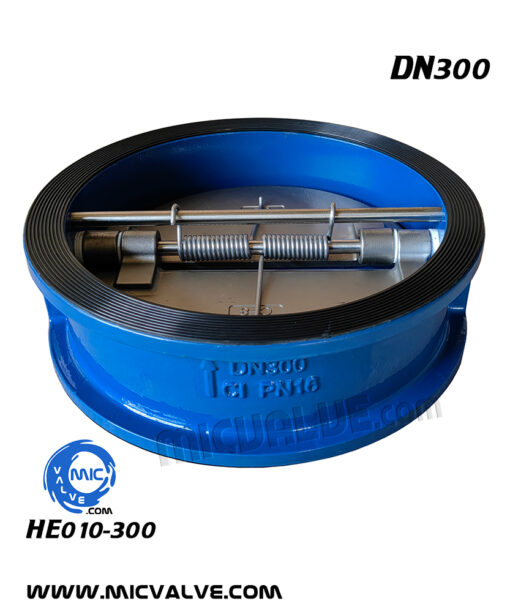
HE010-300 dual-plate wafer check valve — DN300 PN16 ductile-iron body for water utilities and HVAC.

HE010-300 dual-plate wafer check valve — DN300 PN16 ductile-iron body for water utilities and HVAC.

View on supplier site →
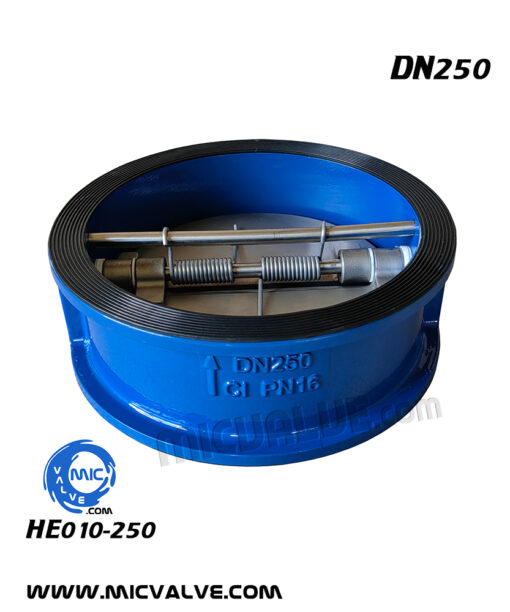
HE010-250 wafer check valve — DN250 mid-size variant of the dual-plate check valve family.

HE010-250 wafer check valve — DN250 mid-size variant of the dual-plate check valve family.

View on supplier site →
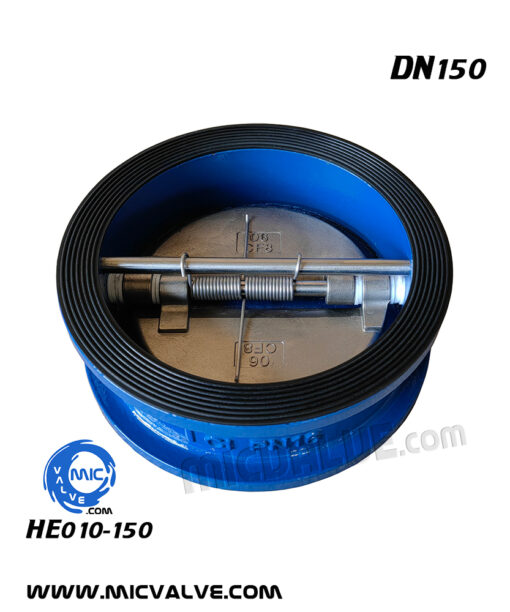
HE010-150 wafer check valve — DN150 standard size for typical industrial water-distribution systems.

HE010-150 wafer check valve — DN150 standard size for typical industrial water-distribution systems.

View on supplier site →

Valve family overview

Valve typeFunctionCommon sizesFOB China typical price (DN100 PN16 ductile iron)
Gate valve (rising stem)Full-bore on/off shutoff for water/oilDN50-DN1200 (2″-48″)USD 65-280 per valve (DN100)
Gate valve (non-rising stem)Compact on/off for buried/underground installationDN50-DN800USD 65-260 per valve (DN100)
Resilient-seated gate valve (RSGV)Water utility shutoff (drinking water)DN50-DN600USD 75-340 per valve (DN100)
Globe valveThrottling and flow controlDN15-DN500USD 95-380 per valve (DN100)
Ball valve (2-piece, full-port)Quarter-turn on/off; high flowDN15-DN300USD 35-180 per valve (DN100)
Ball valve (3-piece)Maintainable ball valve for chemical/processDN15-DN200USD 65-260 per valve (DN100)
Butterfly valve (concentric / centric)Quarter-turn on/off + light throttlingDN50-DN1600USD 55-220 per valve (DN100)
Butterfly valve (eccentric / triple-offset)Tight-shutoff + high-pressure throttlingDN100-DN1200USD 380-1,800 per valve (DN300)
Wafer dual-plate check valveCompact non-return for pumping systemsDN50-DN1200USD 35-180 per valve (DN100)
Swing check valveNon-return for low-velocity systemsDN50-DN600USD 55-260 per valve (DN100)
Ball-type check valveNon-return for sewage / dirty waterDN50-DN300USD 65-220 per valve (DN100)
Knife-gate valveSlurry / fibrous-media on/offDN50-DN600USD 95-380 per valve (DN100)
Air-release / vacuum valveAir management in pipelinesDN15-DN300USD 28-180 per valve
Foot valve (with strainer)Pump-suction protection (prime retention)DN25-DN300USD 35-180 per valve (DN100)

Body materials and applications

Body materialMarkingPressure / temperatureBest applications
Ductile iron (cast)GGG-50 / 65-45-12 / EN-GJS-500Up to PN25; -20 to +120°CWater utility (drinking water), HVAC, fire-protection
Cast iron (gray)GG-25 / GJL-250 / Class 25Up to PN16; +5 to +120°CGeneral water service, freshwater applications
WCB carbon steel (cast)WCB / A216 Gr WCBUp to PN100; -29 to +425°COil-and-gas general service, steam, heated systems
WCC carbon steel (cast)WCC / A216 Gr WCCHigher-temperature carbonRefinery, petrochemical (limited)
Stainless 304 (CF8)CF8 / A351 Gr CF8Up to PN40; -196 to +400°CFood-grade, mild chemical, low-chloride
Stainless 316 (CF8M)CF8M / A351 Gr CF8MUp to PN40; -196 to +400°CMarine, chloride exposure, chemical processing
BronzeB62 / B584PN16; up to +200°CMarine, seawater, premium plumbing
Brass (lead-free)CW617N / NSF 61PN10-PN16; up to +120°CDrinking water (NSF 61 / EN 12164), residential plumbing
Aluminum-bronzeC95400 / C95800PN16-PN25Seawater, desalination, marine
Duplex stainless (CD4MCu, A890)A890 Gr 1B / Gr 4A / Gr 5AUp to PN40; corrosive environmentsSeawater, brackish water, sour gas

End-connection types

End connectionStandard referenceCommon inSizing
Flanged (raised face / RF)EN 1092-1 / DIN 2501 (PN6/PN10/PN16/PN25/PN40)European water/HVAC/industrialDN15-DN3000
Flanged (raised face / RF)ASME B16.5 (Class 150 / 300 / 600 / 900 / 1500 / 2500)USA, Asia oil-gas, international industrial0.5″-24″ in B16.5; larger in B16.47
Wafer (clamped between flanges)API 594 / EN 12266Compact butterfly and check valvesDN40-DN1600
Lugged (with threaded inserts)API 594Butterfly valves with end-of-line capabilityDN40-DN600
Threaded (BSP / NPT)ISO 7-1 (BSP) / ANSI B1.20.1 (NPT)Smaller valves, residential plumbingDN8-DN50 typical
Welded (butt-weld / socket-weld)ASME B16.25 / B16.11Oil-gas, refinery, high-pressure pipingDN15-DN1200
Push-fit / compressionVarious proprietary standardsPlumbing, HVAC retrofitDN15-DN50
Grooved-end (Victaulic-style)AWWA C606 / FM 1924Fire-protection, mechanical contractorsDN50-DN300

Critical certifications by market

CertificationApplies toMarkets where critical
NSF 61 / NSF 372Drinking-water valves (lead-content limits)USA + much of international export
WRAS / KIWA / ACSDrinking-water approval (UK / Netherlands / France)EU drinking-water utilities
EN 1074-2Drinking-water valve performanceEU water utilities
FM Approved / UL ListedFire-protection valves (US/international)Fire-protection systems worldwide
API 6DPipeline valves (oil-and-gas)Oil-and-gas pipelines worldwide
API 600 / API 602 / API 603Steel valves (gate, flanged, etc.)Oil-and-gas + petrochemical
API 609Butterfly valvesOil-and-gas + petrochemical
ASME B16.34Steel valves (general pressure rating)USA + international industrial
ATEX / IECExHazardous-area valves (electric actuators)EU + international Ex-rated environments
3-A Sanitary StandardsFood-and-dairy valvesUSA dairy industry

Drinking-water valve compliance is non-negotiable

Drinking-water valves must comply with the destination market's drinking-water material approval scheme. USA: NSF 61 (material safety) + NSF 372 (lead content under 0.25%); UK: WRAS approval; Germany / Northern Europe: KTW + DVGW W270; Netherlands: KIWA; France: ACS. These approvals require specific brass alloys (lead-free brass like CW625N or CW724R), specific coatings (epoxy meeting NSF 61), and process controls. Suppliers selling "lead-free brass" without specific drinking-water approval certificates are often using close-to-compliant alloys without the testing and audit overhead.

Selling unapproved valves into drinking-water systems creates major liability: contamination of drinking water by leaching lead is a serious public-health concern. For drinking-water market, specify explicit approval and verify current certificates with audit-renewal dates. Reputable suppliers like MIC Valve maintain current NSF 61 / WRAS / KIWA certifications for relevant product families.

Pricing brackets — wholesale

Order tierTotal quantityDiscountContainer utilizationLead time
Small distributor / contractor20-200 valves totalList price; air freight or LCLLCL20-35 days
Mid distributor500-2,500 valves total5-15%20' container25-45 days
National distributor3,000-15,000 valves15-25%40' container35-60 days
OEM project / large utility5,000+ valves on project basis22-32%Multiple 40HQ containers45-90 days

Order workflow — industrial valve distribution

  1. Application analysis — separate by application family (drinking water / fire protection / oil-gas / chemical / general industrial); each has distinct certification, material, and price-band requirements
  2. Specification clarification — for each SKU define: valve type, body material, end connection (flanged / wafer / threaded / welded), pressure class, end-connection standard (EN / ASME), nominal size, special requirements (drinking-water approval, fire-listed, etc.)
  3. Certification verification — request current certificates with audit dates: NSF 61 for drinking water, FM/UL for fire protection, API 6D / 600 / 609 for oil-gas, etc. Verify with certification bodies if needed
  4. Sample order — 1-3 valves of each candidate SKU; verify dimensional accuracy with calipers, function test on bench (open/close cycles, leak test), check material certificate
  5. Field installation trial — install on representative sites for 60-180 days; document any failures, leakage, or operating-issue patterns
  6. First container order — typically 800-3,000 valves mixed across 30-80 SKUs based on local application demand
  7. Series replenishment — quarterly orders aligned with construction and maintenance cycle; typical industrial valves have 6-12 month inventory turn

MIC Valve on weisourcing.com

View the full supplier profile, certifications, contact details, and complete product catalogue.

Frequently asked questions

How does a Chinese aftermarket-fit valve compare to AVK / Pentair / Crane / Hattersley?
Premium-tier Chinese valve manufacturers like MIC Valve deliver valves at quality close to Tier-1 European/American brands (AVK Group / Pentair / Crane / Hattersley / KSB) at meaningfully lower prices. The performance parity is achievable because: (1) BODY CASTINGS — the same ductile-iron foundries supply both Tier-1 and Tier-2 manufacturers; quality differences are in casting QC, not source. (2) ELASTOMER SEATS — premium-tier manufacturers source from same elastomer suppliers (NBR, EPDM, FKM) as Tier-1. (3) STEM AND TRIM — stainless 304/316 stem material is standardized; quality difference is in dimensional tolerance. WHERE TIER-1 RETAINS ADVANTAGE: (1) Spec-driven projects requiring documented decades of field performance; (2) Premium engineering applications (oil-and-gas pipeline, refinery service, nuclear) where Tier-1 has accumulated approvals difficult to replicate; (3) High-pressure/high-temperature service (Class 1500+, severe-service applications). FOR MAINSTREAM APPLICATIONS (water utility, HVAC, fire protection, general industrial), premium aftermarket-fit Chinese valves at 30-45% of Tier-1 pricing deliver fully equivalent performance. Quality verification: insist on material test certificates per relevant standards (EN/ASME), pressure-test certificates per API 598 or EN 12266, hydrostatic test certificates for individual valves at certain price points. Reputable suppliers like MIC Valve provide complete documentation packages.
What's the difference between concentric and eccentric butterfly valves, and when do I use each?
Two distinct performance categories with different applications. CONCENTRIC (CENTRIC) BUTTERFLY VALVE — disc rotates on a centerline that intersects the disc face. Properties: simple construction, lower cost, rubber-lined seat (typically EPDM), good for on/off operation up to PN16/PN25, light throttling capability, 100% bubble-tight shutoff possible at low/medium pressure. Best for: water-utility shutoff, HVAC isolation, low-pressure industrial, retrofit replacing gate valves. Cost: USD 55-220 for DN100 ductile iron. ECCENTRIC (DOUBLE-OFFSET) BUTTERFLY VALVE — disc shaft is offset from disc centerline; reduces seat wear during opening/closing. Properties: better seat life than concentric, suitable for higher pressures (PN25-PN40), suitable for moderate throttling. Best for: industrial process applications, mid-pressure water/oil systems. TRIPLE-OFFSET BUTTERFLY VALVE (TOV) — disc shaft offset PLUS disc seat is at angle (not perpendicular to flow). Properties: metal-to-metal seat (no elastomer), zero leakage at high pressure (PN40 to Class 600+), suitable for high-temperature service (-200°C to +500°C+ depending on materials). Best for: severe-service oil-gas, refinery, power-plant steam isolation, cryogenic service. Cost: USD 1,200-4,800 for DN300 stainless. SELECTION RULES: water utility / general industrial / fire protection up to PN16 → concentric; mid-pressure industrial / chemical-process → eccentric (double-offset); severe-service / refinery / power / cryogenic → triple-offset. Don't over-specify — concentric butterfly handles 90% of typical industrial valve applications at fraction of TOV cost.
Are Chinese-sourced valves acceptable for drinking-water utility applications?
Yes, with appropriate certifications and quality verification — but the supplier must maintain current drinking-water approvals for the destination market. KEY APPROVALS BY MARKET: USA — NSF 61 (material safety) + NSF 372 (lead-free, <0.25% lead by weight); UK — WRAS approval (Water Regulations Advisory Scheme); Germany/Austria/Switzerland — KTW + DVGW W270 + UBA approval; Netherlands — KIWA approval; France — ACS (Attestation de Conformité Sanitaire); Australia — WaterMark + AS/NZS 4020. Each approval requires: (1) Specific lead-free brass alloys (CW625N, CW724R, CW602N, depending on market); (2) Specific coatings (epoxy meeting NSF 61 internal coating); (3) Migration testing (lead, copper, organics into water); (4) Manufacturing audit by approval body. PROCUREMENT WORKFLOW: (1) Verify supplier holds current approval certificate with future audit date; (2) Confirm specific valve product is on the approval scope (not just "the company is approved"); (3) Request migration test reports per relevant standard. COMMON RISK: suppliers offering "drinking water approved" without specifying which approval, or with expired certificates. Working with approved suppliers like MIC Valve who maintain current NSF 61 / WRAS / KIWA / ACS certifications protects against these issues. Failure to verify approvals creates major liability — contaminated drinking water from non-compliant valves has caused recalls, lawsuits, and public-health incidents.
What pressure rating should I specify for water utility distribution?
Water utility valve pressure ratings driven by system operating pressure plus surge / water-hammer allowance. TYPICAL DRINKING WATER DISTRIBUTION: system operating pressure 4-8 bar (60-115 psi) at street main; rural / hilly territory may have higher pressure (up to 15 bar = 220 psi at low-elevation points). Surge pressure during pump start/stop or rapid valve closure can spike to 1.5-2x normal operating pressure. SPECIFICATION RULE: select valve pressure rating at minimum 1.5x normal operating pressure with rounding up to next standard rating. EXAMPLES: (1) Street main at 4 bar normal → PN10 (10 bar) is minimum; PN16 is conservative; (2) Higher-elevation distribution at 8 bar normal → PN16 minimum; PN25 conservative; (3) Booster station / industrial-use at 12 bar → PN25 minimum. STANDARD RATINGS BY MARKET: EU / international — PN10, PN16, PN25, PN40; USA — Class 125, Class 150, Class 300, Class 600 (Class 150 ≈ PN16-25). PRACTICAL APPROACH for distributors: stock PN10/Class 125 for residential and rural service; PN16/Class 150 as the workhorse for urban water utility; PN25 for high-elevation / industrial-use; PN40+ for booster stations / specialty. For utility customers, follow their published specification — most utilities have standard-of-construction documents that mandate specific ratings.
What's the typical service life and how do I plan for utility valve replacement?
Highly material- and application-dependent. RESILIENT-SEATED GATE VALVE (RSGV) for drinking water with proper installation: 50-80 years typical service life; some installed in 1960s still functioning. Rubber seat may need replacement at 30-50 years. METAL-SEATED GATE VALVE: 30-50 years typical; sealing degrades faster than RSGV. BUTTERFLY VALVE (concentric, water service): 25-40 years typical; rubber seat is consumable and may need replacement at 15-25 years. CHECK VALVE (wafer dual-plate, water service): 25-40 years; spring is wear component. BALL VALVE (water service): 20-40 years; PTFE seats wear faster than rubber-lined gate/butterfly. KNIFE GATE (slurry / sewage): 5-15 years; abrasion accelerates wear significantly. UTILITY REPLACEMENT PLANNING: most water utilities operate on 50-year design life; actual replacement driven by failure rather than scheduled retirement. Replacement triggers: leakage at stem packing (often field-rebuildable), seat sealing failure (replacement required for buried installations), structural failure of body (rare). NEW-INSTALLATION DEMAND vs REPLACEMENT DEMAND: in mature water utility markets, replacement typically dominates new-install (60-80% of valve sales). Distributors should track utility replacement schedules and stock accordingly. For new-development markets, new-install dominates — different inventory profile favoring smaller pipe sizes and standard configurations.
How do I evaluate the quality of a check valve for pump-protection applications?
Check valves protect pumps from reverse flow and water-hammer; quality matters for system reliability. QUALITY DIMENSIONS for wafer dual-plate check valve (most common): (1) BODY CASTING — ductile iron GGG-50 / EN-GJS-500 with proper microstructure (ferritic-pearlitic); avoid gray-iron bodies for >PN10 service. (2) SEAT INTEGRITY — elastomer seat (EPDM for water, NBR for oil) properly bonded to body; lifetime ratings should specify temperature and chemical exposure. (3) DISC AND SPRING DESIGN — spring force calibrated for opening pressure (typically 0.05-0.3 bar); insufficient spring causes slow closure (allowing reverse flow); excessive spring causes high pressure drop. (4) AXIS AND PIN — stainless steel pin with proper running clearance; cheap brass pins corrode and seize. (5) PRESSURE TEST CERTIFICATE — hydrostatic test at 1.5x rated pressure should be standard documentation. KEY FIELD-FAILURE MODES TO AVOID: (1) WATER HAMMER on pump shutdown — rapid closure of check valve creates pressure spike; specify "non-slam" check valve with damped closure for high-velocity systems; (2) DEBRIS LODGING — water systems with sediment can lodge debris between disc and seat; specify wider passage for water with sediment risk; (3) SEAT WEAR FROM PARTIAL CLOSURE — disc cycling at low velocity causes premature seat wear; check valve should be sized for full-velocity operation, not throttling. SPECIFICATION RECOMMENDATIONS: for pump systems > 22 kW, specify non-slam check valves; for systems with potential water hammer, consider air vessels or surge arrestors in addition to non-slam check valves. Reputable suppliers like MIC Valve provide application-specific check valve guidance.
⚠ Important Disclaimer

Source: Product images on this page are hosted on the manufacturer's official website (micvalve.com) and link directly back to that website. All product information was summarised from the supplier's public catalogue.

Brand mentions and trademark compliance: References to Tier-1 valve manufacturer brands (AVK Group, Pentair, Crane, Hattersley, KSB, Velan, Cameron, Emerson, Rotork, Auma, Schiebel) are made for the sole purpose of describing functional benchmarks. MIC Valve is not authorized by, affiliated with, or endorsed by any of these brand owners. Products are aftermarket-fit cross-reference parts manufactured under MIC Valve's own brand or buyer-private-label only.

Drinking-water compliance responsibility: Valves used in drinking-water applications must meet destination-market drinking-water material approval (NSF 61 / WRAS / KIWA / ACS / KTW / WaterMark / AS-NZS 4020 etc.). Selling unapproved valves into drinking-water systems creates major public-health liability. Verify all required certifications are current with future audit dates and that specific product is in approval scope, not just supplier company.

Critical-service responsibility: For oil-and-gas, fire-protection, hazardous-area, and severe-service applications, valves must meet specific industry standards (API 6D / 600 / 609, FM Approved / UL Listed, ATEX / IECEx, ASME B16.34) with documented test certificates. Improperly specified valves in these applications can cause leakage, fire, environmental damage, or worker injury.

Pricing & specifications: All price ranges, service-life figures, and tier definitions reflect general market observation. Real-world valve service life depends significantly on water quality, cycling frequency, surge protection, and maintenance. Confirm current pricing, MOQ, lead time, certification status, and configuration directly with the supplier.

No middleman role: Weisourcing provides supplier discovery and editorial content. All transactions occur directly between buyer and supplier through the contact channels published on the supplier's official website.