📦 Real Buyer Inquiry · Pakistan · 2026-04
Industrial Rubber Insulating Mats from China: A Pakistani Substation Buyer's IEC 61111 Sourcing Brief
A Pakistani electrical contractor sent us a precise, engineering-led BOM — 5 rolls of synthetic rubber insulating mats, 1m × 10m × 9mm thickness, IEC 61111 Class 2 (15kV), color-coded black, green, and blue per substation specification, plus 5 rolls of ESD tape (18m × 3 inch). The shape of the BOM tells us the buyer is a substation-fitting contractor running multiple sites simultaneously. Here is what the supplier needs to deliver to win the order.
Pakistani electrical infrastructure is in active expansion. The country added more than 8,000 MW of new generation capacity in 2023-2025 and the corresponding distribution-network buildout has driven steady demand for substation safety equipment. Provincial utilities (LESCO, K-Electric, MEPCO, FESCO, IESCO, GEPCO) and private industrial substations all require IEC 61111-compliant insulating mats in front of medium-voltage switchgear and protection panels — and the buyer who sent us this BOM is running exactly that fitting-out work.
The specification asks for synthetic rubber mat in 9mm thickness, classified to IEC 61111 Class 2 (which covers 15kV working voltage), in three different colors corresponding to different substation voltage classes. The 5-roll quantity — 50 square meters total — covers approximately 4-6 typical control-room installations. This is not a one-off purchase; it's a contractor restocking site supplies.
The actual inquiry (redacted, verbatim)
Names of the buyer, the contracting company, and the engineer authorising specifications have been removed. Product specifications and quantities are preserved.
| Line | Product | Specification | Qty |
|---|
| 1 | Industrial Synthetic Rubber Insulating Mat | 1m W × 10m L × 9mm thick · IEC 61111 Class 2-15kV · color black/green/blue per engineer instruction | 5 rolls |
| 2 | ESD Tape | 18 meter × 3 inch | 5 pcs |
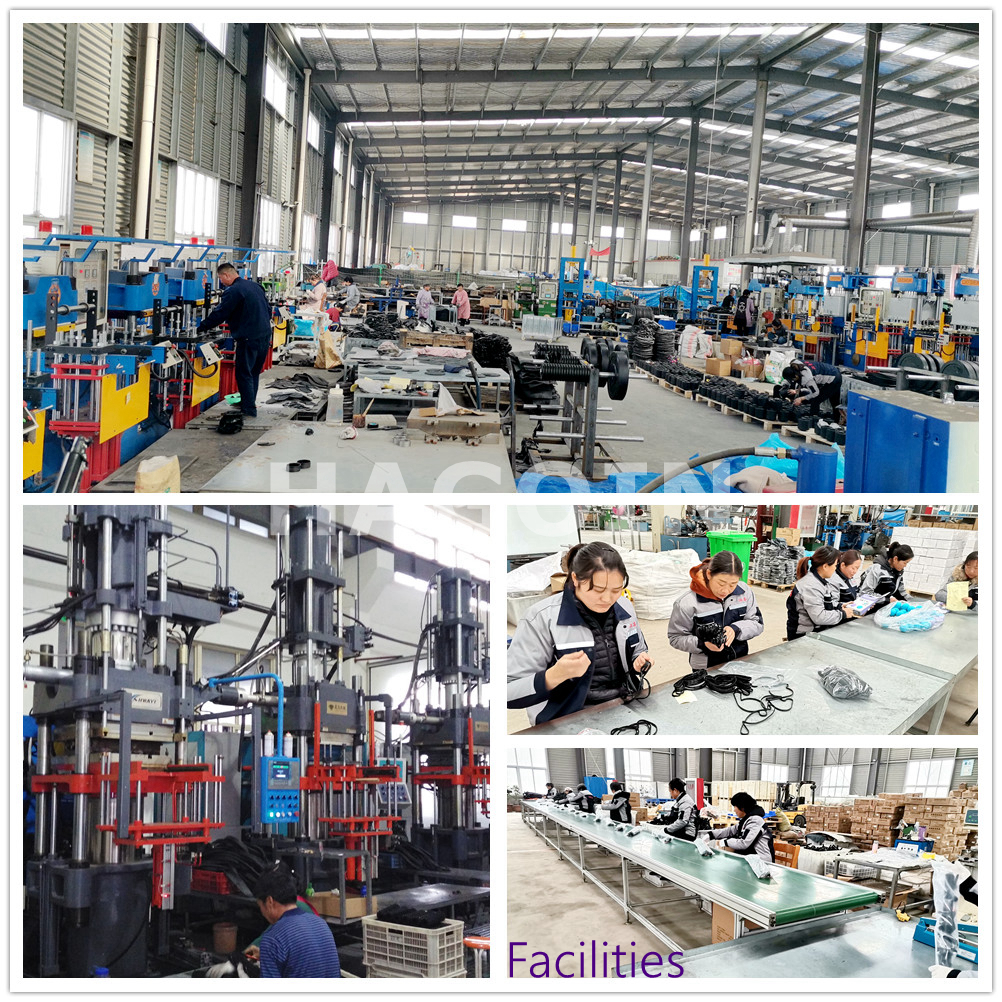
Hagoin rubber-product manufacturing facility — actual factory photos
"5 rolls of Industrial Type Synthetic Rubber mats, 1mW × 10mL × 9mm thickness, Class 2-15kV (IEC 61111), color black/green/blue as per engineer instruction, plus 5 pcs ESD Tape (18 Meter, 3 inch)."
— Buyer's complete BOM, Pakistan, April 2026
This is a contractor-grade specification. Three details signal it:
- "As per engineer instruction" — the BOM defers final color allocation to the project engineer at delivery, suggesting multi-site work where each substation gets a specific color based on its voltage class.
- 9mm thickness — substantially thicker than IEC 61111's minimum requirement, reflecting field experience that 3mm-5mm mats wear out mechanically before they fail electrically.
- Class 2-15kV — the buyer correctly understands the working voltage and proof voltage relationship, naming the standard's class designation rather than just specifying a thickness.
What IEC 61111 actually requires
IEC 61111:2009 is the international standard for electrical insulating matting used as floor covering in electrical installations. The standard specifies five classes of mat, each rated for a specific maximum working voltage:
| Class | Max working voltage (AC) | Proof voltage | Withstand voltage | Typical thickness |
|---|
| Class 0 | 1,000 V | 5,000 V | 10,000 V | 2.0-3.0 mm |
| Class 1 | 7,500 V | 10,000 V | 20,000 V | 2.5-3.5 mm |
| Class 2 | 17,000 V | 30,000 V | 50,000 V | 3.0-4.0 mm (standard) · 6-12 mm (heavy-duty) |
| Class 3 | 26,500 V | 40,000 V | 60,000 V | 3.5-5.0 mm |
| Class 4 | 36,000 V | 50,000 V | 70,000 V | 4.0-6.0 mm |
The standard also requires:
- Material — high-grade elastomer (typically EPDM, less commonly SBR or NR blend) with no fibrous reinforcement embedded.
- Surface — anti-slip ribbed pattern on top; smooth or textured backing.
- Marking — class designation, manufacturer name, and date code permanently molded or stamped into the mat.
- Production testing — every meter of mat must pass production-line dielectric testing at the proof voltage; the manufacturer must keep test records.
- Type testing — sample mats from each batch must pass independent laboratory testing covering dielectric strength, mechanical properties, ozone resistance, oil resistance, flame resistance, and ageing.
Why 9mm — the contractor's calculation
The IEC 61111 standard specifies a minimum thickness of approximately 3mm for Class 2 mats. The buyer is asking for 9mm — three times the minimum. This is not over-specification; it is engineering practice based on field-failure data:
| Thickness | Dielectric service life | Mechanical service life | Cost per m² |
|---|
| 3 mm | 10+ years (if undisturbed) | 1.5-2.5 years (with foot traffic) | USD 12-18 |
| 6 mm | 10+ years | 4-6 years | USD 22-30 |
| 9 mm | 10+ years | 8-12 years | USD 28-45 |
| 12 mm | 10+ years | 10-15 years | USD 38-60 |
For a substation with daily operator traffic, the 9mm specification represents the cost-optimal thickness — substantially longer service life than 3mm at less than 3× the cost, and lower lifetime cost than replacing thinner mats every 2 years.
Color coding — a Pakistani-Indian industry convention
IEC 61111 itself does not specify colors. The color coding is a regional safety-management practice common in the Indian subcontinent and parts of the Middle East:
| Color | Common application | Voltage class typically signalled |
|---|
| Black | General industrial work, control panels, distribution boards | LV / MV (≤ 11kV) |
| Green | Substation control rooms, switchyards | 11kV / 15kV |
| Blue | Transmission infrastructure, higher-voltage substations | 33kV+ |
| Red / Yellow | Temporary or emergency work areas | Variable |
| Grey | Office or low-risk areas | ≤ 1kV |
The buyer asking for "black, green, blue per engineer instruction" reflects multi-site work where each substation gets the locally-appropriate color. This is sophisticated procurement practice — they are signalling that the engineer in the field has decision authority on color allocation, and the supplier should be ready to ship a mixed-color order without further argument.
Verifying the supplier's IEC 61111 capability
Every Chinese rubber-mat manufacturer claims to make IEC 61111 mats. Most do — at least at the entry-level Class 0 / Class 1. Class 2 (the buyer's specification) is the inflection point where capability becomes scarcer:
The seven verification questions for IEC 61111 Class 2 supply
- Type-test certificate — can the supplier produce an IEC 61111:2009 type-test certificate from an ISO 17025-accredited laboratory? Ask for the lab name (TUV, KEMA, CSA, BV are recognised; unspecified Chinese labs are not). The certificate should be dated within the last 5 years.
- Production withstand test record — IEC 61111 requires every meter of finished mat to pass dielectric withstand testing at proof voltage. Ask for a sample test record from a recent production run.
- Material declaration — what elastomer base? EPDM is the gold standard for ageing and ozone resistance; SBR is acceptable; natural rubber (NR) blend is the budget tier with shorter ageing life.
- Thickness tolerance — what is the manufacturing tolerance on 9mm? Tight tolerance (±0.3 mm) signals a controlled process; loose tolerance (±1.0 mm) signals less consistent production.
- Color stability — for the colored variants (green and blue), is the colorant integral to the elastomer compound, or surface-coated? Surface-coated colors fade or rub off; integral colors hold for the life of the mat.
- Marking method — class designation should be permanently molded into the mat, not printed. Printed markings disappear after a few months of foot traffic, leaving a mat with unidentifiable rating.
- Roll consistency — for a 10m × 1m roll, is the mat cut from a single continuous extrusion, or spliced? Spliced rolls have a discontinuity that fails dielectric testing in service.
Pakistani import logistics
Pakistan is one of the more straightforward GCC-adjacent markets for Chinese industrial-rubber import. Standard documentation and a moderate duty rate make it a recurring destination for substation-equipment shipments.
| Logistics line | Approximate range | Notes |
|---|
| FOB Shanghai/Ningbo (5 rolls × 9mm × 10m × 1m + ESD tape) | USD 1,400-2,200 | 50 m² of mat + 90 m of ESD tape |
| Sea freight (LCL) to Karachi | USD 320-480 | Depending on rubber-density volume cubic meters |
| Insurance | USD 15-25 | 0.5% of CIF value |
| = CIF Karachi | USD 1,735-2,705 | |
| Customs duty (HS 4008.21 — vulcanised rubber, 5-15%) | USD 130-405 | Confirm exact rate with current FBR Pakistan tariff schedule |
| Sales tax (17% on duty-paid value) | USD 320-525 | Standard GST rate |
| Port handling + clearance | USD 120-180 | Karachi Port |
| Inland trucking (Karachi → site) | USD 80-250 | Depending on city |
| Approximate landed cost in distributor warehouse | USD 2,385-4,065 | Roughly 1.55-1.70× FOB |
The ESD tape line
The ESD tape (5 pieces × 18m × 3 inch) is a small line item — but worth noting because ESD tape and IEC 61111 mats are often confused as serving the same purpose. They don't:
- IEC 61111 mat — provides electrical insulation between the worker and ground (or between the worker and a conductor) at high voltages. Surface resistance is essentially infinite (10¹⁰-10¹³ Ω·m).
- ESD tape — provides controlled, intentional grounding to dissipate static charges in low-voltage / electronics work environments. Surface resistance is in the dissipative range (10⁶-10⁹ Ω·m).
The buyer using both on the same site is doing so correctly: IEC 61111 mat in front of medium-voltage switchgear, ESD tape on workbench surfaces in adjacent control / instrumentation rooms where electronic protection relays are calibrated. Two different physics; two different applications; one BOM.
Frequently asked questions
What does IEC 61111 Class 2 actually mean for an insulating mat?
IEC 61111 Class 2 specifies an electrical insulating rubber mat with a maximum working voltage of 17,000 V AC. The mat is type-tested at a proof voltage of 30,000 V AC and must withstand 50,000 V AC withstand-voltage testing. Class 2 mats are typically used in front of medium-voltage switchgear (11kV/13.8kV/15kV) where workers operate breakers, change CTs/PTs, or perform live-line work behind glass barriers. The standard also specifies thickness (typically 3.0 mm minimum for Class 2), elastomer material requirements (no inserted reinforcement), and surface texture (anti-slip ribbed top, smooth or textured bottom).
Why does the buyer specify 9mm thickness if the IEC 61111 minimum is much less?
9mm exceeds the IEC 61111 Class 2 minimum thickness (typically 3.0 mm) by approximately 3×, providing a substantial mechanical-durability margin. Substation floors are subject to physical wear (rolling toolboxes, dropped equipment, foot traffic from work boots) that thin mats cannot withstand for years of service. Pakistani electrical contractors specifying 9mm reflect lessons learned from prior installations: a thinner mat passes the dielectric test on day one but fails mechanically within 18-24 months, forcing premature replacement. The 9mm spec is engineering practice, not over-specification.
What is the typical price for IEC 61111 Class 2 insulating rubber mat from China?
At MOQ 5-20 rolls (each typically 1m × 10m), IEC 61111 Class 2 insulating mat in 9mm thickness wholesales at USD 28-45 per square meter FOB China. A single 1m × 10m × 9mm roll runs USD 280-450 FOB. Premium-tier suppliers using EPDM-base elastomer with full IEC 61111:2009 certification and individual roll test certificates run at the upper end (USD 38-45/m²); standard-tier suppliers using SBR or NR rubber blend and batch-test certificates run at the lower end (USD 28-35/m²). For substation work where each rolled mat protects expensive equipment and human life, the premium tier is typically the responsible choice.
What test certificates should accompany an IEC 61111 mat shipment?
For IEC 61111 compliance, each shipment should include: (1) the manufacturer's IEC 61111:2009 type-test certificate showing testing at the specified voltage class — for Class 2, this means 30 kV proof voltage; (2) a current-batch dielectric withstand test certificate (every meter of mat must pass production-line withstand testing per the standard); (3) material composition declaration (EPDM, SBR, or NBR base elastomer); (4) physical-property test report (tensile strength, elongation, hardness Shore A); (5) certificate of origin issued by China Council for the Promotion of International Trade (CCPIT). Some specifications also require third-party (CSA, KEMA, ASTA) certification — confirm with the buyer's electrical authority before specifying.
What does the color coding (black, green, blue) on insulating mats indicate?
Color coding on IEC 61111 mats is not specified by the standard itself — it is a regional convention used by electrical authorities and contractors to visually identify the voltage class of the mat at a glance. In Pakistan and the Indian subcontinent, common conventions are: black for general industrial use, green for low/medium voltage substation work (11kV/15kV), blue for higher-voltage transmission applications (33kV+). Some specifications also use red or yellow for emergency or temporary work mats. The buyer's request for 'black/green/blue as per engineer instruction' indicates the contractor is fitting out multiple substations and wants color-coded mats matching each facility's voltage class — a sensible practice for safety inventory management.
What is ESD tape used for in this BOM, and what specification matters?
ESD (electrostatic discharge) tape is used to electrically bond grounded surfaces in static-sensitive work environments — typically marking the boundary of an ESD-protected area or providing a continuous grounding path along workbench edges. The buyer's '18 meter, 3 inch' specification is a standard roll size; 3-inch (76mm) width covers most workbench edge applications. Key specifications: surface resistance (typically 10⁶-10⁹ Ω·m), adhesive strength (commercial-grade acrylic or rubber adhesive), and base material (vinyl or PVC). ESD tape is a commodity item with relatively narrow quality variation; verify the surface resistance falls within the IEC 61340-5-1 ESD protection zone specification (10⁶-10⁹ Ω) before specifying.
Closing thought
The Pakistani contractor sending us this BOM was not asking for a catalogue. They were asking, implicitly, which Chinese supplier on your network can deliver IEC 61111:2009 Class 2 mats in 9mm with valid type-test certificates, ship a mixed-color order without arguing about MOQ, and stand behind the dielectric performance when the substation engineer commissions the installation?
That's the question this article exists to answer — by walking through the BOM, the standard's actual requirements, the seven verification questions, and the contractor-grade thickness reasoning. If you're working on substation infrastructure and want to skip directly to a shortlist, the supplier card above is where to start.
⚠ Important Disclaimer
Source & redaction: The buyer inquiry summarised in this article was received through our sourcing channels and has been redacted to remove all personal, company, and counterparty information. Quantities, specifications, and inquiry timing are preserved.
Standards mentions: References to IEC 61111:2009, IEC 61340-5-1, ISO 17025, TUV, KEMA, CSA, BV, ASTA are made for the sole purpose of identifying the technical standards and accredited testing bodies relevant to substation safety mat sourcing. None of the suppliers featured on this page hold or claim to hold every certification mentioned. Buyers should verify each supplier's specific certifications and the validity period before specifying for any project.
Pricing and lead times: All price ranges, freight estimates, duty rates, and lead-time figures reflect general market observation and may not apply to specific suppliers, project specifications, or shipment conditions. Pakistan tariff and tax rates change with each fiscal-year budget; verify current rates with FBR Pakistan or a Karachi customs agent.
Supplier capability: Information about Hagoin Rubber and the cross-linked supplier profiles was summarised from publicly available content on each supplier's website. Hagoin's IEC 61111 production capability, current certification scope, and color-availability options should be confirmed directly with the supplier before specifying for safety-critical applications.
No middleman role: Weisourcing provides supplier discovery and editorial content. Buyers are encouraged to work with suppliers directly through the contact channels published on each supplier's official website.