The Brazilian HVAC service market runs on repair, not replacement. A residential split AC that costs BRL 2,500 new is rebuilt for BRL 200–400 in parts plus labor when the capacitor or contactor fails — and there are an estimated 40 million split-AC units in operation across Brazil today, with another 4–5 million sold each year. The country's HVAC distributors restock parts roughly every 60–90 days, and the typical reorder is exactly the BOM that landed in our inbox in late April.
This article walks through the inquiry, what each component does, the typical Chinese supplier landscape for each line, and the verification checklist a serious procurement team uses before issuing the PO.
The actual BOM (redacted, verbatim)
The buyer asked for the following parts, in commercial quantities. Names of the buyer's company and end-customer have been removed; everything else is exactly as written.
| Line | Component | Specification |
|---|---|---|
| 1 | Motor Capacitors | 1.0 µF to 5.0 µF range, single-run |
| 2 | Fan Motor Capacitors | 1.0 µF to 5.0 µF range, condenser fan duty |
| 3 | PCB Relays | 20A and 30A configurations |
| 4 | R410A Gas Adapter | For HVAC service / charging |
| 5 | Filter with Tube | Inline refrigerant filter, integrated tube |
| 6 | PCB Fuse | 3.5 A rating |
| 7 | Filter Driers | With and without tube variants |
| 8 | Schrader Valves | Refrigerant service ports |
| 9 | Access Fittings | R410A / refrigerant service access |
| 10 | Forged Nuts + Reducing Nuts | Brass / forged, refrigerant fitting hardware |
This is a refresh order, not an exploratory inquiry. The buyer knows what each line does and has bought it before. The supplier that wins is the one who can quote all ten lines in a single proforma invoice with line-item lead times — not three separate suppliers with three separate shipments.
What each line means in the field
Lines 1 + 2 — Run capacitors
These are the most replaced HVAC components in residential and light commercial systems. A run capacitor failure is the #1 service call in Brazil during peak summer (December–March), and the typical failure mode is capacitance drift — the rated 5 µF unit gradually drops to 3 µF as the dielectric ages, the motor draws more current to compensate, and eventually the compressor or fan motor itself fails.
The 1.0–5.0 µF range covered in this BOM is what most condenser fan motors and small ECM motors use. For larger split units (24,000 BTU and up), buyers also need 35+5 µF and 45+5 µF dual-run capacitors — but those weren't on this particular list.
Lines 3 + 6 — PCB relays and PCB fuse
The 20A and 30A PCB relays are the through-hole automotive-style relays that sit on the AC indoor unit's main control board, switching the compressor and fan circuits on the high-voltage side. Brazilian buyers favor relays from established manufacturers because a relay welding stuck closed will keep the compressor running indefinitely and cook it — the failure cost is the entire compressor, not just the relay. Hongfa, Omron-equivalent, and Songle are the names that appear on most Brazilian PCBs.
The 3.5 A PCB fuse is glass-tube or radial-leaded depending on the board design. It's a low-cost line but mismatching the fuse rating (5A instead of 3.5A) compromises board protection — buyers should confirm the lead spacing and rating before ordering bulk.
Lines 4 + 8 + 9 — R410A access fittings, Schrader valves, gas adapters
These are the refrigeration-specific service fittings. R410A is the dominant residential refrigerant in Brazil since the R22 phase-out, and the brass forged service fittings need to handle 4.2 MPa (610 psi) working pressure with a safety factor of 4×. These are not commodity components — sub-spec brass forging or undersized o-rings cause refrigerant leaks within months.
Lines 5 + 7 — Filter driers
The filter drier is the desiccant cartridge inline on the liquid side of the refrigeration loop, capturing moisture and contaminant during operation. Two common formats: without tube (just the cartridge body, brazed in by the technician) and with tube (factory-prepared with a length of capillary tube for direct installation in field repairs). Brazilian service shops use both — without-tube for new compressor swaps and with-tube for "in-and-out in 30 minutes" service calls.
Line 10 — Forged nuts + reducing nuts
The line-set hardware. Forged brass with chrome or nickel finish, sized to the SAE flare standards (1/4", 3/8", 1/2", 5/8" most common). Reducing nuts let a 3/8" service technician adapt to a 1/4" port. Cheap forgings crack at the seat and leak — the inspection criterion is the visible parting line and the absence of porosity in the hex faces.
The supplier landscape in China for this BOM
No single Chinese factory makes all ten lines. The procurement reality is one of three:
- One trader who consolidates from 5–6 factories — the buyer gets a single PI, a single shipment, and a 5–10% trader markup baked in. Lead time: 30–45 days. This is the dominant pattern for Brazilian distributors who order under 1×20'GP container quarterly.
- Two specialty manufacturers — one for electrical (capacitors, relays, contactors, fuses), one for refrigeration (filter driers, valves, fittings, nuts). Lower cost than option 1, more coordination overhead. Lead time: 35–55 days.
- Direct from each factory — typically 5–7 separate POs, separate L/Cs or T/Ts, separate inspections. Lowest cost (15–25% below option 1) but only worth it for orders above USD 80,000.
For a typical first-time Brazilian buyer with a USD 8,000–25,000 quarterly order, option 1 wins on total landed cost when freight consolidation and customs entry preparation are factored in.
What "consolidator" actually means in this segment
A real consolidator for HVAC parts isn't a 100-product trader on Alibaba — it's an electrical-automation manufacturer who has agency relationships with refrigeration valve houses and capacitor factories within a 200 km radius (Yueqing → Wenzhou → Ningbo cluster). The consolidator handles in-house QC inspection on adjacent factories' product before consolidating into the export shipment. This is why Yueqing-based electrical manufacturers, in particular, are well-positioned for HVAC parts BOMs — they sit at the geographic center of the Zhejiang electrical cluster.
Watch: how a CJX2 AC contactor wires into HVAC service work
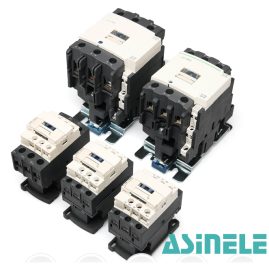
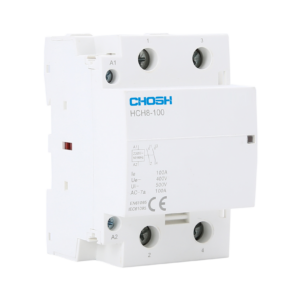
The contactor — line 11 in many service-restock BOMs but not this one — is the workhorse switching device for residential AC outdoor units. The CJX2 series (and its Schneider LC1-D cross-reference) is what most Chinese-made AC condensers use. Here's the wiring overview:
Quality verification — the five-step checklist
Before issuing the PO, a serious distributor goes through the following:
The 5-step verification before PO
- Certificate scans for each SKU. IEC 60947-4-1 for contactors, IEC 60384 for capacitors, RoHS for all components, CE for the assemblies. Real factories produce these on request within 48 hours.
- Batch traceability. Lot numbers and date codes physically printed on the components — not just on the carton. Lots without component-level traceability cannot be recalled if a quality issue surfaces.
- Capacitor life-test data. B10 and B40 service-hour ratings. A motor-run capacitor rated at 10,000 hours B10 means 10% of units fail by 10,000 hours of continuous operation — for tropical Brazilian climates with 16-hour daily run cycles, B10 below 10,000 hours is a service-call generator.
- Burst-pressure test for fittings. R410A working pressure 4.2 MPa, burst test should hit 16.8 MPa (4× safety factor). The supplier should email the test report on demand.
- 50–100 piece air-freight sample. Before the bulk container, the buyer pays USD 200–400 in air freight to receive a sample mix. Tests on Brazilian-installed units. Suppliers who refuse this step are flagging a quality concern.
Indicative price tiers (USD, FOB China)
These are typical 2026 ranges for the components in this BOM at MOQ 1,000–5,000 pieces per SKU. They are indicative only — actual quotes vary 15–25% by supplier, by raw-material price cycle, and by spec subtleties.
| Component | Spec | USD per piece (FOB) | Typical MOQ |
|---|---|---|---|
| CBB60 motor capacitor | 5 µF, 450 VAC | 0.30 – 0.55 | 1,000 |
| Fan motor capacitor | 3 µF, 450 VAC | 0.25 – 0.45 | 1,000 |
| PCB relay | 20A, 250 VAC | 0.50 – 1.20 | 500 |
| PCB relay | 30A, 250 VAC | 0.85 – 1.80 | 500 |
| PCB fuse | 3.5 A, glass | 0.05 – 0.12 | 5,000 |
| R410A access fitting | 1/4" SAE flare, brass | 0.45 – 0.95 | 1,000 |
| Schrader valve | R410A rated | 0.18 – 0.40 | 1,000 |
| Filter drier | Liquid line, 1/4", with tube | 1.20 – 2.80 | 500 |
| Filter drier | Liquid line, no tube, brazed | 0.85 – 2.10 | 500 |
| Forged brass nut | 1/4" SAE | 0.12 – 0.28 | 2,000 |
| Reducing nut | 3/8" to 1/4" | 0.20 – 0.45 | 2,000 |
For the full 10-line BOM at a typical 1,000-piece-per-SKU quantity, the FOB China cost runs USD 4,500–8,500. Add 30–35% for sea freight, Brazilian customs, and import taxes — landed cost typically falls in the USD 7,000–12,500 range per restock cycle.
The supplier we matched this inquiry with
From our network, the closest specialty match for the electrical portion of this BOM (capacitors, relays, contactors, fuses, sensors) is a Yueqing-based electric and automation manufacturer with a complete CJX1 + CJX2 contactor line, DC relays, manual changeover switches, and a five-family sensor portfolio. Profile and direct contact below.