weisourcing.com / products / CRA Machinery / Polishing Buffs & Buff Making

Polishing Buffs & Buff-Making Machinery from China — A B2B Wholesale Buyer's Guide

A practical sourcing guide for polishing buffs and buff-making machinery from China — written for metal-finishing equipment dealers, jewelry-supply distributors, hardware manufacturers, plumbing-fixture producers, and OEM polishing operations. Real product images from cra-machinery.com covering sisal cutting buffs (heavy stock removal), treated sisal (aggressive cutting), flag-pleated cotton buffs (color polishing), airway buffs (high-RPM automated lines), full-disc cotton buffs (final luster), sewn-cotton buffs (general-purpose), treated cloth buffs (single-step polishing), wool and felt buffs for premium applications, and diamond-impregnated buffs for high-precision finishing. Plus the buff-making machinery: sewing machines, pleating machines, center-plate punching, raking lathes, disc-cutting machines, compound impregnation lines, and complete production lines. Buff size and surface-speed selection, polishing-compound progression (cut → color → finish), pricing brackets, and the procurement workflow that establishes profitable polishing-supplies distribution or in-house buff manufacturing.

Manufacturer: CRA Machinery (cra-machinery.com)
Category: Abrasives & Refractory
Reading time: 13 min

Polishing buffs and the related buff-making machinery are the foundation of metal finishing in jewelry, watch case, brass plumbing, stainless cookware, hardware, and decorative metalwork production worldwide. The category includes flag buffs (pleated cotton or sisal), airway buffs (center-perforated for high-speed), full-disc buffs, sisal cutting buffs, and the sewn-cotton compositions that progress from coarse cutting through luster finishing. China supplies a substantial share of global buff demand, particularly in mid-volume and economy tiers. For metal-finishing equipment dealers, jewelry-supply distributors, hardware manufacturers, and OEM polishing operations, sourcing buffs and buff-making machinery directly from a Chinese specialist factory delivers significant cost savings vs European/US equivalents at adequate-to-excellent performance.

This guide covers the CRA Machinery product family — sisal cutting buffs, flag-pleated cotton buffs, airway buffs, full-disc buffs, treated cloth buffs, plus the buff-making machinery that produces these consumables (sewing machines, pleating machines, center-plate machines, raking lathes), and adjacent finishing equipment (polishing motors, dust collectors, polishing compounds). Real product images linking back to the supplier's catalog at cra-machinery.com.

Product range — actual catalogue images

The product images below are hosted on the manufacturer's official website (cra-machinery.com) and link directly to the manufacturer's catalogue. Click any image to view the full specification page in a new tab.
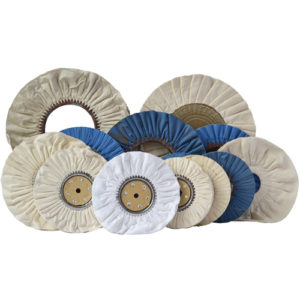
Polishing buff family — sisal, cotton, and treated cloth wheels for metal polishing across abrasive grades.

Polishing buff family — sisal, cotton, and treated cloth wheels for metal polishing across abrasive grades.

View on supplier site →
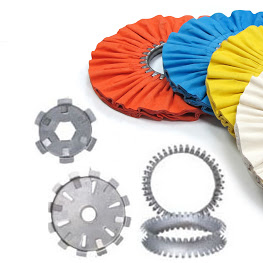
Color buff wheels with center plates — flag/pleated configurations for stainless steel and brass polishing.

Color buff wheels with center plates — flag/pleated configurations for stainless steel and brass polishing.

View on supplier site →
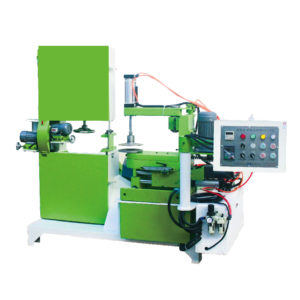
Pleated cotton buff stack — for high-luster final polishing on jewelry, hardware, and decorative metalwork.

Pleated cotton buff stack — for high-luster final polishing on jewelry, hardware, and decorative metalwork.

View on supplier site →

Buff types and applications

Buff typeConstructionBest applicationsFOB China typical price
Sisal cutting buffStiff sisal fiber, sewn or full-discHeavy stock removal, deburring, cutting initial scratchesUSD 0.65-2.40 per buff (8" diameter)
Treated sisal buffSisal + adhesive treatment for added stiffnessAggressive cutting, satin-finish prepUSD 0.85-3.20 per buff
Flag pleated cotton buffFolded/pleated cotton cloth on center plateColor buffing, luster finish, jewelry polishingUSD 0.55-2.20 per buff
Airway buff (perforated)Cotton with center air passages, high RPMHigh-speed automated polishing linesUSD 0.85-3.50 per buff
Full-disc buffSolid cotton disc, sewn edgesFinal polishing, mirror finishUSD 0.45-1.85 per buff
Sewn cotton buff (multiple ply)Compressed cotton plies with sewn rowsGeneral-purpose polishing, satin finishUSD 0.65-2.65 per buff
Treated cloth buffCotton with rouge / compound impregnationSingle-step polishing for productionUSD 1.20-4.50 per buff
Wool buffPure wool, often with leather backingPremium luxury jewelry finishing, watch casesUSD 4.50-18.00 per buff
Felt buff (hard / soft)Compressed wool or synthetic feltSpecific-shape polishing, lens finishingUSD 2.20-9.50 per buff
Diamond-impregnated buffCotton/leather + diamond powderPremium jewelry, high-precision finishingUSD 18-95 per buff

Buff size and mounting

Buff diameterCommon applicationsCenter hole / arbor
3-4 inch (75-100mm)Jewelry, small parts, hand-polishing on bench grinder1/2" or 5/8" arbor
6-8 inch (150-200mm)General hardware, plumbing fixtures, decorative metalwork5/8" or 3/4" arbor
10-12 inch (250-300mm)Larger automotive, marine, architectural metalwork3/4" or 1" arbor
14-16 inch (350-400mm)Industrial production polishing, automated lines1" or 1-1/4" arbor
18-24 inch (450-600mm)Large-part industrial polishing, cookware production1-1/2" or 2" arbor
Custom sizes 30+ inchSpecialty industrial applicationsCustom arbor configuration

Polishing compound progression

CompoundColorAbrasive contentApplication
Black emeryBlackAluminum oxide, coarseHeavy stock removal, deburring
Brown tripoliBrownTripoli, mediumCutting brass, copper, aluminum
White rouge (jewelers rouge)WhiteCalcined alumina or chalk, fineColor buffing softer metals (silver, gold)
Red rougeRedIron oxide, fineFinal luster on precious metals, jewelry
Green rougeGreenChrome oxide, finePremium stainless and chrome finishing
Blue compoundBlueSpecific abrasive, fineFinal polish on stainless steel
Greaseless compound (bar form)VariousOxide + adhesive basePre-polish prep, satin finish
Liquid compound (bottled)VariousSuspended abrasive in liquid carrierAutomated polishing systems

Three-stage progression for mirror finish

Industrial mirror-finish polishing typically progresses through three buff/compound combinations: (1) CUT — sisal buff with brown tripoli or treated sisal compound for stock removal and removing surface scratches; (2) COLOR — flag cotton buff with white rouge or blue compound to develop color and remove cut marks; (3) FINISH — soft cotton buff with red rouge for final luster. Each stage uses a separate dedicated buff (compounds shouldn't mix) and progressively softer wheel construction. Skipping stages produces inferior finish; over-using cut compound produces mirror-quality damage. Production polishing operations track buff inventory and compound consumption carefully — typical mid-volume jewelry shop uses 100-300 buffs and 50-200 lb of compound per month.

Buff-making machinery

Machine typeFunctionProduction capacityFOB China typical price
Sewing machine for buffsSew center plate to cotton/sisal disc1,000-3,000 buffs/shift (semi-auto)USD 2,800-12,000
Pleating machineFold cotton into pleats for flag buffs500-1,500 buffs/shiftUSD 4,500-18,000
Center-plate punching/forming machineForm metal center plates for buff mounting2,000-8,000 plates/shiftUSD 3,500-14,000
Raking lathe (after-shaping)Trim and shape finished buff to spec500-2,000 buffs/shiftUSD 5,500-22,000
Buff disc cutting machineStamp circular discs from cotton/sisal5,000-20,000 discs/shiftUSD 4,500-18,000
Compound impregnation lineTreat buffs with rouge/compound1,000-3,000 buffs/shiftUSD 12,000-45,000
Complete buff production lineIntegrated production from raw cotton to finished buff2,000-5,000 buffs/shiftUSD 65,000-180,000

Pricing brackets — wholesale

Order tierTotal quantityDiscountContainer utilizationLead time
Small distributor / hardware retail500-3,000 buffs totalList price; LCLLCL15-30 days
Mid distributor / regional10,000-50,000 buffs5-15%20' container25-45 days
Large distributor / national100,000-500,000 buffs15-25%40' or 40HQ container35-60 days
OEM industrial / mass production1+ million buffs / private label22-32%Multiple 40HQ containers45-90 days

Order workflow — buff procurement

  1. Application analysis — define what metals are being polished (steel, stainless, brass, aluminum, gold/silver, etc.) and target finish quality (satin, semi-bright, mirror); each requires different buff types and compound combinations
  2. Buff size selection — match diameter to existing polishing motor or grinder spindle speed; smaller buffs run higher RPM, larger buffs run slower to maintain proper surface speed
  3. Sample order — typically 50-200 buffs of each candidate variant; verify cotton/sisal quality, sewing/center-plate quality, dimensional accuracy
  4. Production trial — install on representative polishing operation for 2-4 weeks; measure buff service life vs production target, verify finish quality consistency
  5. First commercial order — typically 5,000-50,000 buffs mixed across 5-15 SKUs based on application demand
  6. Quality acceptance — incoming inspection for cotton/sisal density, dimensional accuracy, sewing integrity; document service-life data per shipment
  7. Series replenishment — quarterly or monthly orders aligned with consumption; typical buff service life 2-8 hours of polishing per buff (varies with metal and compound)

CRA Machinery on weisourcing.com

View the full supplier profile, certifications, contact details, and complete product catalogue.

Frequently asked questions

What's the difference between sisal, cotton, and treated buffs?
Three different fiber compositions with distinct cutting characteristics. SISAL BUFFS — natural sisal fiber, very stiff, aggressive cutting action. Properties: removes material rapidly, leaves cut marks that need finishing. Best for: heavy stock removal, deburring, removing surface scratches, initial polishing stage. Lasts 1-3 hours on typical industrial polishing job. COTTON BUFFS — natural cotton cloth, softer than sisal, gentler cutting action. Properties: leaves smoother finish, less aggressive cut, suitable for finishing stages. Best for: color polishing, satin finish, final luster development. Lasts 2-6 hours. TREATED BUFFS — cotton or sisal with adhesive/sizing treatment. Properties: stiffer than untreated, more aggressive cutting, longer service life. Best for: heavy industrial polishing where stiffness matters more than fine finish. Lasts 2-5 hours. SELECTION RULE: progressive polishing typically goes sisal → treated cotton → cotton → soft cotton, each stage softer than the last. For specific finish quality, match buff stiffness to required cut aggression. Production polishing operations usually maintain 4-8 different buff variants in inventory to support different polishing stages and metal types.
What buff size and motor speed do I need for my polishing setup?
Surface speed (FPM = feet per minute at outer diameter) is the critical parameter. RECOMMENDED SURFACE SPEEDS: (1) Cutting/coarse polishing of steel: 7,500-9,500 FPM; (2) Cutting brass/aluminum: 6,500-8,500 FPM; (3) Color buffing soft metals: 4,500-6,500 FPM; (4) Finish polishing precious metals: 3,500-5,500 FPM. CALCULATING REQUIRED RPM: surface speed (FPM) = π × diameter (inches) × RPM ÷ 12. So for 8" buff at 7,500 FPM: RPM = (7,500 × 12) / (π × 8) = 3,580 RPM. For 12" buff at same speed: RPM = (7,500 × 12) / (π × 12) = 2,386 RPM. PRACTICAL SETUP: typical industrial polishing motor 1.5-2 HP at 1,725 or 3,450 RPM with arbor for 6"-12" buffs covers most applications. Premium industrial setups use variable-speed drives to optimize surface speed for each buff/compound combination. JEWELRY shops typically use 3"-4" buffs at 3,450 RPM. AUTOMOTIVE/HARDWARE typically uses 8"-10" buffs at 1,725 RPM. INDUSTRIAL PRODUCTION uses 12"-16" buffs at 900-1,200 RPM. Wrong surface speed: too slow leaves ineffective polishing; too fast burns metal and degrades buffs rapidly.
How do I source matching buff-making machinery to start a buff production operation?
Buff manufacturing is a viable B2B opportunity with moderate capital investment. MINIMUM EQUIPMENT for basic buff production: (1) Sewing machine for joining cotton plies and center plates: USD 3,000-12,000; (2) Center-plate punching machine: USD 3,500-14,000; (3) Buff disc cutting machine: USD 4,500-18,000; (4) Raking/finishing lathe: USD 5,500-22,000. TOTAL: USD 16,500-66,000 for basic operation. ADDITIONAL EQUIPMENT for premium production: pleating machine (flag buffs) USD 4,500-18,000, compound impregnation line USD 12,000-45,000, automated quality inspection USD 8,000-25,000. PRODUCTION CAPACITY: basic operation ~500-1,500 buffs per shift; premium operation ~2,000-5,000 buffs per shift. RAW MATERIAL COSTS: cotton fabric USD 2.50-4.50 per kg, sisal fiber USD 4.50-9.50 per kg, metal center plates USD 0.15-0.45 per piece. MATERIAL CONTENT per buff (8" diameter): typical 0.05-0.15 kg cotton/sisal + 1 center plate. PRODUCTION ECONOMICS: typical material cost USD 0.25-0.75 per buff; selling price USD 0.65-2.40 per buff; gross margin 50-70%. ROI: well-positioned regional operation can achieve breakeven at 8,000-25,000 buffs/month volume. China BCRA Machinery offers complete production lines plus individual machine options. SOURCING WORKFLOW: factory inspection visit recommended before equipment order; supplier provides installation supervision; commissioning typically 2-3 weeks; ramp-up to full production 1-3 months.
What's the difference between airway buffs and standard buffs?
Airway buffs are designed for high-RPM automated polishing lines. STANDARD BUFF construction: cotton or sisal disc with sewn or stitched center plate; relatively dense; designed for general-purpose polishing on bench grinders or polishing motors. AIRWAY BUFF construction: cotton plies arranged with center air passages (perforated through-holes) to allow cooling air flow during high-RPM operation. Properties: (1) HIGHER MAX RPM — airway construction handles 5,000-8,000 RPM vs standard 1,725-3,450 RPM; (2) BETTER COOLING — airway design prevents friction overheating that destroys standard buffs at high speed; (3) AGGRESSIVE PRODUCTION — high RPM × proper compound = production-grade polishing rates. Best for: AUTOMATED polishing lines (robotic polishing cells with high spindle speed), production polishing of brass plumbing fittings, faucets, hardware. Cost premium: 30-60% over standard buffs. PROCUREMENT NOTES: (1) Match buff bore to specific spindle dimensions of the polishing equipment; airway buffs typically need precise mounting; (2) Compound selection matters more for airway buffs — wrong compound at high RPM creates dangerous fire hazard; (3) Replacement intervals shorter — airway buffs typically 1-3 hours service life vs standard 2-6 hours. For mid-volume polishing operations, standard buffs are adequate; for high-volume production, airway buffs deliver significant productivity gains.
How do I plan inventory for buff and compound consumption in production polishing?
Buff and compound consumption is highly application-specific but follows predictable patterns. TYPICAL BUFF CONSUMPTION: (1) JEWELRY POLISHING — 0.5-2 buffs per worker per day depending on production rate; (2) HARDWARE POLISHING — 2-5 buffs per polishing station per shift; (3) PLUMBING FIXTURE POLISHING — 5-15 buffs per polishing line per shift; (4) AUTOMATED PRODUCTION POLISHING — 15-50 buffs per shift per cell. COMPOUND CONSUMPTION: typical 0.05-0.20 kg of compound per buff; corresponds to 0.5-3 kg compound per polishing station per shift. INVENTORY HOLDING: typical mid-volume operation maintains 1-3 month consumption on hand; large operations 1-2 month due to better procurement cadence. SAFETY STOCK: always carry 25-50% above expected consumption to handle production-rate spikes and supplier delays. PROCUREMENT TIMING: 4-8 week lead time for ocean shipping from China; 1-3 week lead time for US warehouse stocked product. PRODUCTION TRACKING METRICS: (1) Buffs per piece polished — track per metal type and finish target; (2) Compound usage rate per shift; (3) Service life of each buff (hours of active polishing); (4) Production rate (pieces per shift) — verify if buff/compound changes affect productivity. Reputable suppliers like CRA Machinery support customer inventory planning with consumption projections based on similar customer applications.
What polishing compound is right for stainless steel vs brass vs aluminum?
Compound selection is application-specific. STAINLESS STEEL polishing progression: (1) CUT stage with treated sisal + brown tripoli OR sisal + black emery; (2) COLOR stage with cotton + green chrome rouge or specialty stainless compound; (3) FINISH stage with soft cotton + blue compound for high luster. Stainless mirror finish requires careful compound selection — wrong compound leaves haze. BRASS polishing: (1) CUT with sisal + brown tripoli; (2) COLOR with cotton + white rouge; (3) FINISH with soft cotton + red rouge. Brass develops beautiful warm luster with proper progression. ALUMINUM polishing: (1) CUT with sisal + brown tripoli (lighter pressure than steel); (2) COLOR with cotton + greaseless white compound; (3) FINISH with soft cotton + red or white rouge. Aluminum requires gentler cut due to softness. PRECIOUS METALS (gold, silver): (1) Pre-polish with cotton + tripoli (light); (2) FINISH with soft cotton + red rouge or specialty jeweler's compound. Precious metal polishing requires utmost care — too aggressive removes valuable metal mass. CARBON STEEL polishing: (1) CUT with sisal + black emery; (2) COLOR with cotton + green rouge; (3) FINISH with soft cotton + blue. Carbon steel rusts after polishing — apply protective coating immediately. CRITICAL ERROR TO AVOID: never mix compounds on same buff — use dedicated buff per compound. Mixing compounds causes streaking, hazing, and inconsistent finish.
⚠ Important Disclaimer

Source: Product images on this page are hosted on the manufacturer's official website (cra-machinery.com) and link directly back to that website. All product information was summarised from the supplier's public catalogue.

Brand mentions and trademark compliance: References to Tier-1 polishing buff and compound manufacturer brands (Schaffner Magnetics, Anchor Buffing Wheel, Caswell, Eastwood, Norton-Saint Gobain) are made for the sole purpose of describing functional benchmarks. CRA Machinery is not authorized by, affiliated with, or endorsed by any of these brand owners. Products are aftermarket-fit cross-reference manufactured under CRA Machinery's own brand or buyer-private-label only.

Polishing operation safety: Industrial polishing operations create fire hazards (compound + buff dust), inhalation hazards (compound dust, polishing residue), and physical hazards (rotating equipment, ejected material). Polishing facilities must comply with local safety regulations: dust collection systems, fire suppression, personal protective equipment (eye protection, respirators, gloves), proper machine guarding. Compound and buff disposal must follow hazardous waste regulations where applicable.

Pricing & specifications: All price ranges, service-life figures, and tier definitions reflect general market observation. Real-world buff and compound consumption depends on metal type, polishing pressure, compound application rate, and operator technique. Confirm current pricing, MOQ, lead time, and configuration directly with the supplier.

No middleman role: Weisourcing provides supplier discovery and editorial content. All transactions occur directly between buyer and supplier through the contact channels published on the supplier's official website.