weisourcing.com / products / Sunlitec LED / Automotive LED Lighting

Automotive LED Light Bars & Vehicle Lighting from China — A Wholesale Buyer's Guide

A practical sourcing guide for automotive LED lighting from China — written for aftermarket auto parts distributors, off-road specialty retailers, 4x4/overland equipment dealers, commercial vehicle fleet suppliers, agricultural and construction equipment dealers, marine outfitters, and emergency services supply distributors. Real product images from sunlitec-led.com covering off-road LED light bars (single-row, dual-row, curved, 6"-50"+ lengths, 18W-500W), LED work lights (round and square, flush-mount pods), driving and spot lights, fog lights, LED headlight sealed-beam replacements (4" and 7" round, 5x7 rectangular), tail and signal lights for trailers and commercial vehicles, rock lights for off-road undercarriage, LED strobes and emergency warning lights, and OEM-fit interior LED replacements. LED chip technology tiers (economy through premium CREE/OSRAM/Lumileds), beam pattern selection (spot/flood/combo/driving/scene), regulatory certifications (E-Mark, DOT FMVSS 108, SAE, FCC, IP67/68/69K), and the procurement workflow that establishes profitable automotive LED distribution.

Manufacturer: Sunlitec LED (sunlitec-led.com)
Category: Auto Parts & Aftermarket
Reading time: 14 min

Off-road LED light bars, vehicle auxiliary lighting, work lights, and heavy-duty LED illumination represent a multi-billion-dollar global aftermarket. Demand drivers include: (1) the global off-road and overlanding boom (4x4, pickup trucks, side-by-sides); (2) commercial vehicle fleet upgrades to LED for safety and operating cost reduction; (3) construction and agricultural equipment lighting refresh cycles; (4) emergency services and law-enforcement lighting; (5) marine and recreational vehicle aftermarket. China is the dominant global producer of automotive LED lighting with comprehensive coverage from economy through premium E-Mark/DOT-certified tiers, supplying every major aftermarket distributor and OEM auxiliary-lighting supplier worldwide.

This guide covers the Sunlitec LED product family — off-road LED light bars (single-row, dual-row, curved, in lengths from 6" through 50"+ inches), LED work lights (round, square, flush-mount), driving and spot lights, fog lights, vehicle headlights (sealed beam replacements, projector retrofits), tail and signal lights, interior LED, and specialty lighting (police/EMS, agricultural, marine). Real product images linking back to the supplier's catalog at sunlitec-led.com.

Product range — actual catalogue images

The product images below are hosted on the manufacturer's official website (sunlitec-led.com) and link directly to the manufacturer's catalogue. Click any image to view the full specification page in a new tab.
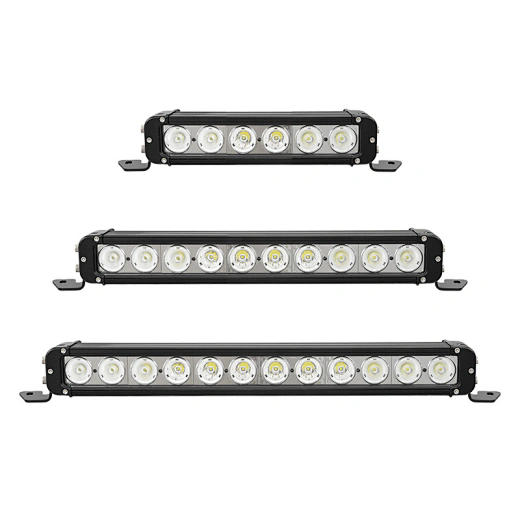
Off-road LED light bars in three lengths — single-row 5W LED arrangement for trucks, ATVs, and off-road vehicles.

Off-road LED light bars in three lengths — single-row 5W LED arrangement for trucks, ATVs, and off-road vehicles.

View on supplier site →
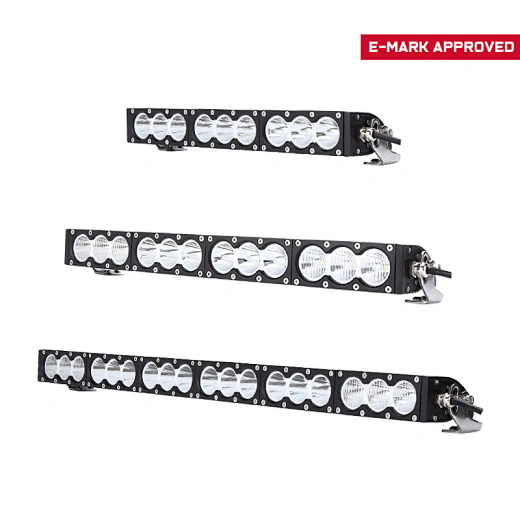
E-Mark approved single-row LED light bars — premium European regulatory compliance for vehicle mounting in EU markets.

E-Mark approved single-row LED light bars — premium European regulatory compliance for vehicle mounting in EU markets.

View on supplier site →
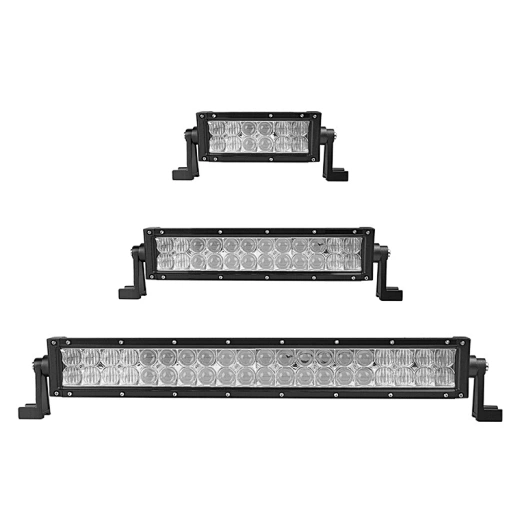
Heavy-duty work light range — premium LED auxiliary lighting for construction, agriculture, and commercial vehicles.

Heavy-duty work light range — premium LED auxiliary lighting for construction, agriculture, and commercial vehicles.

View on supplier site →

Product family overview

Product familyCommon variantsTypical applicationsFOB China typical price
Single-row LED light bar6"-50" lengths; 18W-300WOff-road bumper/roof mount; affordable mainstreamUSD 8-95 each
Dual-row LED light bar10"-52" lengths; 60W-500WHeavy-duty off-road, work vehiclesUSD 18-220 each
Curved LED light bar20"-50" curved housingRoof-mount with vehicle curve matchUSD 25-180 each
LED work light (round/square)3"-9" form factor; 12W-200WAuxiliary, fender, bumper, machineryUSD 4-65 each
Flush-mount LED pod2"-4" form factor; 12W-60WBumper, A-pillar, flush integrationUSD 6-55 each
LED driving / spot light5"-9" round; 30W-180WHigh-beam supplement, long-range projectionUSD 18-160 each
LED fog light3"-7" round/square; 12W-60WOEM fog replacement, aftermarket fogUSD 8-95 each
LED headlight (sealed beam)4"-7" round; 5x7 rectangularClassic vehicle, military, agricultural retrofitUSD 25-180 each
LED tail light / signalVarious OEM-fit form factorsTrailer, truck, commercial vehicleUSD 4-85 each
LED rock lightRGB/white, set of 4-12Off-road undercarriage lightingUSD 25-120 per set
LED strobe / warningLinear and rotating; emergency colorsPolice, EMS, snow plow, tow truckUSD 35-380 each
Interior LED dome / mapVarious OEM-fit replacementsOEM interior lighting upgradeUSD 2-25 each

LED chip technology tiers

Chip tierCommon chipsPropertiesTypical lifespan
EconomyGeneric Chinese chips (Epistar, Bridgelux economy lines)~80-100 lm/W efficacy; basic thermal management; cost-driven15,000-25,000 hours
Mid-tierCREE XM-L, CREE XB-D, Epistar 3030~110-130 lm/W; better thermal characteristics; consistent quality30,000-50,000 hours
PremiumCREE XHP70, CREE XP-L, Osram, Lumileds Luxeon~140-180 lm/W; high luminous flux; premium thermal management; superior beam characteristics50,000-80,000 hours
Premium high-powerCREE XHP70.2, OSRAM premium~180-220 lm/W; highest performance; premium-tier OEM applications50,000-100,000 hours

LED chip authenticity matters — counterfeit chips are common in cheap LED lighting

Many "CREE" or "Osram" labeled LED products from low-tier suppliers actually contain counterfeit or remarked LED chips. Common deception patterns: (1) Generic Chinese chips remarked with CREE/Osram logos; (2) "CREE Inside" claims when only a tiny fraction of LEDs are genuine; (3) Cheaper chip generation marketed as latest. CONSEQUENCES of fake chips: significantly lower lumen output (often 30-50% of claimed), faster lumen depreciation (50% output at 5,000 hours vs 25,000 hours for genuine), thermal failures (premature LED chip failure), color shift over time (white turns yellow/blue).

VERIFICATION METHODS: (1) Request chip lot codes for verification with manufacturer (CREE and Osram have authentication procedures); (2) Independent photometric testing — measure actual lumen output vs claimed; (3) Thermal imaging — proper chip-and-heatsink design shows expected temperature distribution; (4) Long-term operating test (200+ hours) — genuine LEDs maintain output; counterfeit dim significantly. PROCUREMENT IMPLICATIONS: premium-tier Chinese suppliers like Sunlitec LED use genuine premium chips and can provide authentication documentation. Sample testing before main order is essential — cost USD 200-500 for independent test pays back many times in avoided returns and warranty claims.

Regulatory certifications

StandardApplicationMarkets where required/expected
E-Mark (ECE R10)Vehicle lighting EMC and approvalsEU, UK, Russia, many international
E-Mark (ECE R7/R23/R87)Specific lighting functions (position, reversing, daytime running)EU vehicle lighting
DOT (FMVSS 108)US vehicle safety lightingUSA on-road vehicles
SAE J592 / J583SAE specifications for auxiliary lightingUSA voluntary, but expected
FCC Part 15EMC for electronicsUSA
CE markingEU market accessEU mandatory
RoHSRestricted substancesEU and most international
UL listingUS safety certificationUSA premium retail
IP67/IP68/IP69KWaterproof and dustproof ratingMandatory for off-road; IP69K for harsh environments
RCMAustralia / NZ regulatory markAustralia, New Zealand
SASOSaudi Arabia regulatorySaudi Arabia, Gulf states

Beam pattern selection

Beam patternCharacteristicsBest applications
Spot (10-15° spread)Long-distance focused beamLong-range driving, off-road high-speed
Flood (30-60° spread)Wide near-field illuminationWork area, equipment lighting, close work
Combo (mix of spot + flood)Both long-range and near-fieldMost off-road applications, versatile use
Driving (10-25° asymmetric)Wider than spot, longer than floodHighway speed driving with corner illumination
Scene (60-90° wide)Maximum spread for area lightingWork scenes, camp/site lighting
Diffuse (90°+ spread)Soft wide illuminationInterior, indirect, ambient applications
Selective yellowAmber/yellow filtered for fog penetrationFog conditions, snow, rain

Pricing brackets — wholesale

Order tierTotal quantityDiscountContainer utilizationLead time
Sample / pilot50-300 piecesList price; LCLLCL15-25 days
Small distributor500-3,000 pieces5-12%20' container25-45 days
Mid distributor / aftermarket retailer5,000-25,000 pieces12-22%40' container or multiple 20'35-60 days
Large distributor / chain retail50,000+ pieces20-32%Multiple 40HQ containers45-90 days
Private label / OEM3,000+ pieces per SKUCustom OEM pricing + toolingCustom packaging50-100 days first batch

Order workflow — automotive LED procurement

  1. Market positioning — define target tier (economy / mid / premium), distribution channel (off-road specialty, big-box auto, online retail, fleet)
  2. Product selection — choose specific products fitting market positioning; verify supplier capability for full range needed
  3. Branding strategy — supplier own-brand for fastest entry; private label for differentiated brand value
  4. Sample order — typically 50-200 pieces per SKU; verify build quality, beam pattern accuracy (with light meter), lumen output, waterproof rating
  5. Certification verification — E-Mark for EU markets, DOT for US on-road, FCC for US connected products
  6. Field test — install on representative vehicle/equipment for 60-180 days; verify durability, no failures, beam pattern maintained
  7. First commercial order — typical 1,000-10,000 units per SKU for distribution launch
  8. Quality acceptance — incoming inspection per AQL plan (typical 1.0-2.5%); function test on sample units; visual inspection for packaging damage
  9. Series replenishment — quarterly orders aligned with sales velocity; for high-volume, framework agreement

Sunlitec LED on weisourcing.com

View the full supplier profile, certifications, contact details, and complete product catalogue.

Frequently asked questions

How do I tell a good LED light bar from a cheap one when looking at supplier samples?
Multiple quality indicators to evaluate. PHYSICAL CONSTRUCTION: (1) HOUSING — aluminum extrusion (good) vs cast pot-metal (poor); look for "6063 aluminum" or "die-cast aluminum"; (2) WEIGHT — premium products are heavier (more material) than cheap ones for same form factor; (3) LENS — polycarbonate (good) vs acrylic (degrades in UV); should be clear and impact-resistant; (4) GASKETS — premium use silicone (good for thermal cycling) vs cheap EPDM rubber; verify IP67+ rating with submersion test. INTERNAL QUALITY: (1) LED chips — request photos through housing; counted LEDs should match advertised count; chips should look uniform; (2) DRIVER — separate driver (good thermal management) vs integrated driver (cheap, fails first); look for "constant current driver" specifications; (3) WIRING — gauge appropriate for current; weather-sealed connectors; (4) HEATSINK — verify thermal mass adequate for heat dissipation. PERFORMANCE TESTING: (1) Lumen output — use a lux meter at standard distance; should be within 90-110% of claimed; (2) Color temperature — should match specification (4000K, 6000K, etc.); (3) Beam pattern verification — flood/spot/combo per specification; (4) Power draw — should match specification (typical 80-90% efficiency means 100W chips draw 110-120W from battery). DURABILITY TESTING: (1) Thermal cycling — operate continuously for 4-8 hours; case should not exceed 80°C in ambient 25°C; (2) Vibration testing — vehicle-vibration spectrum for several hours; (3) Saltwater spray test if marine application; (4) UV exposure for outdoor applications. Reputable suppliers like Sunlitec LED can provide test reports and welcome customer testing of samples.
Are CREE LEDs always better than other brands?
CREE is one of several premium chip manufacturers but not the only option. CREE (now Wolfspeed) — historically the dominant brand in premium automotive LED. Strong in high-power, large-die products (XHP series, XM-L series). Premium pricing but well-established quality. OSRAM (Germany) — premium European brand, strong in OEM automotive (their LEDs in many Audi, BMW, Mercedes vehicles). Excellent quality. Often used for premium signal and headlight applications. LUMILEDS (formerly Philips Lumileds) — Luxeon series; premium quality; strong in OEM and high-end aftermarket. EPISTAR (Taiwan) — large Taiwanese manufacturer; quality varies by product line (premium lines comparable to CREE; economy lines significantly lower); cost-effective for mid-tier applications. BRIDGELUX (USA-China) — premium chip manufacturer; competitive with CREE in many applications. EVERLIGHT (Taiwan) — established quality, strong in specific applications. SAMSUNG and SEOUL SEMICONDUCTOR (Korea) — premium quality, often used in OEM. SELECTION PRINCIPLE: CREE retains brand value but is not always best technical choice. Modern OSRAM, Lumileds, and premium Epistar match CREE performance at lower cost. PROCUREMENT RECOMMENDATION: (1) Don't pay premium for "CREE" branding alone — verify actual chip lot codes and authenticity; (2) For OEM applications requiring specific certifications, brand may matter for documentation; (3) For aftermarket, focus on actual photometric performance vs claimed brand. AUTHENTIC CREE products from premium Chinese suppliers cost less than CREE through Western channels; suppliers like Sunlitec LED maintain authentication procedures for genuine premium chips.
What's the difference between E-Mark, DOT, and SAE certifications, and which do I need?
Three different regulatory frameworks for vehicle lighting. E-MARK (European Council Regulation, ECE Regulations) — comprehensive vehicle lighting framework covering function-specific approvals: ECE R7 (position lights), ECE R10 (EMC), ECE R19 (front fog), ECE R23 (reversing), ECE R87 (daytime running), ECE R98 (xenon headlamps), etc. Properties: (1) MANDATORY for EU, UK, Russia, Turkey, Israel, many other markets; (2) Comprehensive testing covering EMC, durability, photometric performance; (3) Each function has separate approval (a single headlamp may have multiple E-Marks); (4) E1-E47 numbering indicates country of approving authority (E1=Germany, E2=France, E3=Italy, etc.). Cost: USD 3,000-15,000 per product per function for certification testing. DOT (Department of Transportation, FMVSS 108) — US Federal Motor Vehicle Safety Standard for lighting. Properties: (1) MANDATORY for on-road vehicles in USA; (2) Self-certification system (no formal approval, but liability for compliance); (3) Testing per SAE specifications; (4) "DOT" marking indicates manufacturer compliance assertion. Cost: USD 500-3,000 per product for self-certification testing. SAE (Society of Automotive Engineers) — US voluntary standards: J592 (auxiliary lighting), J583 (headlamps), etc. Properties: (1) Voluntary technical standards; (2) Often referenced by DOT regulations; (3) Premium products advertise SAE compliance. PROCUREMENT IMPLICATIONS: (1) Products sold for EU markets MUST have E-Mark for their specific function; (2) Products sold for US on-road use should have DOT compliance; (3) Off-road only products (light bars, etc.) typically don't require these certifications in US but are restricted from on-road use; (4) Products sold for both markets need both certifications. Reputable suppliers like Sunlitec LED maintain current certifications for major export markets.
How do I source private-label LED lighting vs supplier-branded products?
Different sourcing strategies for different business models. SUPPLIER OWN-BRAND (RESALE): supplier produces under their own brand; you buy at wholesale and resell. PROS: (1) Low MOQ (100-500 pieces); (2) Fast time-to-market (2-4 weeks); (3) Already-tested product; (4) Easy to test multiple products. CONS: (1) Margin sandwiched between brand and your competitors; (2) No brand differentiation; (3) Brand value stays with supplier. PRIVATE LABEL (CUSTOMER BRAND): supplier produces with your branding, packaging, sometimes product modifications. PROS: (1) Brand equity belongs to you; (2) Higher margins (cut out reseller markup); (3) Long-term brand value; (4) Differentiation. CONS: (1) Higher MOQ (typical 1,000-5,000 per SKU); (2) Tooling for packaging (USD 1,500-15,000); (3) Longer initial lead time (60-120 days); (4) Brand-building investment needed. ODM (ORIGINAL DESIGN MANUFACTURER): supplier customizes existing products to your specifications (housing color, beam pattern, branding, even electronics modifications). PROS: (1) Differentiated product specifications; (2) Better margins than private label; (3) Long-term competitive advantage. CONS: (1) Higher MOQ (typical 5,000+ per SKU); (2) Tooling and development cost (USD 5,000-50,000); (3) Longest lead time (90-150 days). OEM (CUSTOM ENGINEERING): supplier develops completely new product to your design. PROS: Total differentiation; deepest customization. CONS: Very high MOQ (10,000+); large engineering investment (USD 50,000+); 6-12 month development. SELECTION RULE: (1) Startup or testing market → supplier brand; (2) Established distribution with marketing capability → private label; (3) Premium differentiated retail brand → ODM; (4) OEM auxiliary lighting supplier → OEM custom engineering. Most B2B LED distributors mix strategies across product portfolio.
What's the typical defect rate for LED lighting from Chinese suppliers?
Defect rates vary significantly by supplier tier and product complexity. ECONOMY SUPPLIERS: typical 8-25% defect/return rate Year 1; failure modes vary: (1) Initial DOA (dead on arrival) 3-8%; (2) Lumen depreciation faster than claimed 5-15%; (3) Water/dust ingress despite IP rating claims 3-10%; (4) Driver failure 2-8%; (5) Connector/wiring issues 2-5%. MID-TIER QUALITY: typical 2-5% defect rate Year 1; DOA 0.5-2%, gradual failures 1-3%. PREMIUM SUPPLIERS (like Sunlitec LED): typical 0.5-2% defect rate Year 1; DOA <0.5%, quality control prevents most issues. DEFECT TYPE ANALYSIS: (1) WATER INGRESS — most common failure mode for off-road LED; verify IP67/IP68 rating with submersion test of samples; (2) THERMAL FAILURE — chip overheating from inadequate heatsink; verify operating temperature in continuous use test; (3) DRIVER FAILURE — most failures in vibration-prone applications; verify driver quality with vehicle-mounted test; (4) LED CHIP FAILURE — gradual lumen depreciation; verify with long-term test (200+ hours); (5) MECHANICAL FAILURE — broken mounts, cracked housings; verify with vibration test. WARRANTY ECONOMICS: typical 1-3 year warranty on premium products; calculate warranty cost = (defect rate × replacement cost × volume); typical 3-5% of revenue for premium tier; 15-25% for cheap. MITIGATION STRATEGIES: (1) Pre-shipment inspection with random sample testing; (2) Choose suppliers with established quality systems (ISO 9001); (3) Reference customer feedback verification; (4) Begin with smaller orders to verify quality before large commitment; (5) Maintain spare parts inventory for warranty replacement. Reputable suppliers like Sunlitec LED maintain rigorous quality control with documented defect rates well below industry average.
What's the typical timeline and certification cost for entering new export markets?
Market entry timeline 3-12 months depending on certification scope. EUROPEAN UNION (E-MARK): (1) Test selection — identify all function-specific approvals needed (R7, R10, R19, R23, R87, etc.); (2) Sample submission to E-Mark testing lab (e.g., UTAC, KBA, RDW); (3) Photometric testing — typical 4-8 weeks; (4) EMC testing per ECE R10 — typical 2-4 weeks; (5) Mechanical/durability testing; (6) Approval issuance — typical 2-3 months total. Cost: USD 3,000-15,000 per product per function. UNITED STATES: (1) DOT FMVSS 108 testing — self-certification system; lab testing 4-8 weeks; (2) FCC Part 15 for EMC — 2-4 weeks; (3) Documentation. Cost: USD 1,500-8,000 per product. AUSTRALIA / NEW ZEALAND (RCM): self-declaration based on testing; 3-6 weeks; USD 1,500-5,000. UAE / SAUDI ARABIA (SASO/GSO): (1) SASO testing - mandatory; (2) Conformity certificate; 8-16 weeks; USD 3,000-12,000. INDIA (BIS / AIS): (1) AIS-008 for vehicle lighting; (2) BIS for some electronics; 12-24 weeks; USD 5,000-25,000. BRAZIL (INMETRO): mandatory for vehicle lighting; 12-20 weeks; USD 5,000-18,000. CHINA (CCC): for products sold in China; 6-12 weeks; USD 3,000-15,000. STRATEGIC RECOMMENDATIONS: (1) Choose suppliers with existing certifications for target markets (saves time and cost); (2) For new product launches, budget USD 20,000-100,000 across major markets; (3) Use harmonized standards where possible (CE often accepted as basis for other markets); (4) Some certifications transferable between similar products (saves cost on follow-on SKUs); (5) Annual surveillance audits for many certifications (USD 500-3,000 per year per certification). Premium suppliers like Sunlitec LED maintain comprehensive existing certifications and can support OEM customer certification needs.
⚠ Important Disclaimer

Source: Product images on this page are hosted on the manufacturer's official website (sunlitec-led.com) and link directly back to that website. All product information was summarised from the supplier's public catalogue.

Brand mentions and trademark compliance: References to Tier-1 LED chip and lighting brands (CREE/Wolfspeed, OSRAM, Lumileds, Bridgelux, Epistar, Samsung, Seoul Semiconductor, Rigid Industries, Baja Designs, KC HiLites) are made for the sole purpose of describing functional benchmarks. Sunlitec LED is not authorized by, affiliated with, or endorsed by any of these brand owners. Products are aftermarket-fit cross-reference manufactured under Sunlitec LED's own brand or buyer-private-label only.

LED chip authenticity: Premium LED chip brands (CREE, OSRAM, Lumileds) have authentication procedures. Verify chip authenticity through manufacturer authentication services or independent photometric testing before large commitments. Counterfeit chips are common in cheap LED lighting and significantly degrade product performance and lifespan.

Vehicle lighting regulations: Vehicle lighting installations must comply with destination jurisdiction lighting regulations. On-road vehicle use requires DOT (USA) or E-Mark (EU) certifications for specific lighting functions. Off-road auxiliary lighting in many jurisdictions is restricted from on-road use. Verify compliance with local regulations before commercial sale.

Pricing & specifications: All price ranges and tier definitions reflect general market observation. Vehicle lighting pricing varies significantly with LED chip authenticity, certifications, and order volume. Confirm current pricing, MOQ, lead time, and certification scope directly with the supplier.

No middleman role: Weisourcing provides supplier discovery and editorial content. All transactions occur directly between buyer and supplier through the contact channels published on the supplier's official website.