Alcohol breath testing equipment serves a specialized but high-stakes B2B market: fleet operators managing driver compliance, workplace safety programs in mining and heavy industry, law enforcement agencies, court-ordered ignition interlock programs for DUI offenders, occupational health screening, and bars/restaurants for self-service patron testing. The technology divides into two distinct categories: semiconductor sensors (lower cost, suitable for screening) and electrochemical fuel cell sensors (higher accuracy, required for evidential and legal-compliance use). Demand for breathalyzer equipment has expanded significantly with stricter workplace alcohol policies, expansion of fleet safety programs, and ignition interlock mandates in many US states and other jurisdictions for DUI offenders.
This guide covers the ALCOKSON product family — handheld personal breathalyzers, professional-grade fuel-cell units, wall-mounted and station-style breathalyzers with face recognition, ignition interlock devices for vehicles, calibration equipment, and consumable mouthpieces. Real product images linking back to the supplier's catalog at alcokson.com.
Product range — actual catalogue images
The product images below are hosted on the manufacturer's official website (alcokson.com) and link directly to the manufacturer's catalogue. Click any image to view the full specification page in a new tab.
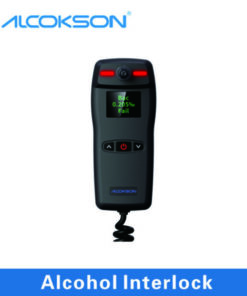
Handheld breathalyzer with carry case — ALCOKSON-branded portable alcohol detection device.
View on supplier site →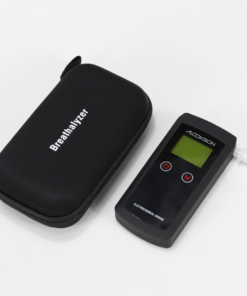
ALC-215D handheld breathalyzer with case ("Breathalyzer" labeled) — fleet inspector / compliance use.
View on supplier site →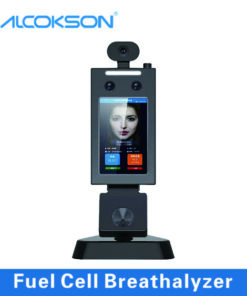
Wall-mount fuel-cell breathalyzer with face-recognition tablet — workplace entrance / station application.
View on supplier site →Sensor technology — the fundamental distinction
| Sensor type | Accuracy | Service life | Calibration interval | Cost level | Best for |
|---|---|---|---|---|---|
| Semiconductor (MOS) | ±0.01-0.02% BAC at 0.05% level | 1,000-3,000 tests typical | 3-6 months or after 200-500 tests | Lowest | Personal screening, low-volume use |
| Electrochemical fuel cell (basic) | ±0.005-0.010% BAC at 0.05% level | 5,000-20,000 tests | 6-12 months | Mid | Professional screening, fleet operations |
| Electrochemical fuel cell (premium) | ±0.003-0.005% BAC at 0.05% level | 20,000-100,000 tests | 12 months typical | High | Law enforcement, court-evidential, ignition interlock |
| Infrared spectroscopy (lab/clinical) | ±0.001-0.003% | Permanent (calibrated) | Annual | Highest | Hospital, lab, court-evidential primary |
Why semiconductor vs fuel cell matters
Semiconductor sensors detect alcohol indirectly through tin oxide film resistance change — they respond to alcohol but also to acetone, methane, and other volatiles, leading to false positives in some scenarios. They're fine for personal screening ("am I OK to drive?") where occasional false positive is tolerable, but inappropriate for legal/compliance use where accuracy and specificity matter. Fuel cell sensors use an electrochemical reaction specific to ethanol, with much better accuracy, repeatability, and specificity. For any legal, compliance, or court-related use, fuel cell technology is essentially mandatory.
Product categories and pricing
| Product | Sensor | FOB China per unit | Annual consumables (mouthpieces) |
|---|---|---|---|
| Personal pocket breathalyzer | Semiconductor | USD 8-22 per unit | 50-100 mouthpieces × USD 0.05-0.18 |
| Personal premium pocket | Semiconductor (high-grade) | USD 18-45 per unit | Same as above |
| Handheld professional (fuel cell) | Fuel cell basic | USD 65-180 per unit | 500-2000 mouthpieces × USD 0.05-0.18 |
| Handheld premium (fuel cell) | Fuel cell premium | USD 180-450 per unit | Same as above |
| Police/evidential grade | Fuel cell premium + DOT/EU certification | USD 380-1,200 per unit | Per-test mouthpiece tracking required |
| Wall-mounted fixed station | Fuel cell premium + tablet/face recog | USD 580-2,400 per unit | 5,000-20,000 mouthpieces annually |
| Vehicle ignition interlock | Fuel cell premium + GPS + camera | USD 380-1,200 per unit | Service contract typically required |
| Calibration gas (alcohol simulator) | N/A | USD 18-45 per cylinder | Used for sensor calibration; per-device |
| Mouthpiece (single-use, individually wrapped) | N/A | USD 0.05-0.22 per piece | Bulk purchase 1000+ at lower cost |
| Calibration service kit | N/A | USD 38-120 per kit | For periodic recalibration |
Application markets
| Application | Equipment requirement | Volume per program |
|---|---|---|
| Trucking fleet (driver pre-shift testing) | Handheld fuel cell, mid-grade | 1 unit per 5-15 drivers (rotation); 100-500 units per major fleet |
| Bus / transit fleet | Handheld + occasionally fixed station | 1 unit per 8-20 drivers; centralized testing locations |
| Mining / construction (workplace safety) | Wall-mounted at site entrance, optional handheld for foreman | 1-3 fixed units per site; 5-20 handheld for supervisors |
| Manufacturing / industrial workplace | Wall-mounted at entrance for high-risk operations | Per-site basis; growing adoption |
| Law enforcement (roadside / station) | Premium fuel cell + evidential grade | State/national contracts; thousands per program |
| Court-mandated ignition interlock (DUI program) | Vehicle interlock + service contract | State-by-state programs; 10,000-200,000 units per state program |
| Bars / restaurants (patron self-service) | Coin-operated wall unit | 1 per location for risk-averse establishments |
| Healthcare / occupational medicine | Premium fuel cell, calibrated | Per-clinic basis; modest volume |
| Personal/consumer retail | Personal pocket units | Mass market; e-commerce + retail distribution |
| Aviation / specialty industries | Premium fuel cell, often customized | Per-company programs; high-precision requirements |
Compliance and certification requirements
| Standard | Scope | Markets where required |
|---|---|---|
| DOT (Department of Transportation) approved | US commercial driver alcohol testing per 49 CFR Part 40 | USA — required for FMCSA-regulated drivers |
| NHTSA conforming products list | US evidential breath testing | USA law enforcement |
| OIML R 126 | International standard for alcohol breath analyzers | EU, many other markets |
| EN 15964 (EU) | European standard for breath alcohol analyzers | EU |
| EN 16280 (EU) | Personal breath testers | EU consumer market |
| CE marking | EU compliance | EU / EEA |
| FCC certification (radio, if equipped) | US wireless compliance for connected devices | USA |
| RoHS | Hazardous substance restrictions | EU; expanding globally |
| State-specific ignition interlock approval | Each state in US has approved-device list | USA state-by-state |
| Calibration traceability | NIST or equivalent reference standard | Required for evidential / court use |
Regulatory complexity for ignition interlock devices
Ignition interlock devices (IID) are heavily regulated in the US — each state maintains its own approved-device list, and getting on multiple state lists requires individual state certification (often USD 25,000-150,000 per state plus annual renewal fees). For Chinese aftermarket-fit IID manufacturers, US market entry typically requires (a) partnership with an established US service provider who handles state certifications, (b) volume commitments to justify certification investment, (c) ongoing compliance with state-specific reporting requirements. Without state-by-state approval, IID hardware cannot be legally sold for court-mandated programs in that state. EU has Type Approval requirements through national authorities. Practical implication: most Chinese IID manufacturers focus on private workplace applications (less regulatory complexity) rather than court-mandated programs which require local certification partnerships.
Common buyer profiles
| Buyer type | Typical order pattern |
|---|---|
| Fleet management company | Annual: 50-500 handheld units + ongoing mouthpiece supply |
| Workplace safety program (mining, construction) | Project: 5-20 fixed wall units + handheld for supervisors; ongoing supplies |
| Industrial safety equipment distributor | Continuous: full catalog stock with fast-moving consumables |
| Government / law enforcement agency | Multi-year contracts; tens of thousands of units; rigorous certification requirements |
| Court-mandated IID service provider (US) | Continuous: hardware + service contracts; state-certified products only |
| Personal / e-commerce reseller | Continuous: high-volume low-margin mass-market personal units |
| Healthcare / occupational medicine clinic | Periodic: 1-5 premium units per clinic with annual recalibration |
| Hospitality / bar service | Per-location: 1 coin-operated unit + ongoing mouthpiece supply |
Order workflow — alcohol testing equipment procurement
- Application analysis — define use case (screening vs evidential, fleet vs workplace vs personal); map technical requirements (sensor type, calibration interval, connectivity, certifications)
- Compliance specification — verify destination-market and application-specific certifications required (DOT for US fleet, OIML R 126 for international, state-specific for IID, evidential standards for law enforcement)
- Sample / pilot order — 5-25 units of each candidate model; verify accuracy with reference solutions, evaluate ergonomics, test mouthpiece supply, verify connectivity (Bluetooth, app integration if applicable)
- Calibration verification — verify supplier provides calibration certificates; understand recalibration interval and process; budget for ongoing calibration
- First wholesale order — typically 50-500 units depending on application; specify exact configuration, mouthpiece compatibility, calibration certificate per unit
- Quality acceptance — incoming inspection per AQL 0.4% for major (calibration accuracy), 1.0% for minor (cosmetic, packaging); verify each unit operates within specification
- Mouthpiece supply — establish ongoing mouthpiece supply with proper hygiene packaging; budget annual consumable cost; consider air-freight on stockout
- Calibration service plan — establish recalibration program (3-12 month interval); budget annual recalibration cost; document per-unit calibration history for legal/compliance use