📦 Real Buyer Inquiry · USA · 2026-04
2000W 72V Electric Motorcycles to the US: A Container-Level Importer's VIN, DOT and Lithium-Battery Sourcing Guide
A US importer messaged us with a tightly-scoped specification: 40-foot container of 2000W 72V tank-style electric scooters, 60-80km range, lithium battery option, VIN allocation, and full US export documentation. Five lines that signal exactly the kind of importer who has done the homework — and exactly the kind of supplier who can answer in one round, versus the supplier who'll waste two months figuring out NHTSA documentation requirements.
The US electric two-wheeler market grew approximately 19% year-over-year between 2023 and 2025, with the bulk of that growth in the sub-USD-3,000 retail tier — meaning Chinese-imported 72V electric scooters and tank-style mopeds are the volume product. The federal regulatory framework, however, has not kept pace with the product. A 2000W 72V scooter sits awkwardly between three categories — e-bike (federal cap 750W), moped (state-defined, varies by state), and motorcycle (DOT-compliant, requires VIN and registration). Smart importers don't fight this — they pre-configure their containers for the buyer segment they actually serve and the state they ship into.
The importer who messaged us is one of the smart ones. Their five-line specification is not a question — it's a configuration brief.
The actual inquiry (redacted, verbatim)
Buyer name and importer company have been removed; product specifications and commercial requirements are preserved.
| Specification | What the importer is asking for |
|---|
| Quantity | 40-foot container (one full FCL load) |
| Vehicle type | Tank-style / large scooters |
| Motor power | 2000W |
| Battery voltage | 72V |
| Range per charge | 60-80 km |
| Battery type | Lithium battery option |
| Documentation | VIN for USA + export documentation |
ZP electric scooter — actual product from zpmotos.com
ZP electric motorcycle range — actual production unit
"Quantity: 40ft container, Specs: Tank-style/large scooters, 60-80 km range, Lithium battery option, VIN for USA and export documentation."
— Buyer's complete request, USA, April 2026
What 2000W 72V actually means in the US market
Federal e-bike law (15 U.S.C. § 2085) defines an electric bicycle as having "an electric motor of less than 750 watts" and a top speed under 20 mph on motor power alone. A 2000W 72V electric scooter exceeds both thresholds substantially:
| Configuration | Top speed (motor only) | US regulatory category | Required documentation |
|---|
| Federal e-bike (≤750W) | ≤ 20 mph | Electric bicycle | None federal; some states require Class 1/2/3 sticker |
| Class 3 e-bike | ≤ 28 mph | Speed pedelec | State Class 3 registration in some states |
| Moped (state-defined) | ≤ 30 mph typically | Moped — varies by state | State title, registration; sometimes VIN; license varies |
| 2000W 72V tank-style | 30-40 mph typical | Electric motorcycle in most states | 17-digit VIN, DOT-compliant lighting/tires/mirrors, MCO, state title, motorcycle license |
The importer asking for VIN explicitly signals they intend the units to be sold as street-legal motorcycles (or moped-class where allowed), not as e-bikes. This is a higher-margin segment than the e-bike tier — typical retail USD 1,800-3,500 versus USD 700-1,500 for an equivalent-spec e-bike — but it requires a much more capable supplier on the export-documentation side.
Why VIN allocation separates real exporters from traders
VIN (Vehicle Identification Number) allocation is the single most-important capability check on a US-bound electric motorcycle supplier. Real exporters have already obtained a World Manufacturer Identifier (WMI) from SAE and have an established VIN-allocation process. Traders or aftermarket factories typically don't.
What a real US-export-ready supplier shows you in 24 hours
- WMI letter from SAE — confirms the supplier's manufacturer code (Chinese manufacturer codes typically begin with L)
- Sample VIN string with breakdown of the 17 digits per ISO 3779
- NHTSA verification record — confirms VIN format passes NHTSA's automated check
- MCO (Manufacturer's Certificate of Origin) sample for a previously-exported unit
- DOT compliance attestation — covering FMVSS standards applicable to motorcycles (lighting, controls, controls labeling, brakes, mirrors)
- EPA exemption letter — electric vehicles are exempt from EPA emissions standards but the exemption needs to be documented
- Reference shipment records — at least 2-3 prior US-bound containers with reference customers (under NDA)
A supplier who provides all seven within 24 hours is a real US-export-ready manufacturer. A supplier who provides 1-2 and needs to "check with our team" on the rest is a 6-12 week documentation setup project. The importer's order goes to the first kind.
Lithium battery — the shipping risk that derails first-time imports
The buyer's request for "lithium battery option" sounds simple. The actual logistics are not.
Lithium-ion vehicle batteries ship under UN 3171 (battery-powered vehicle) or UN 3480/3481 (battery alone or in equipment). All three classifications are Class 9 dangerous goods under IMDG Code for sea freight. The required documentation per shipment includes:
- UN 38.3 test report — confirms the battery has passed eight specific safety tests (altitude simulation, thermal test, vibration, shock, external short circuit, impact/crush, overcharge, forced discharge). Without this report, the container cannot legally ship.
- Battery MSDS — chemistry-specific Material Safety Data Sheet (NMC vs LiFePO4 require different documents).
- IMDG declaration — Class 9 dangerous goods declaration on the bill of lading.
- Class 9 packaging — proper hazard markings on the outer container per IMDG.
- State of charge ≤30% — batteries must be partially discharged before sea shipment to minimize thermal risk.
- Cargo Insurance Class 9 endorsement — standard cargo insurance often excludes lithium-battery damage; the importer needs explicit Class 9 coverage.
The detail that catches first-time importers
Many Chinese suppliers offer to ship the scooter without the battery installed — battery in a separate Class 9 carton inside the same container. This sometimes simplifies customs and reduces insurance complexity, BUT it requires the US importer to install batteries in their warehouse before retail distribution. Confirm this configuration explicitly: "Are batteries pre-installed at the factory or shipped separately for in-warehouse installation?" The answer changes the importer's labor model and the per-unit landed cost.
The 40-foot container math
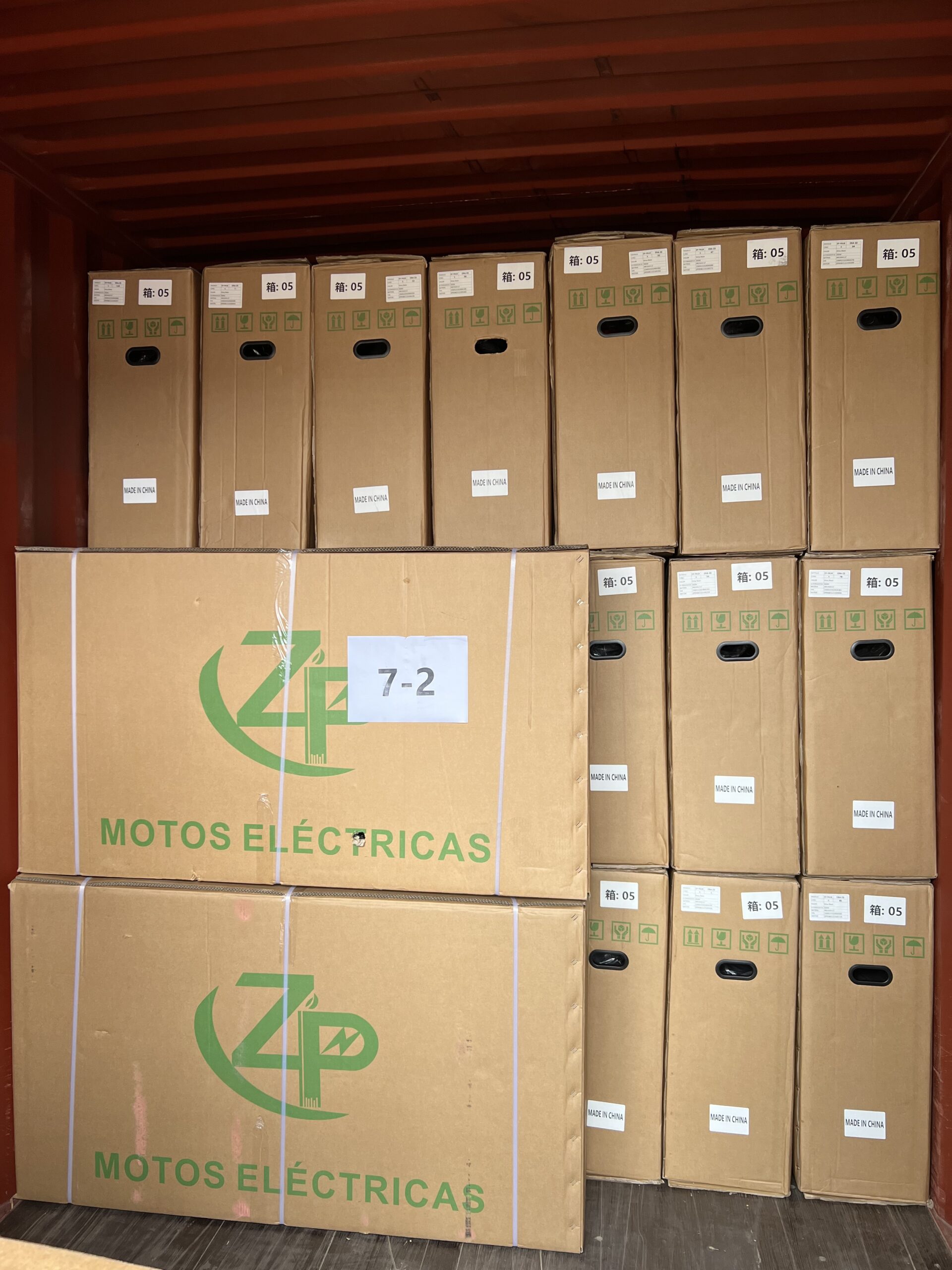
For 2000W 72V tank-style scooters with seat, typical crated dimensions are approximately 1.9m × 0.7m × 1.1m, weighing 110-130 kg per unit including battery. Container packing options:
| Packing approach | Units per 40ft HC | Total weight | Notes |
|---|
| Single-tier crate, vertical | 22-26 | ~3,000 kg | Maximum protection; lowest packing density |
| Two-tier nested crate | 28-32 | ~3,800 kg | Standard mainstream packing |
| Disassembled (handlebars + mirrors removed) | 34-40 | ~4,500 kg | Best density; requires importer assembly time |
The container is volume-limited, not weight-limited (max 26,500 kg) — even at 40 disassembled units, the container is only at ~17% of weight capacity. Most importers choose the two-tier nested crate as the practical balance between unit cost and warehouse handling time.
Reference video — what 2000W 72V looks like on the road
For context, here is a US-perspective review of a 2000W brushless 72V electric motorcycle in the same product category as the inquiry — useful both for buyers evaluating fitment to the US market and for distributors training staff on customer expectations:
The economic ladder — FOB to dealer wholesale
| Cost line | Approximate range | Notes |
|---|
| FOB China per unit (US-DOT prepped) | USD 950-1,400 | 2000W, 72V/30Ah lithium, VIN-allocated |
| Sea freight (40ft HC, 28 units typical) | USD 95-145 per unit | USD 2,800-4,200 container · LA / Long Beach / NY route |
| Marine insurance (Class 9) | USD 25-45 per unit | Class 9 endorsement adds 30-50% over standard cargo insurance |
| = CIF Los Angeles per unit | USD 1,070-1,590 | |
| US customs duty (HTS 8711.60.10) | 0% | Electric motorcycles classified under HTS 8711.60 currently 0% duty |
| Section 301 tariff (China-origin) | +25% | Applies to Chinese-origin electric motorcycles 2026 |
| Section 301 amount per unit | USD 270-400 | On CIF value |
| Customs broker + ISF + entry filing | USD 30-60 per unit | Spread over container |
| Inland to East Coast (if Atlantic destination) | USD 80-180 per unit | From West Coast port to dealer warehouse |
| = Dealer-warehouse landed cost | USD 1,450-2,230 per unit | Approximately 1.55-1.65× FOB |
| Typical dealer wholesale to retail dealer | USD 1,800-2,500 | Dealer margin 20-25% |
| Typical retail price to consumer | USD 2,400-3,800 | Retail margin 30-40% over wholesale |
Note on the 25% Section 301 tariff: This applies specifically to Chinese-origin electric motorcycles and is not transferable through transhipment via Vietnam, Indonesia, or Mexico unless the supplier has substantial value-add (typically defined as 35%+ value transformation) in the third country. This tariff has been the driving factor in some Chinese e-motorcycle manufacturers establishing assembly operations in Mexico (USMCA-eligible) for 2026-onward US imports — but for direct China-origin shipments, the tariff is part of the cost.
The state-by-state registration dimension
Once the importer's US-DOT containers arrive, dealer-network distribution faces state-by-state registration variance. Key categories:
- States with friendly e-motorcycle / moped registration — Texas, Florida, North Carolina, South Carolina, Georgia, Tennessee. Standard motorcycle title + registration, motorcycle license required for street operation.
- Restrictive states — California, New York, New Jersey treat 2000W+ as full motorcycles requiring CA Air Resources Board (CARB) certification (electric vehicles largely exempt but exemption letter required); New York requires DMV verification of VIN.
- Off-road-only states for low-power vehicles — some Western states classify low-DOT-spec units as off-road only, restricting street use.
Smart importers configure containers for specific state markets. A Florida-bound container with 28 units pre-titled for Florida moped registration is a different fulfilment than a New York container that requires individual VIN inspection at DMV. The supplier doesn't need to know all of this — but the supplier needs to provide VIN documentation that's valid for whichever state the importer is fulfilling.
Frequently asked questions
How does VIN allocation work for Chinese-made electric motorcycles imported to the USA?
Vehicle Identification Numbers (VINs) for vehicles imported to the USA are allocated by the Society of Automotive Engineers (SAE) under standard ISO 3779. For Chinese e-motorcycle manufacturers, the VIN's first character indicates country of origin (L for China), the second and third characters identify the manufacturer, and the remaining characters identify the model year, plant, and sequential serial. The manufacturer obtains a World Manufacturer Identifier (WMI) from SAE, then assigns sequential VINs per produced unit. Critically, vehicles intended for US registration as motorcycles (not e-bikes) require a 17-digit VIN that conforms to NHTSA standards and is permanently affixed to the frame. The supplier must produce VINs that pass NHTSA verification — counterfeit or duplicate VINs cause the vehicle to be detained at customs.
Does a 2000W 72V electric scooter qualify as an e-bike or a motorcycle in the USA?
Federal law (15 U.S.C. § 2085) classifies e-bikes as having motor power up to 750W and top speed below 20mph (under throttle). A 2000W 72V scooter exceeds both thresholds and is classified as an electric motorcycle, requiring DOT-compliant tires, lighting, mirrors, and frame, plus state-level motorcycle registration, insurance, and operator license. Some states have additional categories (Class 1/2/3 e-bikes, mopeds) with different power and speed thresholds. The Tank-style design described in the inquiry is consistent with US 'street-legal moped' or 'electric motorcycle' classification depending on state. Importers should specify DOT-compliance configuration explicitly to the supplier — the same physical machine can be configured for e-bike export (lower power firmware), moped export (mid-power), or motorcycle export (full DOT).
How many electric scooters fit in a 40-foot container?
For 2000W 72V tank-style scooters with seat (typical dimensions: 1.9m × 0.7m × 1.1m crated), a 40-foot high-cube container holds approximately 26-34 units depending on packing density, whether scooters are crated individually or stacked in nested pairs, and whether batteries ship inside the units or in separate compartments. Container weight is typically the limiting factor before volume — at ~110-130kg per scooter (including a 72V/30Ah lithium battery), the container approaches its 26,500kg maximum weight at 28-30 units. Importers should confirm with the supplier whether batteries ship installed (regulated as Class 9 dangerous goods, requires UN 3171 declaration) or separately (often shipped Section II Class 9 with reduced documentation).
What lithium-battery shipping documentation is required for sea freight to the USA?
Lithium-ion batteries for vehicles ship as UN 3171 (battery-powered vehicle) or UN 3480/3481 (lithium-ion battery in equipment or stand-alone). Documentation requirements: (1) UN 38.3 test report — mandatory verification that the battery has passed altitude simulation, thermal test, vibration, shock, external short circuit, impact/crush, overcharge, and forced discharge tests; (2) MSDS (Material Safety Data Sheet) for the specific battery chemistry; (3) IMDG Code declaration on the bill of lading; (4) for sea freight, proper Class 9 packaging marking; (5) certification that batteries are at less than 30% state of charge during shipping. The supplier must produce these documents — without them, the container is held at port indefinitely.
What are typical FOB China prices for 2000W 72V electric scooters?
At MOQ 20-30 units (one container), 2000W 72V tank-style electric scooters with lithium battery option range from USD 580-1,200 FOB China per unit depending on battery capacity (20Ah / 30Ah / 40Ah), build quality (entry-tier vs DOT-grade hardware), and feature set (digital dashboard, alarm system, USB charging port). The lower end covers entry-tier machines with smaller batteries and basic component grades; the upper end covers DOT-prepped units with larger batteries (≥30Ah), upgraded controllers, and US-spec lighting. For VIN-allocated, US-DOT-prepped units with full export documentation, expect USD 950-1,400 FOB per unit.
Why is the buyer specifying VIN and US export documentation explicitly?
Because most Chinese electric scooter exports go to markets where the units are sold as e-bikes or low-speed mopeds without state registration. US-bound containers require an entirely different documentation package: 17-digit VIN per unit, MCO (Manufacturer's Certificate of Origin) with VIN, DOT compliance attestation, EPA exemption letter for electric drive (CFR 40 Part 86 — though electric vehicles are largely exempt), and state-specific titling paperwork. By specifying these explicitly upfront, the importer is screening out suppliers who don't routinely export to the US market — about 70% of Chinese e-scooter manufacturers fall into this category and would need 6-12 weeks to set up VIN allocation and US documentation, derailing the import timeline.
Closing thought
The US importer who sent us this inquiry was not asking for a brochure. They were asking, implicitly, which Chinese supplier on your network actually has SAE WMI registration, ships UN 38.3-tested lithium batteries with full Class 9 documentation, has prior NHTSA-verified VIN history, and treats a US-bound container as a routine fulfilment rather than a 6-week documentation scramble?
That's the question this article exists to answer — by walking through the specification, the regulatory category in the US, the VIN allocation process, the lithium-battery shipping rules, and the state-by-state distribution dimension. If you're sourcing electric two-wheelers for the US market and want to skip directly to a shortlist, the supplier card above is where to start.
⚠ Important Disclaimer
Source & redaction: The buyer inquiry summarised in this article was received through our sourcing channels and has been redacted to remove all personal, company, and counterparty information. Quantities, specifications, and inquiry timing are preserved.
Regulatory information: Statements about US federal e-bike law (15 U.S.C. § 2085), NHTSA VIN requirements, DOT FMVSS standards, lithium-battery UN 38.3 / UN 3171 / UN 3480 / UN 3481 / IMDG Class 9 classifications, EPA exemption requirements for electric vehicles, and state-by-state registration variance reflect general regulatory observation as of 2026. Importers must verify current FMVSS, DOT, EPA, NHTSA, and applicable state-DMV requirements through qualified US legal counsel and licensed customs brokers before importing. Section 301 tariff rates change with US-China trade policy — confirm the current rate for HTS 8711.60.10 with a US licensed customs broker.
Pricing and lead times: All FOB ranges, freight estimates, tariff calculations, and dealer-margin figures reflect general market observation and may not apply to specific suppliers, container configurations, or shipment routes. Lithium-battery shipping insurance availability and pricing varies sharply between cargo insurance providers.
Supplier capability: Information about ZP Motos and the cross-linked supplier profiles was summarised from publicly available content on each supplier's website. ZP Motos's specific WMI registration status, NHTSA verification history for VIN allocations, US-DOT compliance configuration availability, and prior US-bound container reference shipments should be confirmed directly with the supplier before placing the PO.
No middleman role: Weisourcing provides supplier discovery and editorial content. Buyers are encouraged to work with suppliers directly through the contact channels published on each supplier's official website.