Brake and wheel-end work accounts for the largest share of recurring service revenue in any general workshop — far more than engine work, transmission, or even routine maintenance. Brake pads wear every 25,000-60,000 km. Brake discs warp or wear-thin every 80,000-150,000 km. Brake calipers seize from corrosion or piston failure every 8-12 years. Wheel bearings fail at 120,000-200,000 km. ABS sensor rings get destroyed by debris or curb impacts. For a workshop processing 800-1,500 vehicle visits annually, brake-and-wheel-end work represents 35-50% of total parts revenue and is the most predictable, repeat-purchase parts category in the entire aftermarket.
This guide is the focused companion to our general aftermarket-fit auto parts guide, narrowed specifically to brake system and wheel-end components — calipers, discs, pads, master cylinders, brake hoses, wheel hubs, bearings, and ABS sensor rings. For workshop owners, parts distributors, and specialty resellers focused on the brake-and-wheel-end category, this is the highest-velocity inventory you stock and the parts that drive the most steady annual revenue.
Product range — actual catalogue images
The product images below are hosted on the manufacturer's official website (kingrunauto.com) and link directly to the manufacturer's catalogue. Click any image to view the full specification page in a new tab.
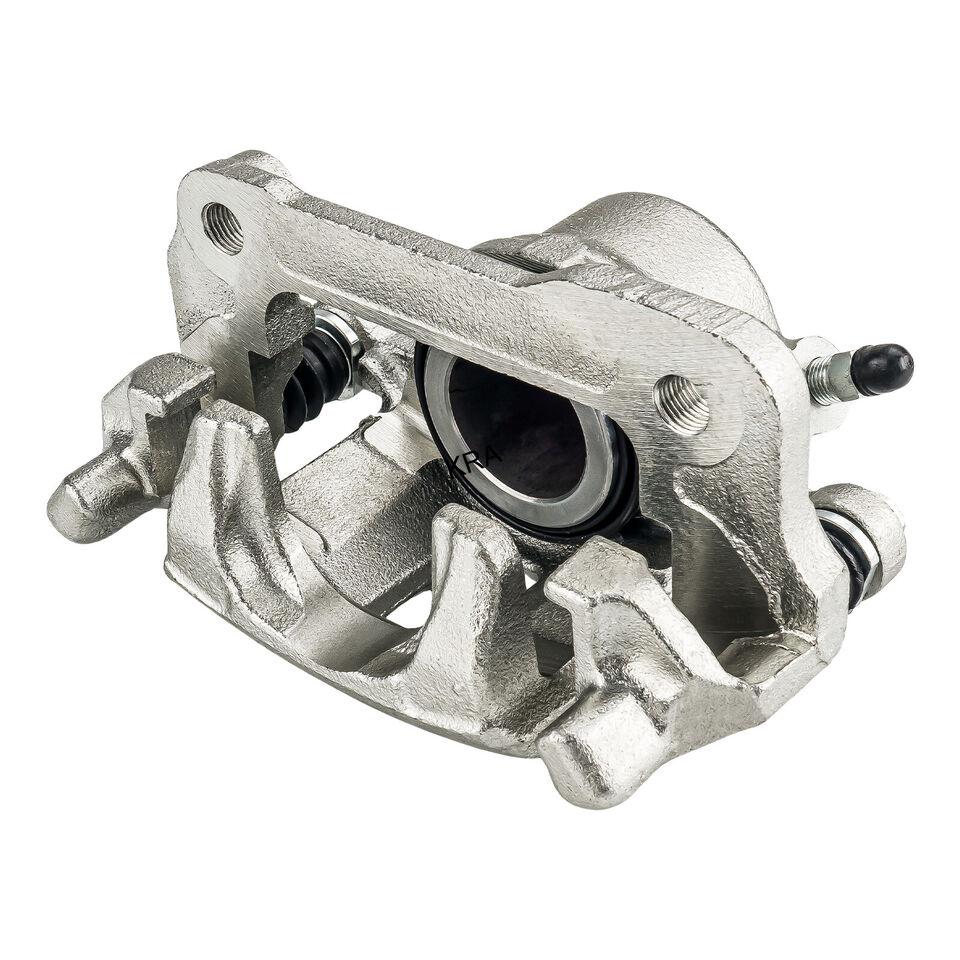
Brake caliper assembly — sliding pin design with piston boot and mounting bracket, pre-bled.
View on supplier site →
Wheel hub assembly with integrated ABS sensor ring — pair (LH+RH), ready-press fit.
View on supplier site →
Steering knuckle assembly — pair with ball joint and hardware kit pre-installed.
View on supplier site →
Complete suspension overhaul kit — control arms, tie rods, sway links, ball joints (one-shot job).
View on supplier site →Brake system parts — what you need to stock
| Component | Service interval (typical) | FOB China per unit (premium) | OE dealer per unit |
|---|---|---|---|
| Brake pad set (front) | 25,000-50,000 km | USD 6-22 | USD 45-180 |
| Brake pad set (rear) | 40,000-70,000 km | USD 5-18 | USD 38-150 |
| Brake disc / rotor (front) | 80,000-150,000 km or with 2-3 pad sets | USD 18-65 | USD 95-380 |
| Brake disc / rotor (rear) | 100,000-180,000 km | USD 14-55 | USD 75-280 |
| Brake caliper (single) | 8-12 years or major service | USD 35-95 | USD 220-450 |
| Brake caliper rebuild kit | 5-7 years for refurbishment | USD 8-28 | USD 35-110 |
| Master cylinder | 10-15 years or seal failure | USD 28-95 | USD 180-480 |
| Brake hose (single) | 8-12 years or visible cracking | USD 5-18 | USD 28-95 |
| Brake booster (vacuum) | 10-15 years | USD 65-180 | USD 380-850 |
| Brake fluid (per liter) | 2-year service interval | USD 1.20-3.50/L (DOT 3/4) | USD 8-22/L (dealer) |
| ABS sensor (wheel speed) | 5-10 years or impact damage | USD 12-38 | USD 95-280 |
| ABS module | 10-15 years (rare failure) | USD 95-280 | USD 580-1,800 |
Wheel-end components — bearings, hubs, knuckles
| Component | Service interval | FOB China per unit (premium) | OE dealer per unit |
|---|---|---|---|
| Wheel hub assembly (with bearing + ABS ring) | 120,000-200,000 km | USD 25-65 | USD 95-380 |
| Wheel bearing only (loose) | 120,000-200,000 km | USD 8-32 | USD 45-150 |
| Steering knuckle assembly | Replacement only on damage | USD 38-95 | USD 280-680 |
| ABS sensor ring (tone wheel) | Damage-driven replacement | USD 4-15 | USD 28-110 |
| Wheel stud (per piece) | Damage-driven; over-tightening | USD 0.80-2.50 | USD 4-12 |
| Wheel nut (per piece) | Damage-driven; corrosion | USD 0.50-2.00 | USD 3-10 |
| Lug bolt (European cars) | Damage-driven | USD 1.20-3.50 | USD 6-18 |
| Wheel speed sensor harness | 5-8 years (rodent damage common) | USD 8-25 | USD 65-180 |
Brake pad material selection — the spec that matters most
Brake pad material directly affects stopping performance, pad and disc service life, brake dust generation, and brake noise. Three primary material families:
| Material type | Composition | Best for | Service life | Brake dust | Noise |
|---|---|---|---|---|---|
| Semi-metallic | 30-65% steel/iron + ceramic + binder | Heavy vehicles, towing, high-performance | 30,000-55,000 km | High (dark dust) | Medium-high under braking |
| Ceramic | Ceramic + copper + non-ferrous metals | Daily-driver passenger cars | 40,000-70,000 km | Low (light dust) | Low under braking |
| NAO (Non-Asbestos Organic) | Glass fiber + rubber + carbon + binder | Quiet operation, low-stress applications | 30,000-50,000 km | Low | Lowest noise |
| Low-metallic NAO | NAO + 10-30% steel | Mid-range balance | 35,000-55,000 km | Medium | Medium-low |
Pad material selection by customer profile
Most distributors stock 2-3 pad material variants per common application. Recommended stock split for typical mixed-vehicle market: 50% ceramic (daily drivers, passenger cars), 30% semi-metallic (heavier vehicles, SUVs, light trucks), 15% low-metallic NAO (luxury sedans where brake dust on alloy wheels is a customer concern), 5% performance/sport variants for niche applications. Sub-USD-3-per-pad budget products are usually basic NAO with minimal metal content — adequate for older vehicles where the customer prioritizes price over performance, but not recommended for vehicles with active safety systems (ABS, ESC) where brake response consistency matters.
Brake disc specifications — solid vs vented vs drilled vs slotted
| Disc type | Application | FOB China premium | Notes |
|---|---|---|---|
| Solid disc (no vents) | Small cars, rear axles on most vehicles | USD 12-32 | Lower cooling requirement; cheaper to produce |
| Vented disc (internal cooling vents) | Front axles on most passenger vehicles | USD 18-65 | Standard for front; cooling vents reduce thermal warping |
| Drilled disc (cross-drilled holes) | Performance / sport applications | USD 32-95 | Marginal cooling improvement; can crack between holes under heavy use; mostly aesthetic |
| Slotted disc (curved slots) | Performance / racing | USD 28-85 | Removes pad gas + brake dust; reduces pad life ~15% |
| Drilled + slotted disc | Performance retail / appearance | USD 38-110 | Mostly aesthetic for mainstream customer; legitimate for track use |
| 2-piece floating disc | High-performance, weight-sensitive applications | USD 95-280 | Aluminum hat + iron friction ring; reduces weight 25-35% |
Quality tier definitions for brake parts
| Tier | Caliper material/process | Pad compound | Disc grade | Service life | Price ratio vs OE |
|---|---|---|---|---|---|
| Premium aftermarket-fit (KRA premium) | Cast iron with electrolytic zinc finish; full-bore honed; OE-grade seals | R90/ECE compliance; premium ceramic or semi-metallic | OE-equivalent G3000 cast iron, balanced ground | 85-100% of OE | 20-30% of OE |
| Standard aftermarket | Cast iron with primer + paint; standard seals | Standard NAO or basic ceramic | Standard cast iron, machined | 55-75% of OE | 10-18% of OE |
| Budget | Basic cast iron, painted; standard seals | Basic NAO, low-metallic | Lower-grade cast iron | 30-50% of OE | 5-10% of OE |
Why brake-system tier matters more than for any other part
Brake system failure has consequences no other part failure can match. A failed control arm causes alignment issues; a failed brake caliper or worn-through pad causes accidents, injuries, and potential fatalities. Workshop liability for a brake-related accident can exceed any vehicle's value. For brake parts, the operating cost difference between premium aftermarket-fit (USD 35-95 for caliper) and budget (USD 18-50) is meaningless against the risk of brake failure under emergency stop. Always specify premium tier for brake parts. Budget-tier may be acceptable for pads (visible wear lets customer monitor); never acceptable for calipers, master cylinders, brake hoses, or brake boosters where failure is sudden and catastrophic.
R90 certification — required for EU brake parts wholesale
EU Regulation 90 (R90) governs aftermarket-fit brake-pad and brake-disc compliance. Any brake part sold in EU markets must carry R90 certification. The certification process verifies that the aftermarket-fit part meets the same braking performance, fade resistance, recovery, and durability requirements as OE.
| Test category | Requirement | Why it matters |
|---|---|---|
| Friction coefficient | Within 15% of OE | Ensures braking distance comparable to OE |
| Fade resistance | Test at elevated temperatures | Brakes don't fade under repeated heavy use |
| Recovery | Performance returns after fade event | Brakes work reliably after hot stop |
| Wear rate | Within reasonable range of OE | Service life predictability |
| Compatibility with ABS | Friction profile compatible with ABS algorithms | ABS / ESC works as designed |
R90 certification testing costs approximately USD 8,000-15,000 per friction material × per disc/drum spec combination at accredited test labs. Most premium Chinese aftermarket factories maintain R90 certification on their highest-volume cross-references; budget-tier factories typically do not. For EU distributors, R90 is non-negotiable: non-certified parts will be seized at customs.
Equivalent certifications by region: USA — DOT-compliance + state-specific requirements; Russia/EAEU — EAC certification per GOST; Saudi Arabia — SASO; Brazil — INMETRO; South Africa — SABS Mark.
Container loading economics for brake parts
| Order tier | MOQ (mixed SKUs) | Discount | Container utilization | Lead time |
|---|---|---|---|---|
| Sample / dealer trial | 3-15 sets each SKU | List price; air courier | DHL / FedEx | 3-7 days |
| Workshop direct buy | 200-500 sets total | 5-15% | LCL or pallet | 10-20 days |
| Small distributor | 1500-3000 sets total | 15-25% | 20' container | 20-35 days |
| Mid distributor | 5000-12000 sets total | 25-35% | 40' or 40HQ container | 30-50 days |
| Large distributor / private label | 15000+ sets total | 35-48% | 40HQ x N containers | 50-75 days |
A 40HQ container of mixed brake parts holds approximately 8,000-15,000 sets depending on size mix (front pad sets pack densely; brake discs are heavy/bulky). For a new distributor, typical first container mixes 60-100 SKUs covering top brake pad + disc cross-references for the local vehicle parc, plus essential calipers, master cylinders, and wheel hubs.
Brake-focused workshop economics
Why brake-focused parts wholesale is the most stable category
Brake parts have three economic characteristics that make them the most attractive segment for parts wholesale:
- Predictable demand — every vehicle needs brake service on a schedule defined by mileage. Demand correlates with vehicle parc and average annual driving distance — slow but predictable trends, not subject to fashion cycles or technology disruption
- High repeat purchase — workshops typically replace customer brakes 2-3 times during the workshop relationship; each customer represents USD 200-700 brake-parts revenue per vehicle over its life
- Quality-tier discrimination — workshops can sell premium brake parts at premium pricing because customers understand the safety-critical nature; premium aftermarket-fit at 25-30% of OE price still feels like value to the customer paying a 30-50% retail markup
For new parts distributors building inventory, prioritize brake parts in the first container — they will be your highest-velocity, highest-margin, most stable revenue category over the next 5+ years.
Order workflow — brake-parts focused distributor
- Vehicle parc analysis — identify top 20-30 vehicle make/model/year combinations in your local market by registration data; this becomes your priority cross-reference list
- SKU mix planning — for each top vehicle, identify front pad set + rear pad set + front disc + rear disc + caliper rebuild kit. This generates 100-150 priority SKUs covering 80%+ of brake-service demand in your market
- Quality tier specification — premium tier for calipers, master cylinders, brake hoses, brake boosters (safety-critical, sudden-failure consequences); standard tier acceptable for pads (visible wear) and discs (visible warping); budget tier only for end-of-life vehicle market
- Sample order — 3-5 sets each of top 30-50 SKUs by air courier; functional test on actual customer vehicles, document pad bedding-in behavior, brake feel, noise level
- Certification verification — R90 certificates for EU markets, DOT compliance for US, SASO for Saudi, etc. Verify scope per SKU
- First container order — 1500-3500 sets across 60-100 SKUs based on local vehicle parc analysis
- Series replenishment — monthly air-freight replenishment for fast-movers (top 20% SKUs are 80% of volume); quarterly container replenishment for full inventory refresh
- Workshop training — for direct workshop sales, supplier-provided training on installation procedures, bedding-in, torque specs, ABS calibration helps workshops accept aftermarket-fit brake parts confidently