Concrete brick and block making machinery — concrete block machines, paving brick presses, AAC autoclaved aerated concrete plants, and related material-handling equipment — are foundational capital equipment for the global construction supply chain. Every developing market needs domestic brick and block production capacity to support residential and commercial construction; established markets need replacement and upgrade equipment for existing concrete-products plants. China is the world's largest producer of concrete-block making machinery with comprehensive product range across capacity tiers and quality levels. For aspiring brick plant entrepreneurs, established concrete-products manufacturers, construction-industry conglomerates, and machinery dealers in developing markets, sourcing brick-making equipment directly from a Chinese specialist factory delivers significant cost savings vs European/American equivalents at adequate-to-excellent performance for typical applications.
This guide covers the China BrickMate product family — fully automatic block machines (QT4-15, QT8-15, QT10-15, QT12-15 capacity tiers), semi-automatic block machines for smaller operations, paving brick presses, AAC autoclaved aerated concrete production lines, mortar production equipment, mixers and material-handling, curing chamber systems, and palletizing/packaging accessories. Real product images linking back to the supplier's catalog at chinabrickmate.com.
Product range — actual catalogue images
The product images below are hosted on the manufacturer's official website (chinabrickmate.com) and link directly to the manufacturer's catalogue. Click any image to view the full specification page in a new tab.
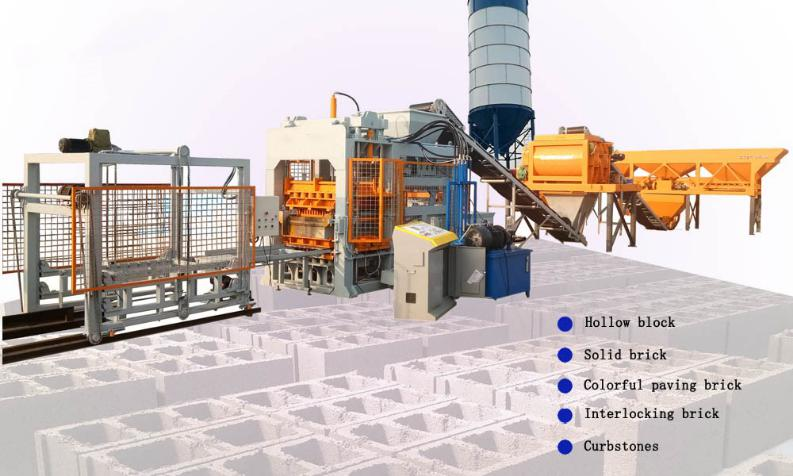
QT12-15 fully automatic concrete brick / block production line — multi-mold output, hollow blocks, solid bricks, paving bricks, interlocking bricks, curbstones.
View on supplier site →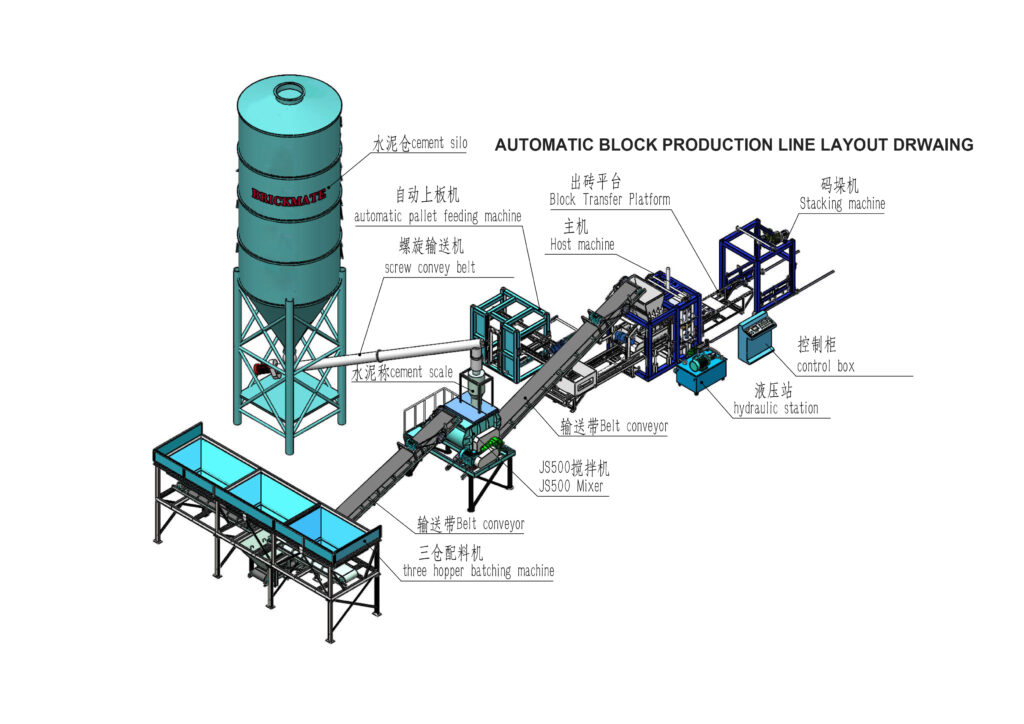
Brick production line flow chart — material handling, mixing, molding, curing, palletizing.
View on supplier site →Block machine capacity tiers
| Model | Mold size | Hollow block output (8" / 200mm) | Solid brick output | Typical FOB China price |
|---|---|---|---|---|
| QT4-15 (entry, small) | ~860 × 580mm | 2,400-3,200 pcs / 8hr shift | 4,800-6,400 pcs / 8hr | USD 14,000-22,000 |
| QT6-15 (mid-tier) | ~1000 × 1000mm | 4,000-5,200 pcs / 8hr | 8,000-10,400 pcs / 8hr | USD 28,000-42,000 |
| QT8-15 (popular tier) | ~1200 × 1000mm | 5,200-6,800 pcs / 8hr | 10,400-13,600 pcs / 8hr | USD 45,000-65,000 |
| QT10-15 (large) | ~1400 × 1100mm | 6,800-8,800 pcs / 8hr | 13,600-17,600 pcs / 8hr | USD 75,000-110,000 |
| QT12-15 (full automatic) | ~1500 × 1200mm | 8,800-11,200 pcs / 8hr | 17,600-22,400 pcs / 8hr | USD 120,000-185,000 |
| QT15-15 (premium) | ~1600 × 1200mm | 11,200-14,400 pcs / 8hr | 22,400-28,800 pcs / 8hr | USD 165,000-260,000 |
Capacity numbers (e.g., "QT8-15") indicate two parameters: first number is mold size class (production capability) and second number is cycle time in seconds. QT4-15 means small mold class, 15-second cycle (~4 cavities per cycle). Real-world output depends on labor efficiency, raw material consistency, and shift discipline; typical 60-75% utilization vs theoretical maximum.
Product types from concrete block machines
| Product | Typical dimensions | Mold change time | Common applications |
|---|---|---|---|
| Hollow block (concrete masonry unit, CMU) | 200 × 200 × 400mm or 150 × 200 × 400mm | 30-60 min mold swap | Load-bearing wall construction, infill walls |
| Solid concrete brick | 240 × 115 × 53mm or similar | 30-60 min mold swap | Load-bearing walls, retaining walls |
| Paving brick (interlocking) | 200 × 100 × 60-80mm various shapes | 30-60 min mold swap | Driveways, sidewalks, plazas, public spaces |
| Hollow block (curtain / non-load-bearing) | 200 × 100 × 400mm thinner walls | 30-60 min mold swap | Interior partitions, infill walls |
| Curbstone | 200 × 200 × 1000mm typical | 30-60 min mold swap | Road edge separation, landscaping |
| Insulating concrete (ICF) blocks | Custom geometry with EPS insulation insert | Specialty mold | Energy-efficient construction |
| Slope blocks (interlocking landscaping) | Custom geometry | Specialty mold | Landscaping, retaining walls, decorative |
| Concrete pipe / tile | Various | Specialty mold-machine combination | Drainage, cable trough, concrete tile |
Production line components and economics
| Component | Function | Typical cost (per QT8-15 line) |
|---|---|---|
| Block making machine (core) | Vibration molding, hydraulic pressing | USD 45,000-65,000 |
| Aggregate batcher | Sand, gravel, cement weighing and feeding | USD 12,000-22,000 |
| Concrete mixer (planetary, twin-shaft) | JS750 or JS1000 mixer for fresh concrete | USD 8,000-18,000 |
| Aggregate feeding belt | Convey material from batch plant to mixer | USD 4,000-12,000 |
| Mixer-to-machine conveyor | Convey fresh concrete to molding machine | USD 3,000-8,000 |
| Pallet supply system | Auto-feed wooden or PVC pallets to machine | USD 5,000-15,000 |
| Curing chamber (steam or natural) | Cure fresh blocks 12-48 hours | USD 18,000-45,000 (basic) up to 80,000 (climate-controlled) |
| Stacker / palletizer | Auto-palletize cured blocks for shipping | USD 35,000-90,000 |
| Pallet wrapping / strapping | Secure stacks for shipping | USD 5,000-12,000 |
| TOTAL TYPICAL LINE | Complete production line excluding building / civil works | USD 130,000-250,000 (QT8-15 tier) |
Production economics for block plant
| Cost element | Typical figure | Notes |
|---|---|---|
| Equipment (QT8-15 full line) | USD 130,000-250,000 | Capital cost |
| Building / civil works | USD 80,000-200,000 | Concrete pad, structure, drainage, electrical service |
| Total capital investment | USD 210,000-450,000 | Excluding land |
| Material cost per block (8" hollow) | USD 0.18-0.32 | Cement + aggregate + admixtures |
| Energy cost per block | USD 0.02-0.05 | Electricity for machinery + curing |
| Labor cost per block | USD 0.05-0.18 | Depends on country and automation level |
| Total cost per block | USD 0.30-0.55 | Excluding capital recovery |
| Selling price per block (typical local market) | USD 0.55-1.20 | Depends on market, quality, transport |
| Gross margin per block | USD 0.20-0.65 (35-55% gross) | Before capital recovery |
| ROI typical for QT8-15 line | 14-30 months | Depends on market demand |
Why concrete blocks remain economical
Despite the rise of alternative wall systems (steel framing, prefab panels, modular construction), concrete masonry continues to dominate residential and small-commercial construction in most developing markets and remains significant in developed markets. Drivers: (1) Local production possible — heavy aggregate is uneconomical to import, so block plants serve regional markets without competition from imports; (2) Labor-friendly construction — installation skills are widely available; (3) Cost-effective material per square meter of wall; (4) Fire-resistant and durable; (5) Acoustic / thermal performance acceptable for most applications. The production-cost differential between locally-made blocks and imported alternative wall systems typically favors blocks by 30-60% — a stable economic moat. Block plants installed in developing markets with population growth typically achieve breakeven within 12-24 months.
Pricing brackets — wholesale
| Order tier | Equipment scope | Discount vs list | Lead time |
|---|---|---|---|
| Single machine | Block machine only; buyer sources auxiliary equipment locally | List price | 30-60 days |
| Core production package | Block machine + mixer + batcher + main conveyors | 5-10% | 45-75 days |
| Complete production line | Full line including stacker, curing system, palletizer | 10-18% | 60-100 days |
| Multi-line / large project | Multiple production lines for larger plant | 15-22% | 90-150 days |
| Turnkey package | Equipment + installation supervision + training + commissioning support | Custom pricing | 120-180 days |
Order workflow — block machine procurement
- Capacity analysis — define daily production target (e.g., "5,000 8-inch hollow blocks per shift"); back-calculate required machine capacity tier with 25-40% headroom
- Site analysis — verify available power supply (typically 50-150 kW for QT8-15 line), water supply, drainage, and structural foundations; assess raw material logistics (sand, aggregate, cement supply chain)
- Mold specification — define which products to produce; choose mold inventory accordingly (typically 3-6 different molds in initial set)
- Supplier qualification — verify supplier maintains active production with reference customers, can provide installation supervision, has spare parts supply chain
- Sample / inspection visit — for capital-equipment purchases, factory inspection visit recommended before order; verify production capability and quality control practices
- Order placement — typically 30% deposit to start production, 60-65% before shipment, 5-10% after commissioning; clear technical specification in contract
- Pre-shipment inspection — third-party inspection or buyer site visit to factory before shipment; verify all components match specification
- Installation and commissioning — supplier provides supervision (typically 7-14 days on-site); buyer provides labor for installation; commissioning includes test production with operator training
- Ongoing operation — spare parts inventory (10-15% of equipment cost typical first-year stocking), preventive maintenance schedule, mold inventory expansion as product line grows