Commercial kitchen equipment — gas ranges, deep fryers, char broilers, ovens, refrigerators, freezers, ice machines, dishwashers, food processors, prep tables, sinks, shelving, and a hundred other items — represents one of the highest single-investment categories in the foodservice industry. A new restaurant typically invests USD 80,000-300,000 in commercial kitchen equipment; a hotel kitchen USD 200,000-2 million; a chain expansion or remodel can run into millions. Beyond initial purchase, the equipment must be reliable, durable, energy-efficient, easy to clean, and compliant with food-safety codes — failed equipment costs restaurants USD 1,500-15,000 per day in lost revenue and emergency replacements. China dominates global commercial kitchen equipment supply, with specialist factories serving everything from small independent restaurants to multi-national chain rollouts.
This guide covers the ACooker product family — commercial cooking equipment (gas ranges, electric ranges, fryers, char broilers, griddles, ovens, induction cooktops), refrigeration (commercial fridges, freezers, ice machines, salad bars, display cases), food processing (slicers, mincers, vegetable cutters, mixers, dough sheeters), stainless steel furniture (prep tables, sinks, shelving, hoods), warewashing (dishwashers, glasswashers), and supporting items. Real product images linking back to the supplier's catalog at acooker.com.
Product range — actual catalogue images
The product images below are hosted on the manufacturer's official website (acooker.com) and link directly to the manufacturer's catalogue. Click any image to view the full specification page in a new tab.
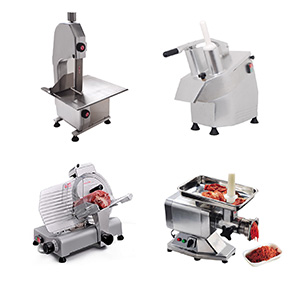
Commercial food processing line — bone saw, vegetable cutter, meat slicer, mincer in compact catalog grid.
View on supplier site →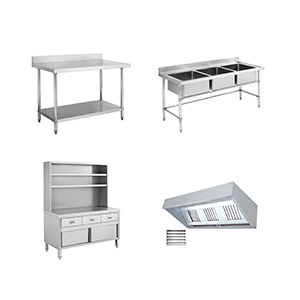
Stainless steel commercial kitchen equipment — prep tables, 3-compartment sinks, exhaust hoods, prep with shelving.
View on supplier site →Equipment categories and pricing brackets
| Category | Common items | FOB China typical price range |
|---|---|---|
| Commercial gas range (4-6 burner) | Free-standing range with oven below | USD 350-1,200 per unit |
| Commercial gas range (6-10 burner) | With double oven, salamander option | USD 1,200-3,800 per unit |
| Commercial deep fryer (single basket) | Free-standing 12-22L oil capacity | USD 220-680 per unit |
| Commercial deep fryer (double basket) | Higher-capacity twin basket | USD 480-1,400 per unit |
| Char broiler / grill (counter-top) | Gas-fired with lava rock or radiant | USD 280-1,100 per unit |
| Convection oven (single deck) | Forced-air convection, electric or gas | USD 580-2,400 per unit |
| Pizza oven (deck or conveyor) | Stone deck, gas or electric | USD 850-4,800 per unit |
| Rotary rack oven (bakery) | For high-volume bread/pastry production | USD 4,500-18,000 per unit |
| Combi steam oven | Combined convection + steam | USD 2,500-12,000 per unit |
| Induction cooktop (commercial) | High-power induction for restaurant use | USD 380-1,800 per unit |
| Walk-in cooler / freezer | Modular panel construction | USD 4,500-22,000 per unit |
| Reach-in refrigerator (1-3 door) | Stainless front, full-height | USD 680-2,800 per unit |
| Salad bar / cold display | Counter-top or free-standing | USD 850-3,200 per unit |
| Hot food display / bain-marie | Heated holding for buffet service | USD 380-1,800 per unit |
| Ice machine (50-200 kg/day) | Cube or flake ice production | USD 850-3,800 per unit |
| Commercial dishwasher (under-counter) | Hood-type for café/small restaurant | USD 1,200-3,800 per unit |
| Commercial dishwasher (rack conveyor) | High-volume restaurant/cafeteria | USD 6,500-28,000 per unit |
| Commercial meat slicer (10-14") | Manual or auto slicer | USD 220-980 per unit |
| Commercial meat mincer / grinder | 22-32 size with hopper | USD 280-1,400 per unit |
| Commercial vegetable cutter | Chop / dice / shred attachments | USD 380-1,200 per unit |
| Bakery dough mixer (spiral or planetary) | 20-80L bowl capacity | USD 580-2,800 per unit |
| Bone saw (commercial) | Vertical band saw for meat processing | USD 380-1,400 per unit |
| Stainless steel prep table | Standard 4ft to 8ft length, 304 SS | USD 180-680 per unit |
| 3-compartment sink (stainless) | With drain boards both sides | USD 480-1,800 per unit |
| Stainless steel shelving (4-tier) | NSF-grade adjustable | USD 120-480 per unit |
| Exhaust hood (4-12ft) | Type I cooking hood with grease filters | USD 580-3,800 per unit |
| Make-up air unit | For exhaust hood balance | USD 1,800-6,500 per unit |
Critical compliance certifications
| Certification | Scope | Markets where required |
|---|---|---|
| NSF/ANSI Standard 2 (food zones) | Food-contact equipment surfaces and design | USA — required for commercial use |
| NSF/ANSI Standard 4 (commercial cooking) | Cooking equipment standards | USA |
| NSF/ANSI Standard 7 (refrigeration) | Commercial refrigeration food safety | USA |
| UL listed | Electrical safety | USA / Canada |
| cUL / CSA | Canadian electrical safety | Canada |
| CE marking | EU machinery + electrical compliance | EU / EEA |
| EN 631 (gastronorm) | European standard pan sizing for prep equipment | EU |
| ETL listed | Alternative to UL listing in US | USA |
| RoHS | Restriction of hazardous substances | EU; increasingly other markets |
| Energy Star | Energy efficiency labeling | USA voluntary; preferred by chains |
| AGA (Australian Gas Association) | Gas appliance safety | Australia / NZ |
| SAA / RCM mark | Australian electrical safety | Australia / NZ |
| F-Gas / refrigerant compliance | HFC/HFO refrigerant rules | EU; tightening in other markets |
NSF / UL listing is non-negotiable in regulated markets
For commercial kitchen equipment in US installations, NSF (National Sanitation Foundation) listing for food-contact equipment and UL listing for electrical equipment are essentially mandatory. Health departments inspect for these listings; uncertified equipment may fail inspection or be ordered out of service. Chain restaurants typically require NSF listing as a condition of supplier approval.
For Chinese aftermarket-fit equipment to enter US market legitimately, manufacturer must work with NSF to certify specific product models. Counterfeit "NSF marked" equipment without legitimate certification creates liability for buyer if discovered. Verify NSF certification by checking the public NSF database (info.nsf.org) — listing should match exact product model. Reputable manufacturers like ACooker maintain proper certification on US-export models; budget-tier suppliers may sell uncertified equipment with counterfeit markings — never acceptable for US commercial use.
Common buyer profiles
| Buyer type | Typical project value | Equipment scope |
|---|---|---|
| Independent restaurant (new build) | USD 60,000-180,000 | 30-80 equipment items; full back-of-house + counter |
| Chain restaurant rollout (10-50 locations) | USD 500,000-3 million | Standardized equipment package per store; same SKU across rollout |
| Hotel kitchen (mid-size) | USD 250,000-800,000 | 50-150 items; banquet + room service + restaurant kitchens |
| Hotel kitchen (luxury / large) | USD 1-4 million | 200-500 items; multiple kitchens, bakery, banquet, fine dining |
| Catering / event company | USD 80,000-400,000 | Mobile equipment + central commissary; transport-friendly |
| School / institutional foodservice | USD 150,000-500,000 | Heavy-duty production equipment; cafeteria service line |
| Hospital foodservice | USD 200,000-1 million | HACCP-compliant; patient-tray system |
| Restaurant equipment dealer (regional) | USD 500,000-2 million annual purchasing | Catalog stock across 200-500 SKUs; project-based custom orders |
| Foodservice export distributor | USD 1-5 million annual | Multi-container shipments to specific country markets |
Key technical specifications
| Equipment | Critical specifications to verify |
|---|---|
| Gas equipment | BTU rating; gas type (natural / LPG); manifold pressure; ignition system (pilot, electronic, hot-surface); meets local gas code |
| Electric equipment | Voltage (single phase 220V/240V; 3-phase 380V/400V/480V); kW rating; amperage; plug type or hard-wire |
| Refrigeration | Refrigerant type (R134a, R290, R600a, R448A); ambient operating range; reach-in capacity; door swing direction |
| Cooking dimensions | Cooking surface area; chamber capacity (for ovens); BTU/hour input capacity |
| Stainless steel grade | 304 SS (standard food contact) vs 430 (cheaper, less corrosion-resistant); thickness (16-gauge typical for prep tables) |
| Insulation (refrigeration) | Polyurethane density; thickness (50-100mm typical); CFC-free |
| Welding quality (stainless) | TIG welds vs spot welds; smooth-finish for food contact |
| Casters / legs | NSF-listed casters with brakes; adjustable height legs |
Order workflow — commercial kitchen procurement
- Project scope analysis — work with kitchen designer or consultant to define equipment list per menu, throughput, kitchen layout; final equipment specification document with model numbers, dimensions, electrical/gas requirements, exhaust calculations
- Compliance specification — verify destination-market certifications (NSF, UL, ETL for US; CE for EU; AGA/SAA for Australia); explicit refrigerant compliance for refrigeration units
- Supplier shortlist — identify 2-4 candidate suppliers with relevant export track record + appropriate certifications
- Sample/showroom evaluation — visit factory or showroom; verify equipment quality, finish, controls, durability of construction
- Container order plan — typical commercial kitchen project fits 1-3 containers (40HQ); large hotel projects 5-15 containers; chain rollouts ongoing container streams
- Pre-shipment acceptance test — for major equipment (combi ovens, dishwashers, refrigeration), supplier should perform PSAT on actual product before shipping
- Container shipment — coordinate with kitchen-build schedule; equipment typically arrives 2-3 months before kitchen opening
- Installation + commissioning — professional installation + start-up; for major equipment, supplier engineer may attend on-site (especially for combi ovens, dishwashers, large refrigeration)
- Training + warranty period — operator training; warranty typically 12 months parts; spare parts kit recommended for high-failure consumables