weisourcing.com / products / Risheng PX / Porcelain Insulators & Transformer Bushings

Porcelain Insulators & Transformer Bushings from China โ€” A Wholesale Buyer's Guide

A practical sourcing guide for electrical porcelain insulators from China โ€” written for utilities, transformer manufacturers, switchgear assemblers, electrical contractors, and OEM distribution equipment buyers. Real product images from rishenginsulator.com covering low-voltage transformer bushings (1.2-3.6 kV), medium-voltage transformer bushings (10-35 kV), high-voltage bushings (72.5-145 kV), pin-type and post-type distribution insulators, suspension disc insulators, and specialty bushings (capacitor, reactor, breaker). Voltage class and standard mapping (IEC 60137, IEEE C57.19, ANSI C57.12, GB/T 4109, DIN 42533, ะ˜ะž Russian, BS EN 50386, IS 2099, JIS C 4202), construction specifications, pollution-class creepage selection per IEC 60815, application-specific selection criteria, pricing brackets, and the procurement workflow that establishes electrical porcelain sourcing relationships.

Manufacturer: Risheng PX (rishenginsulator.com)
Category: Chemicals, Adhesives & Synthetic
Reading time: 14 min

Electrical porcelain insulators are essential components in power distribution and transmission infrastructure โ€” transformer bushings that bring high-voltage conductors into transformer enclosures, pin-type insulators that support overhead distribution conductors on cross-arms, post insulators in switchgear, and various specialty bushing forms for breakers, capacitors, and reactors. Despite the rise of polymer composite alternatives in some applications, porcelain insulators retain dominant share in: medium-voltage transformer bushings (porcelain better for sealing under oil); high-temperature applications (porcelain stable to 200ยฐC+); legacy distribution networks (porcelain compatible with existing hardware); and applications where decades-long service life justifies higher initial cost.

This guide covers the Risheng product family โ€” low-voltage transformer bushings (1.2-3.6kV), medium-voltage transformer bushings (10-35kV), high-voltage bushings, pin-type and post-type distribution insulators, station-class post insulators, and specialty applications. Real product images linking back to the supplier's catalog at rishenginsulator.com.

Product range โ€” actual catalogue images

The product images below are hosted on the manufacturer's official website (rishenginsulator.com) and link directly to the manufacturer's catalogue. Click any image to view the full specification page in a new tab.
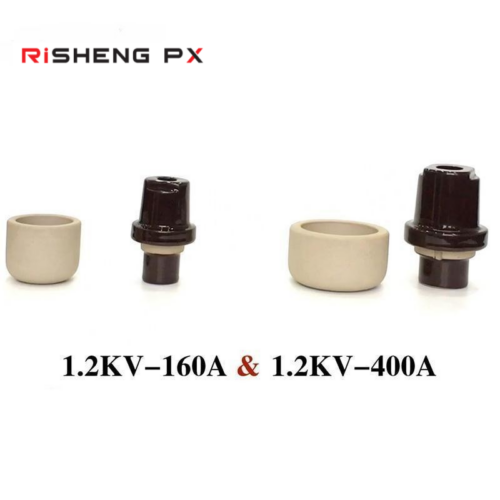
Risheng PX 1.2kV-160A and 1.2kV-400A low-voltage transformer bushing insulators.

Risheng PX 1.2kV-160A and 1.2kV-400A low-voltage transformer bushing insulators.

View on supplier site โ†’
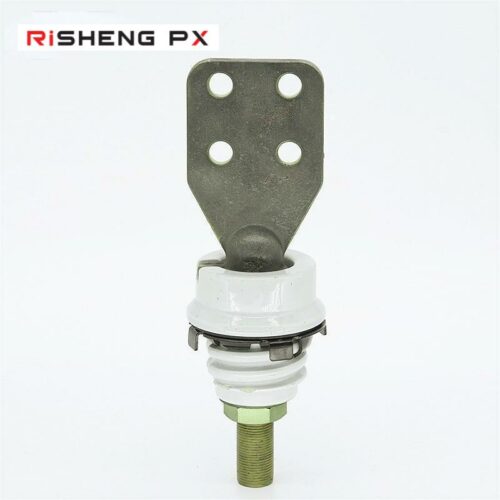
ANSI low-voltage ceramic bushing insulator with mounting bracket and threaded stud.

ANSI low-voltage ceramic bushing insulator with mounting bracket and threaded stud.

View on supplier site โ†’
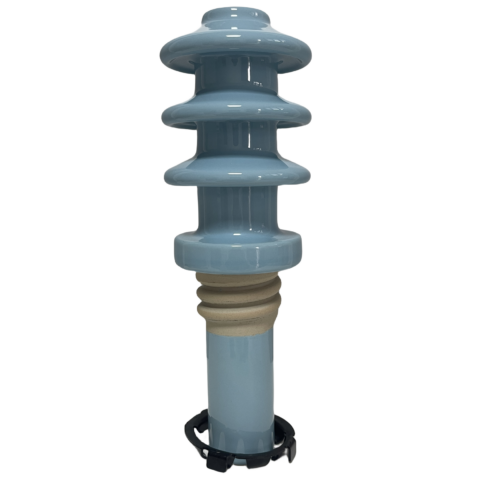
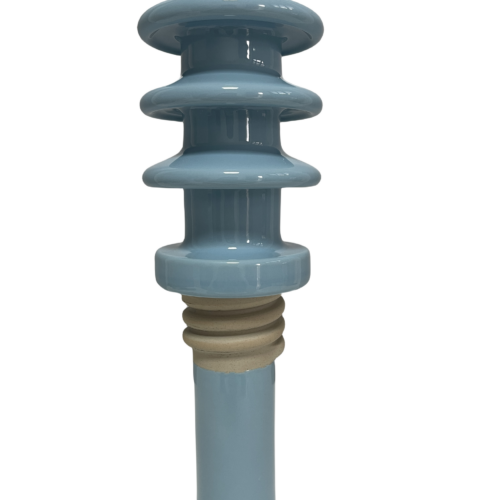
10kV threaded porcelain bushing โ€” multi-shed design for medium-voltage applications.

10kV threaded porcelain bushing โ€” multi-shed design for medium-voltage applications.

View on supplier site โ†’
Pin-type porcelain insulator โ€” for overhead distribution line support applications.

Pin-type porcelain insulator โ€” for overhead distribution line support applications.

View on supplier site โ†’

Product family overview

Product familyVoltage classCurrent ratingTypical FOB China per unit
Low-voltage transformer bushing1.2-3.6 kV160-3,150 AUSD 12-65 per unit
Medium-voltage transformer bushing10-15 kV250-3,150 AUSD 35-180 per unit
Medium-voltage transformer bushing20-35 kV250-2,000 AUSD 75-380 per unit
High-voltage transformer bushing (porcelain)72.5-145 kV630-2,000 AUSD 380-1,800 per unit
Pin-type distribution insulator11-33 kVN/A (line support)USD 4.50-22.00 per unit
Post-type insulator (station / substation)11-72.5 kVN/A (structural)USD 18-180 per unit
Disc insulator (suspension)11-220 kV chainN/A (suspension)USD 6-25 per disc
Cap-and-pin disc insulatorStandard 70-300 kN strength ratingsN/AUSD 4.50-12.00 per disc
Specialty (capacitor, reactor, breaker bushings)VariousVariesUSD 65-1,200 per unit

Voltage class and standards

StandardCoverageMarkets
IEC 60137 (transformer bushings)Bushing for transformers and reactorsEU, IEC-aligned countries
IEEE C57.19 (transformer bushings)Bushings for liquid-filled transformersUSA, IEEE-aligned countries
ANSI C57.12 (transformers)Bushings as part of transformer specificationsUSA, North America
GB/T 4109 (China national)Insulating bushings for transformersChina; export with this spec
DIN 42533 (Germany)Specific bushing dimensionsGermany, central Europe
ะ˜ะž (Russian)Russian electrical insulator standardsRussia, EAEU, former Soviet
BS EN 50386 (UK)Insulating bushings up to 1kV / 3.6kVUK, BS-aligned
IS 2099 (India)Bushings for transformers and reactorsIndia
JIS C 4202 (Japan)Transformer bushingsJapan, JIS-aligned

Construction specifications

SpecDescriptionTypical values
Porcelain compositionC-110 alumina porcelain (high-strength); C-120 / C-130 for higher BILMechanical strength 70-200 MPa
Glaze colorBrown / dark brown standard; gray for some markets; sky-blue for indoorUV-stable glaze for outdoor service
Conductor materialCopper standard; aluminum for cost-sensitive applicationsConductor sized to current rating
Sealing system (transformer bushings)Oil-tight gasket between porcelain and metal flangeNBR / Viton gaskets typical
Power frequency withstand voltageFor 10kV class: typically 42 kV (1 minute dry) / 30 kV (10 sec wet)Per IEC 60137 / IEEE C57.19
BIL (basic impulse level)For 10kV class: 95-110 kV; for 35kV class: 200 kV; for 145kV: 650-750 kVRequired by transformer specification
Creepage distanceFor polluted environments specify high creepage (25-31 mm/kV per IEC 60815)Light pollution: 16 mm/kV; heavy: 25-31 mm/kV; very heavy: 31+ mm/kV
Mechanical cantilever loadFor post insulators rated to specific cantileverStandard 4-12 kN; specialty up to 25 kN
Mechanical tensile (suspension discs)Standard 70/120/160/210/300 kNSpecified per chain configuration
Operating temperature-40ยฐC to +90ยฐC standard; specialty -60ยฐC to +120ยฐCClimate-appropriate spec

Application-specific selection criteria

ApplicationInsulator typeCritical specifications
Distribution transformer (utility pole)10/20/35 kV transformer bushingMatch transformer voltage; oil-tight sealing; UV-resistant glaze
Power transformer (substation)72.5-145 kV bushing (porcelain or RIP)BIL match; PD level test certificates; bushing condition monitoring tap
Overhead distribution line (cross-arm)Pin-type insulator 11-33 kVMechanical load (line tension); creepage for pollution class
Switchgear / RMUCompact bushing (epoxy or porcelain)Size constraint; PD level; GIS or AIS compatibility
Capacitor bankSpecialty capacitor bushingsCurrent rating matches capacitor; thermal cycling
Reactor (series, shunt)Reactor bushing (similar to transformer but different mechanical)Mechanical fault current handling; vibration tolerance
Breaker (oil-filled, SF6, vacuum)Breaker bushing (specialty)Mechanical fault current; pressure rating for SF6 types
Polluted environment (coastal, industrial)High-creepage bushing/insulatorIEC 60815 pollution class; field history in similar service
Cold climate (-30ยฐC ambient or below)Cold-rated porcelainTested below -40ยฐC; thermal-shock resistance
Hot/desert climateUV-stable glaze; thermal cycling testedOperating temp +90ยฐC continuous capable

Why standards matching matters more than people realize

Transformer bushings interface with both the transformer (mechanical fit, oil-tight seal) and the high-voltage system (electrical performance). A "10kV bushing" from one manufacturer is not necessarily interchangeable with a "10kV bushing" from another even within the same standard, because mounting flange dimensions, oil-side dimensions, and connection details vary by national standard family (DIN, IEC, IEEE, GOST). Specifying replacement bushings requires documentation of: (1) original transformer manufacturer and model; (2) standard family (DIN 42533 vs IEC vs IEEE); (3) specific dimensions if non-standard; (4) BIL, current rating, creepage required.

For utility maintenance procurement, working from the transformer's nameplate and OEM bushing part number is the safe path. Quality Chinese manufacturers like Risheng can produce equivalents to most major OEMs (ABB, Siemens, GE, Crompton Greaves, Hyundai, Mitsubishi) with proper specification documentation. Specifying just "10kV bushing" without standard family and dimensional details delivers something that may or may not fit the actual transformer.

Pricing brackets โ€” wholesale

Order tierTotal quantityDiscountLead time
Sample / spec verification1-10 unitsList price; air courierCatalog items 7-15 days; custom 30-50 days
Small wholesale20-100 units5-12%20-35 days for catalog; 45-60 for custom
Standard wholesale200-1,000 units12-20%30-50 days
Large project / utility purchase2,000-20,000 units18-28%50-90 days (single batch); split shipments possible
OEM / transformer manufacturer contractContinuous supplyNegotiated; typically annual contractJust-in-time per production schedule

Order workflow โ€” porcelain insulator procurement

  1. Application analysis โ€” define voltage class, current rating, BIL, creepage, mechanical loads, environmental conditions, and standard family (IEC/IEEE/DIN/GOST/etc.)
  2. Specification documentation โ€” for replacement applications, document original equipment make/model and OEM part number; for new equipment, document the transformer/breaker/switchgear specification
  3. Sample order with type test โ€” 1-3 units; verify dimensional accuracy, sealing system, and electrical performance via type test (independent test lab if needed, typically USD 800-3,500 per type test)
  4. Quality acceptance criteria โ€” for production batches, agree on acceptance test plan: routine tests (PD measurement, dielectric tests) on 100% of bushings; type tests on samples; mechanical tests on samples
  5. Volume order with batch QC โ€” typical 200-2,000 units per order; include pre-shipment inspection if order is large enough to warrant cost
  6. Field acceptance testing โ€” for critical applications (power transformers, large substations), perform commissioning tests (PD, dielectric, oil sample) before energizing; document for warranty
  7. Series replenishment โ€” utility maintenance orders typically aligned with annual outage planning + emergency stock for storm restoration

Risheng PX on weisourcing.com

View the full supplier profile, certifications, contact details, and complete product catalogue.

Frequently asked questions

How do Chinese aftermarket-fit porcelain insulators compare to ABB, Siemens, GE, or Hyundai equivalents?
Premium-tier Chinese manufacturers like Risheng deliver porcelain insulators at quality close to Tier-1 (ABB Micafil, Siemens, GE, Hyundai, Crompton Greaves, BHEL) at meaningfully lower cost. PERFORMANCE PARITY: for routine distribution-class porcelain bushings (1-35 kV), premium Chinese products meet equivalent IEC 60137 / IEEE C57.19 performance. Differences emerge at: (1) HIGHER VOLTAGE CLASSES (>72.5 kV) where Tier-1 has more accumulated service experience and refined design; (2) PD (PARTIAL DISCHARGE) performance โ€” Tier-1 typically maintains lower PD levels through more rigorous QC; budget Chinese variants can have PD levels marginally higher, acceptable for most service but not for the most demanding applications; (3) LONG-TERM AGING โ€” Tier-1 has more documented field history showing 30-50 year service life; Chinese aftermarket has 15-25 years of accumulated field history with similar trends. PRICE DIFFERENTIAL: Chinese aftermarket-fit typically 35-60% of Tier-1 list pricing for distribution-class products. For utility procurement at scale, the savings are significant. RISK MANAGEMENT: for critical applications (high-voltage power transformers, generator step-up units), specify Tier-1 if budget allows; for distribution-class applications (medium-voltage transformer bushings, pin insulators), premium Chinese aftermarket-fit delivers excellent value with proper specification and acceptance testing.
When should I specify porcelain vs polymer (silicone-rubber composite) insulators?
Two technologies with different optimal applications. PORCELAIN ADVANTAGES: (1) Mature with 100+ years of service history; (2) Stable under high temperature (oil-filled transformers, hot climates); (3) Better for transformer bushings (oil-tight sealing more reliable); (4) Easier to clean (smooth glazed surface); (5) Visual inspection of damage easier. PORCELAIN DISADVANTAGES: (1) Heavier (3-5x weight of polymer for same voltage class); (2) Brittle โ€” vandalism, projectile damage, or seismic events can cause catastrophic failure; (3) Lower performance in extreme pollution (sea salt, industrial) without supplemental cleaning. POLYMER (SILICONE RUBBER COMPOSITE) ADVANTAGES: (1) Much lighter โ€” easier handling and transportation; (2) Hydrophobic surface โ€” pollution doesn't form continuous wet film as readily; (3) Vandalism / projectile resistant โ€” bullet hits don't shatter; (4) Better in heavy pollution environments. POLYMER DISADVANTAGES: (1) Shorter accumulated service history (40-50 years vs 100+); (2) UV degradation can affect performance over decades; (3) Difficult to verify internal condition (can't see hidden damage); (4) Generally not used for transformer bushings (sealing complexity). SELECTION RULES: distribution lines in moderate climates โ†’ porcelain (cost-effective, proven); coastal / heavy-pollution / vandalism-prone areas โ†’ polymer (silicone rubber); transformer bushings โ†’ porcelain (especially for oil-filled transformers); rural transmission with vandalism risk โ†’ polymer composite. Many utilities use both types in their distribution mix and choose per location risk profile.
What pollution-class creepage distance should I specify for coastal or industrial environments?
IEC 60815 defines pollution classes and recommended unified specific creepage distance (USCD): CLASS I (LIGHT POLLUTION) โ€” Areas without industries; agricultural areas with light dust; minimum 16 mm/kV phase-to-phase. Examples: rural inland, light dust in dry climates. CLASS II (MEDIUM POLLUTION) โ€” Agricultural areas with moderate dust; areas with industries not producing pollution; coastal areas with mild salt influence; minimum 20 mm/kV. Examples: typical suburban areas, light coastal influence. CLASS III (HEAVY POLLUTION) โ€” Industrial areas with significant pollution; coastal areas exposed to salt mist; areas with extensive cement industry; minimum 25 mm/kV. Examples: chemical industrial parks, near coastlines, cement plant vicinities. CLASS IV (VERY HEAVY POLLUTION) โ€” Industrial areas with heavy emissions; coastal areas with strong salt influence; desert areas with frequent sandstorms; minimum 31 mm/kV. Examples: directly coastal, near smelters, severe industrial exposure. CLASS V (EXTREME POLLUTION) โ€” Marine offshore platforms; very specific industrial environments; specifications higher than 31 mm/kV. EXAMPLES OF SPECIFICATION: 33 kV pin insulator in coastal application = 33,000V ร— 25 mm/kV = 825 mm minimum creepage. Standard 33kV pin insulator creepage typically 600-1,000 mm depending on design. ENGINEERING PRACTICE: oversize creepage for actual conditions; cleaning schedule reduction in service; combined with periodic inspection for early failure detection. REGIONAL VARIATIONS: utilities in different countries have different standard creepage practices; verify with local utility standards before specifying.
What's the typical service life of porcelain insulators?
Porcelain insulator service life is exceptionally long under normal conditions. NORMAL SERVICE: 50-80 years for distribution-class; some installations have continuous service since 1920s-1930s with original porcelain still functional. MAJOR FAILURE MODES: (1) MECHANICAL DAMAGE โ€” vandalism (gunshots), projectile impacts, seismic events; not gradual aging but acute failure. (2) ELECTRICAL FLASHOVER โ€” pollution-induced flashover during wet conditions in inadequately specified creepage; cleaning and re-greasing extends service life. (3) THERMAL SHOCK โ€” rapid temperature changes can crack porcelain; rare but happens in extreme conditions. (4) METAL FATIGUE OF FITTINGS โ€” bolts, brackets, and conductor connections fatigue before porcelain typically. (5) GASKET DEGRADATION (transformer bushings) โ€” rubber gaskets harden over 30-50 years; replace during transformer overhauls. INSPECTION TYPICAL FINDINGS: 95-98% of distribution-class porcelain insulators inspected after 30-40 years show no significant deterioration; failures concentrated in: (1) badly specified creepage in actual pollution; (2) mechanical damage; (3) gasket-related issues. ECONOMIC IMPLICATIONS: porcelain insulators are extraordinarily long-lived assets with effective amortization over 50-80 years; specifying premium-quality at small price premium per unit delivers exceptional total cost of ownership. PROCUREMENT IMPLICATION: don't over-optimize for unit price; prioritize quality and proper specification โ€” failure cost (outages, restoration, possible safety incidents) far exceeds price savings.
How do I verify that received insulators meet specified electrical performance?
Three-tier verification approach: (1) MANUFACTURER'S TYPE TEST CERTIFICATES โ€” initial product approval should include type test certificates from accredited high-voltage test labs (CESI Italy, KEMA Netherlands, KEPRI Korea, etc.). Type tests cover: power frequency withstand voltage (dry/wet), lightning impulse withstand, switching impulse (HV applications), partial discharge, radio interference voltage, mechanical (cantilever/tensile), thermal shock. Verify certificates are current (typically valid 5 years) and from accredited lab. (2) ROUTINE TESTS ON 100% OF PRODUCTION โ€” every shipped unit should have: dimensional check, visual inspection, power frequency dry withstand voltage, partial discharge measurement (if specified). Test results should accompany shipment as routine test certificates. Premium Chinese manufacturers like Risheng provide this documentation. (3) FIELD ACCEPTANCE TESTING โ€” for critical/high-voltage applications, conduct independent commissioning testing before energizing: insulation resistance (>10,000 Mฮฉ); power frequency withstand at reduced voltage; for transformer bushings, oil-impregnated paper PD if applicable. INDEPENDENT VERIFICATION: for high-stakes orders, send 1-3 sample units to accredited test lab for full type test verification; cost USD 800-3,500 per sample but provides definitive assurance. Reputable manufacturers welcome independent verification; suppliers refusing third-party testing are red flags. PROCUREMENT BEST PRACTICE: include explicit acceptance test requirements in purchase contract; specify that supplier covers retest cost if failures are found; require routine test certificates per shipment.
What are MOQ and lead time for custom porcelain insulators?
Custom porcelain insulators require die fabrication and pilot production runs. STANDARD CATALOG ITEMS โ€” manufacturers maintain inventory or quick-turn capability for common voltage class / current ratings. MOQ as low as 10-50 units; lead time 7-30 days. CUSTOM DIMENSIONS (existing standard with specific dimensions) โ€” manufacturers can adjust existing dies or use modular tooling. MOQ typically 100-500 units; lead time 30-50 days. CUSTOM SHAPES (new bushing or insulator design) โ€” requires new die fabrication, often new pilot production runs, type testing on prototypes, and qualification before volume production. MOQ typically 1,000-5,000 units; lead time 90-180 days including: 30-45 days die fabrication, 30-45 days pilot production and testing, 15-30 days type testing if certifications needed, 30-60 days volume production. NRE COSTS: die fabrication USD 3,500-15,000 typical; pilot production tests USD 1,500-5,000; type testing at independent lab USD 5,000-25,000 depending on voltage class. AMORTIZATION: NRE costs amortized into per-unit pricing for first volume order (10-25% premium typical) or paid as separate engineering charge. SUBSEQUENT ORDERS: same custom item ordered again has standard production lead time (30-50 days) without NRE. PLANNING IMPLICATIONS: for custom transformer bushings tied to specific transformer manufacturer needs, plan 6-9 months from initial specification to first production delivery. For utility customers, this often means coordinating with transformer purchase well in advance. Standard catalog items remain the practical choice for most distribution-class applications.
โš  Important Disclaimer

Source: Product images on this page are hosted on the manufacturer's official website (rishenginsulator.com) and link directly back to that website. All product information was summarised from the supplier's public catalogue.

Brand mentions and trademark compliance: References to Tier-1 transformer and bushing manufacturer brands (ABB Micafil, Siemens, GE, Hyundai, Crompton Greaves, BHEL, Mitsubishi, Hitachi) are made for the sole purpose of describing functional benchmarks and equivalence reference. Risheng (Pingxiang Risheng Electrical Porcelainfor Co., Ltd.) is not authorized by, affiliated with, or endorsed by any of these brand owners. Products are manufactured under Risheng's own brand or buyer-private-label only.

High-voltage safety: Porcelain insulators handle voltages from 1.2 kV through 145 kV+ which can be lethal. Installation, testing, and maintenance must be performed by qualified electrical workers with appropriate personal protective equipment per local electrical safety regulations (OSHA 1910.269 in USA, EN 50110-1 in EU, IEC 61936-1 globally). Improper installation can cause flashover, equipment damage, fire, or serious injury / death. Verify all required local certifications and engineering review before commercial deployment.

Standards verification responsibility: Buyer is responsible for verifying that received porcelain insulators meet all required electrical, mechanical, and dimensional specifications for the specific application. Routine test certificates from supplier should be verified; independent type testing from accredited high-voltage labs (CESI, KEMA, KEPRI, etc.) is recommended for critical applications. Specifying without proper standards documentation increases risk of incompatibility or field failure.

Pricing & specifications: All price ranges, voltage class capabilities, and tier definitions reflect general market observation. Confirm current pricing, MOQ, lead time, and configuration directly with the supplier.

No middleman role: Weisourcing provides supplier discovery and editorial content. All transactions occur directly between buyer and supplier through the contact channels published on the supplier's official website.