weisourcing.com / products / Huisun Solar / Solar Street Lights & Off-Grid Systems

Solar Street Lights & Off-Grid Solar Systems from China — Municipal & Rural Electrification Wholesale Guide

A practical sourcing guide for solar street lights and off-grid solar systems from China — written for municipal procurement, infrastructure contractors, off-grid project developers, distributors, and rural electrification agencies. Real product images from huisunsolar.com.cn covering all-in-one integrated solar street lights (PV + battery + LED + controller in single housing, 30-200W LED capacities), split-type solar street lights with separate panel + light, garden and pathway bollard lights, large-area solar floodlights for parking lots and sports fields, solar warning/barrier lights for construction safety, signage/billboard lights, and complete off-grid solar systems (1-200+ kW capacity for residential, commercial, telecom, and microgrid applications). All-in-one vs split-type selection criteria, sizing methodology by application, application use cases (rural electrification, municipal lighting, off-grid telecom, solar water pumping, refugee camps), certifications, and the procurement workflow that establishes profitable solar lighting / off-grid solar distribution.

Manufacturer: Huisun Solar (huisunsolar.com.cn)
Category: Solar / Renewable Energy
Reading time: 14 min

Solar street lights, off-grid residential solar systems, and remote-area solar installations represent a growing global market driven by: (1) rural electrification programs in developing markets where grid infrastructure is limited; (2) urban and municipal lighting infrastructure investment; (3) commercial parking and community facilities; (4) emergency/disaster recovery installations; (5) cost-effective alternatives to grid-connected lighting where utility connection cost is prohibitive. China dominates global production of solar street lights and integrated off-grid solar systems with comprehensive coverage from low-cost municipal applications through premium designer-grade installations. For municipal procurement, infrastructure contractors, off-grid project developers, distributors, and rural electrification agencies worldwide, sourcing solar street lights and complete off-grid systems directly from a Chinese specialist supplier delivers significant cost savings while maintaining adequate-to-excellent quality.

This guide covers the Huisun Solar product family — all-in-one integrated solar street lights (PV + battery + LED + controller in single housing), split-type solar street lights (separate panel + light), garden and pathway solar lights, large-area floodlights with solar panel + remote battery box, off-grid residential solar systems (3-15 kW capacity), commercial off-grid solar systems (15-50 kW capacity), and complete off-grid energy solutions including panels, charge controllers, batteries, and inverters. Real product images linking back to the supplier's catalog at huisunsolar.com.cn.

Product range — actual catalogue images

The product images below are hosted on the manufacturer's official website (huisunsolar.com.cn) and link directly to the manufacturer's catalogue. Click any image to view the full specification page in a new tab.
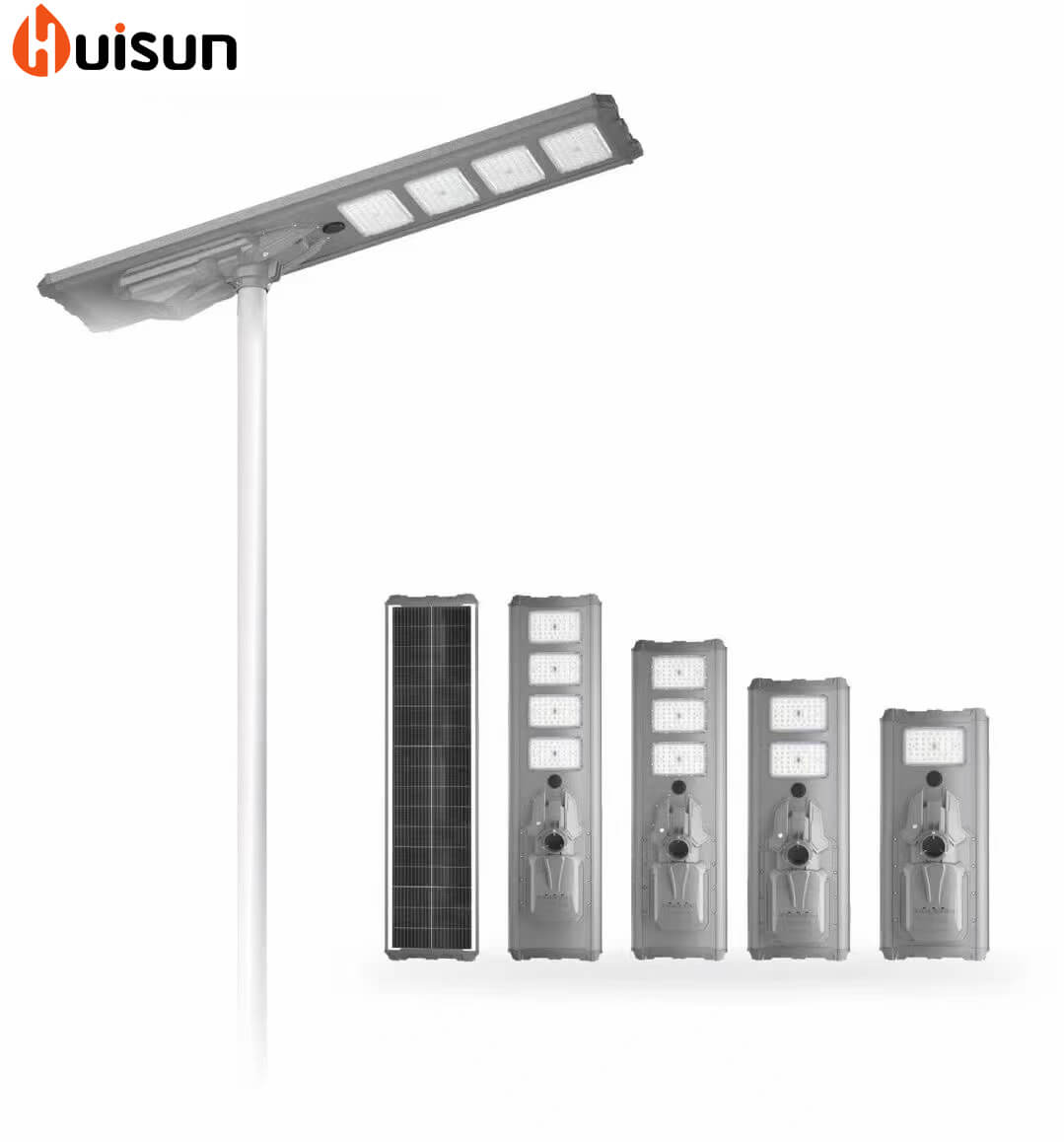
All-in-one integrated solar street light range — single-piece design with PV panel, lithium battery, LED, and controller integrated.

All-in-one integrated solar street light range — single-piece design with PV panel, lithium battery, LED, and controller integrated.

View on supplier site →
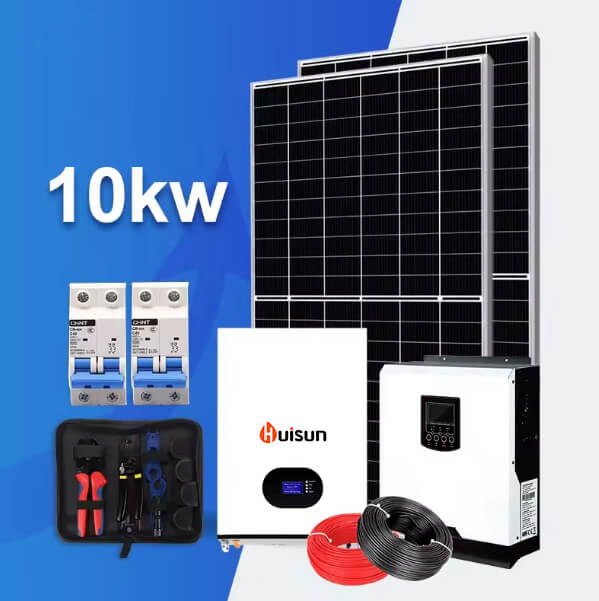
Off-grid 10kW residential solar system — panel array + storage + inverter for remote and unreliable-grid applications.

Off-grid 10kW residential solar system — panel array + storage + inverter for remote and unreliable-grid applications.

View on supplier site →
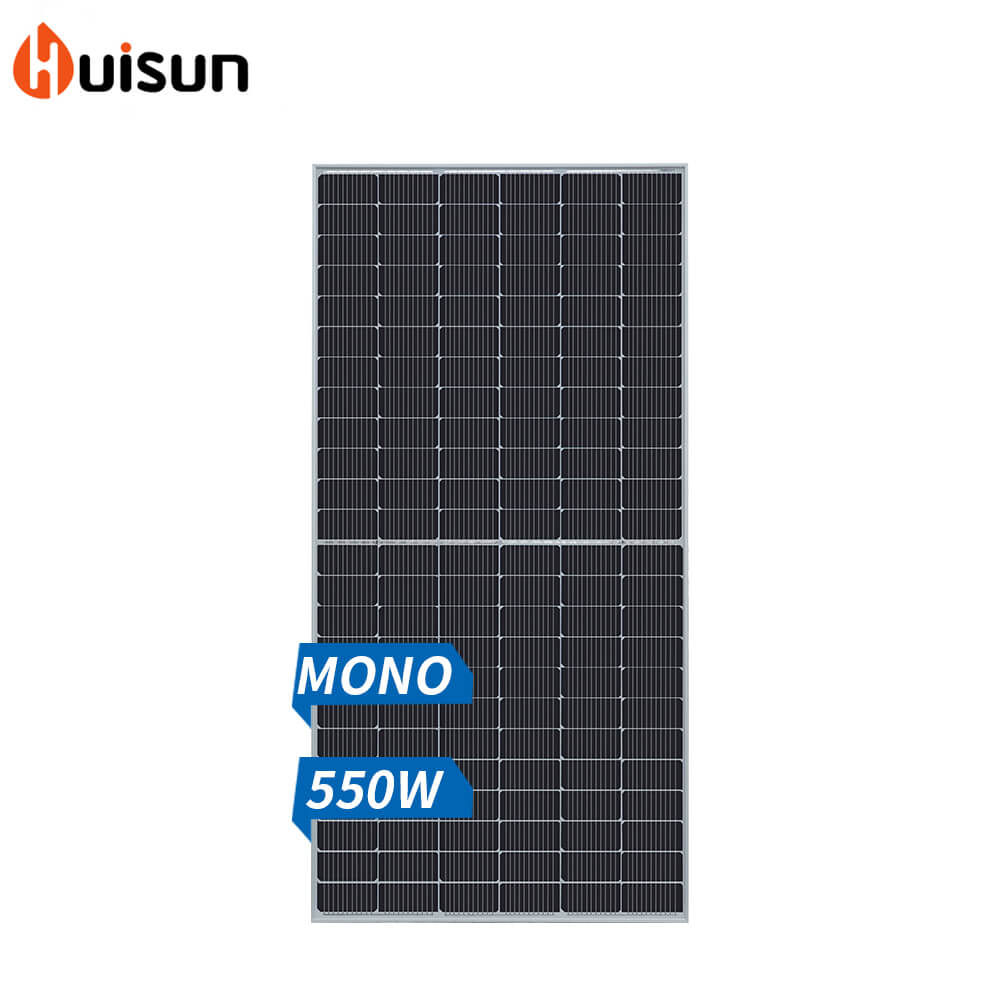
550W monocrystalline solar panel — utility-grade mono PERC for off-grid and remote-area applications.

550W monocrystalline solar panel — utility-grade mono PERC for off-grid and remote-area applications.

View on supplier site →

Solar street light categories

TypeWattage rangeBattery capacityCommon applicationsFOB China typical price
All-in-one integrated30-100W LED + 30-100W PV panel10-40 Ah LiFePO4Pathways, residential streets, parksUSD 65-280 each
All-in-one premium100-200W LED + 80-200W PV panel30-80 Ah LiFePO4Main roads, commercial areas, premium municipalUSD 220-550 each
Split-type (separate panel + light)40-200W LED + separate PV panel20-80 Ah LiFePO4Wide-spaced installations, taller poles, premium lookUSD 95-380 each (light + panel)
Garden / pathway light (5-30W)3-30W LED + small PV panel5-15 Ah LiFePO4Residential pathways, garden lightingUSD 25-120 each
Solar floodlight (large area)100-500W LED + PV panel + remote battery box50-200 Ah LiFePO4Parking lots, sports fields, securityUSD 280-950 each
Solar warning / barrier light5-20W LED + small PV panel3-8 Ah LiFePO4Construction zones, traffic safetyUSD 35-180 each
Solar bollard light5-30W LED + integrated PV5-15 Ah LiFePO4Walkway markers, decorative lightingUSD 35-150 each
Solar billboard / signage light30-100W LED + PV panel20-50 Ah LiFePO4Roadside signage, billboardsUSD 120-420 each

Off-grid solar system packages

System sizeComponentsApplicationFOB China typical price
Small home (1-3 kW)2-6 panels + MPPT charge controller + 5-15 kWh battery + 2-3 kW inverterBasic residential lighting + appliancesUSD 1,800-4,500
Mid home (3-5 kW)6-10 panels + MPPT + 10-20 kWh battery + 3-5 kW inverterFull residential power, kitchen, A/CUSD 3,500-8,500
Premium home (5-15 kW)10-30 panels + MPPT + 15-50 kWh battery + 5-15 kW inverterWhole-home off-grid, all loadsUSD 7,500-22,000
Commercial (15-50 kW)30-100 panels + multiple MPPTs + 30-150 kWh battery + 15-50 kW inverterTelecom tower, irrigation, mining camp, hospitalUSD 18,000-65,000
Industrial (50-200 kW)100-400 panels + multi-string + 100-400 kWh battery + multi-inverterIndustrial site, agriculture irrigation, processingUSD 55,000-180,000
Microgrid (200+ kW)Large panel array + central control + container battery + multiple invertersVillage microgrid, commercial campus, remote operationsUSD 175,000-1,200,000

All-in-one solar street light specifications

SpecificationTypical 100W LEDNotes
LED power100WEquivalent to ~250-400W traditional
Lumens output15,000-18,000 lmPremium high-efficacy LEDs
Color temperature3000K, 4000K, 5000K, 6500K options5000-6500K most common for streets
CRI (Color Rendering)Ra ≥ 75 typicalHigher for premium products
PV panel100W monoSized 1.0-1.2× LED wattage typical
Battery30 Ah LiFePO4 (12.8V)~384 Wh; powers 12-15 hours typical
Cycle life (battery)2,500-4,000 cycles~6-10 years service typical
Working time per charge10-15 hours night operationWith 5-day battery autonomy
Sensor / motion detectionPIR optional, microwave optionalAuto-dim or auto-on options
Pole height compatibility4-8 meters typicalStandard street light pole heights
IP protectionIP65 (waterproof)Outdoor weather resistance
Operating temperature-30°C to +60°CBattery thermal management for extreme
Lifespan / warranty50,000 hours LED / 5-year warrantyBattery 6-10 year service

All-in-one vs split-type — which is right for your project?

ALL-IN-ONE INTEGRATED LIGHTS — PV panel, battery, LED, and controller in single housing mounted at top of pole. PROS: (1) Faster installation (no panel-light wiring); (2) Lower theft risk (no separate components); (3) Lower system cost; (4) Cleaner aesthetic; (5) Better for residential streets and parks. CONS: (1) PV panel size limited to mounting space (typical 50-200W max); (2) Battery housed at top requires lifting for service; (3) PV panel may collect bird droppings affecting performance.

SPLIT-TYPE LIGHTS — separate PV panel + light fixture connected by cable. PROS: (1) Larger PV panel possible (up to 300W+); (2) PV positioned for optimal sun angle; (3) Battery accessible at base of pole; (4) Better for high-output applications. CONS: (1) Higher installation cost (panel + light wiring); (2) Two separate components; (3) Higher theft risk on visible panel; (4) Less aesthetic.

SELECTION RULE: residential streets, parks, light commercial → all-in-one; main roads, premium municipal, high-output applications → split-type. Most projects mix both based on specific street type.

Pricing brackets — wholesale

Order tierTotal quantityDiscountContainer utilizationLead time
Sample / pilot project5-50 unitsList price; LCLLCL or partial20-35 days
Small distributor / municipal pilot50-300 units5-12%20' container (~80-150 all-in-one units)30-50 days
Mid distributor / project500-2,500 units12-22%40' container (~200-400 units)40-70 days
Major project / national distributor5,000+ units20-30% frameworkMultiple 40HQ containers50-100 days

Application use cases

ApplicationTypical specificationsMarkets
Rural village street lighting30-60W LED all-in-one; 200-300 lights per villageAfrica, South Asia, Latin America rural electrification
Municipal road lighting60-150W LED split-type; 5-7m pole; thousands of unitsWorldwide, especially developing market urban
Commercial parking lots100-300W LED floodlight; 6-8m pole; coverage areaGlobal commercial, retail, industrial parking
Sports field lighting200-500W LED floodlight; multiple poles per fieldEducational, recreational facilities
Highway and bridge lighting100-200W LED split-type; 8-12m pole; long stretchesNational infrastructure projects
Residential pathway lighting5-30W LED bollard or post; ambient lightingWorldwide residential
Industrial / mining site100-300W LED floodlight; perimeter securityMining, oil/gas, large industrial
Off-grid telecom tower3-10 kW system + battery + tower lightingCellular infrastructure in remote areas
Off-grid water pumping1-15 kW solar + DC pump + tankAgriculture, livestock, rural water supply
Refugee camps / disaster recovery5-50 kW system + LED lighting + charging stationsHumanitarian deployment

Order workflow — solar lighting + off-grid system procurement

  1. Application analysis — define use case (street lighting, off-grid system, specific application); identify key parameters (lumen output, runtime, pole height, environmental conditions)
  2. Site assessment — for off-grid systems, verify available space, sunlight conditions, expected daily energy consumption, backup days requirement
  3. Specification selection — choose LED wattage, battery capacity, panel size based on requirements + 25-50% margin for cloudy days
  4. Sample order — typically 5-20 units for pilot installation; verify build quality, performance, weather resistance, ease of installation
  5. Pilot installation — 30-90 day field test; document any issues with installation, performance, durability
  6. First commercial order — typically 500-3,000 units for distributor business launch or municipal pilot
  7. Quality acceptance — incoming inspection per AQL plan; verify each unit's specifications match purchase order
  8. Series replenishment — quarterly orders or framework agreement for ongoing supply

Huisun Solar on weisourcing.com

View the full supplier profile, certifications, contact details, and complete product catalogue.

Frequently asked questions

How long do solar street lights last, and what's the maintenance schedule?
Component lifespans differ across the system. LED LIGHT MODULE — typical lifespan 50,000+ hours which equates to 10-15 years for typical 12-15 hour nightly operation; high-quality LEDs may last 80,000-100,000 hours. Failure modes: gradual lumen depreciation (replacement when below 70% original output), driver electronics failure, occasional LED chip failure. BATTERY (LiFePO4) — typical lifespan 6-10 years (2,500-4,000 cycles at one cycle per night). Failure modes: capacity degradation (replacement when below 70-80% original), internal short circuits, BMS failure. PV PANEL — typical lifespan 25+ years with gradual efficiency degradation; can outlast other components if installed properly. Failure modes: micro-cracks from thermal cycling, encapsulation degradation, junction box failure. CONTROLLER — typical lifespan 5-8 years; failure modes: capacitor failures, solid-state component aging. STRUCTURAL POLE — 15-25 year lifespan depending on coating quality and environment. MAINTENANCE SCHEDULE: (1) ANNUAL — visual inspection, cleaning of PV panel surface, verification of light operation; (2) BIENNIAL — battery testing for capacity, controller diagnostics; (3) AT 6-8 YEAR MARK — typical battery replacement (largest maintenance event); (4) AT 10-15 YEAR MARK — LED replacement if light output significantly degraded. TOTAL LIFETIME COST: typical premium solar street light system runs 15-25 years total service before complete replacement, with battery replacement at 6-10 years being primary mid-life maintenance event. For municipal applications, battery replacement budget should be planned at year 6-8 of installation.
How do I size a solar street light for specific application?
Three parameters drive sizing: required brightness, battery autonomy, and load duration. STEP 1 — REQUIRED BRIGHTNESS: (1) Quiet residential street: 30-50W LED equivalent, ~5,000-8,000 lumens; (2) Local roads: 50-100W LED, ~8,000-15,000 lumens; (3) Main municipal roads: 100-200W LED, 15,000-30,000 lumens; (4) Highway/major arterial: 150-300W LED, 25,000-45,000 lumens; (5) Sports field/parking: 200-500W LED floodlight per fixture. SPACING: typical 25-40 meters between lights for residential streets, 30-50 meters for arterial roads. STEP 2 — BATTERY AUTONOMY: how many cloudy days the system should run without sun. Typical: 2-3 days for partly cloudy regions, 3-5 days for cloudy regions, 5-7 days for very cloudy or polar regions. Battery capacity = LED watts × hours per night × autonomy days × 1.3 (efficiency factor). Example: 100W LED × 12 hours × 3 days × 1.3 = 4,680 Wh = ~366 Ah at 12.8V LiFePO4. STEP 3 — PV PANEL SIZE: must replace daily energy use plus battery losses. Typical: PV panel watts = 1.0-1.5× LED watts in sunny climates; 1.5-2.5× in cloudy climates. Example: 100W LED in moderate climate = 120-150W PV panel needed. STEP 4 — INTEGRATION CHECK: verify all components fit physical space; for all-in-one units, panel size limited by mounting; for split-type, consider pole geometry and panel mounting. Reputable suppliers like Huisun Solar provide application-specific sizing tools and recommendations.
What's the difference between standard and premium solar street lights?
Wide quality range exists in solar street light market. STANDARD/ECONOMY TIER (USD 65-180 per all-in-one unit): low-cost LED chips (lower efficacy, faster degradation), small basic PV panel, 5-15 Ah battery (limited capacity), basic plastic housing, basic controller, 1-2 year warranty, 3-5 year typical operational life. Best for: cost-driven projects with replacement budget, short-term applications, low-priority installations. MID-TIER STANDARD (USD 180-380 per unit): premium LED (better efficacy and color rendering), appropriately-sized PV panel, 20-40 Ah battery, IP65 aluminum housing, MPPT controller, 3-5 year warranty, 7-12 year typical life. Best for: most municipal applications, residential streets, parks, balanced cost/performance. PREMIUM TIER (USD 350-650+ per unit): premium high-efficacy LED chips (Cree, Lumileds tier), large PV panel (premium mono), large LiFePO4 battery (60-100+ Ah), aluminum die-cast premium housing with thermal management, smart controller with motion detection / smart dimming, 5-7 year warranty, 12-15 year typical life. Best for: premium municipal projects, commercial applications, harsh environments, projects with extended warranty requirements. SELECTION CONSIDERATIONS: (1) LIFE-CYCLE COST analysis — premium tier often cheaper per year when including replacement avoidance; (2) ENVIRONMENT — harsh climates (high heat, humidity, salt spray) require premium tier durability; (3) APPLICATION CRITICALITY — main roads need premium tier reliability; (4) BUDGET ALLOCATION — for cost-driven projects, mid-tier strikes best balance. Reputable suppliers like Huisun Solar offer all tiers with clear specifications.
How does an off-grid solar system compare to grid-tied with backup?
Different system architectures with different applications. OFF-GRID SOLAR — no grid connection; system handles 100% of energy needs. Properties: (1) Battery sized for full autonomy (typically 1-3 days storage); (2) Larger system size (must cover worst-case daily consumption); (3) No grid backup option (requires careful sizing); (4) Higher capital cost per kWh of consumption; (5) Independence from utility - immune to grid outages. Best for: remote locations without grid access, applications where grid connection cost is prohibitive, RV/boat/specialty applications. GRID-TIED WITH BACKUP — grid-connected system with battery storage. Properties: (1) Battery sized for backup duration (typically 4-12 hour outage coverage); (2) Smaller system overall (grid covers shortfall); (3) Lower capital cost per kWh of consumption; (4) Grid serves as effectively-infinite backup; (5) Net metering can provide revenue/credit. Best for: urban/suburban locations with reliable grid access, applications with grid available but desire for backup, places with favorable net metering. ECONOMIC COMPARISON: typical off-grid system costs 1.5-3x more per kWh of effective consumption than grid-tied + backup; the difference goes to larger battery capacity. SIZING DECISION: (1) Verify grid connection cost and availability — sometimes grid connection cost makes off-grid economical; (2) Calculate true energy independence value — for some users, immunity from grid outages is valuable beyond pure economics; (3) For temporary/seasonal applications (cabins, RVs), off-grid is often the only practical choice. Mixed systems (grid-tied with backup PLUS expandable to off-grid mode) provide best of both.
How do I plan a rural electrification project with solar street lights?
Municipal solar street lighting project follows a structured implementation framework. STEP 1 — PROJECT SCOPE DEFINITION: (1) Total street kilometers to be lit; (2) Light spacing standards (typical 30-50m); (3) Required light type per zone (residential: 60-100W LED, main roads: 100-200W LED); (4) Total quantity calculation (kilometers × lights per km); (5) Project budget envelope. STEP 2 — TECHNICAL SPECIFICATION: (1) Climate zone (sun hours, temperature range, salt/dust exposure); (2) Required battery autonomy (cloudy days backup); (3) Pole height and mounting hardware; (4) Anti-theft and vandal-resistant features; (5) Installation labor availability and skill level. STEP 3 — SUPPLIER QUALIFICATION: (1) Verify supplier maintains relevant CE / IEC certifications; (2) Reference customers in similar climate / use case; (3) Production capacity to deliver project quantity in required timeframe; (4) After-sales service capability for spare parts and warranty. STEP 4 — PILOT INSTALLATION: (1) Install 10-50 units in representative location; (2) 90-180 day performance verification; (3) Document any issues or modifications needed; (4) Refine specification before main order. STEP 5 — MAIN PROCUREMENT: (1) Place order with detailed delivery schedule (often phased over 6-18 months); (2) Quality control protocol with first-article inspection; (3) Installation training for local crews; (4) Documentation in local language. STEP 6 — INSTALLATION: typical 5-15 lights per crew per day; large projects 6-24 month installation period. STEP 7 — COMMISSIONING & MAINTENANCE: (1) Operational verification of each unit; (2) Inventory of spare parts at site; (3) Local maintenance training; (4) Annual maintenance contract typical. PROJECT TIMELINE: 2-5 years typical from concept through full deployment for medium municipality (1,000-5,000 lights). FUNDING: often financed by national / international development funds (World Bank, Asian Development Bank, African Development Bank); supplier should support documentation requirements. Reputable suppliers like Huisun Solar provide technical and project-management support.
What documentation should I receive with my solar lighting / off-grid system order?
Comprehensive documentation enables installation, operation, and warranty enforcement. EQUIPMENT DOCUMENTATION: (1) Specification sheet for each component (LED, battery, panel, controller) showing actual delivered specifications; (2) Material/component certifications (battery UN 38.3, panel IEC 61215, etc.); (3) Photovoltaic panel flash test data (per panel for utility-scale); (4) Warranty cards for each component with terms and contact information. INSTALLATION DOCUMENTATION: (1) Installation manual in customer's language; (2) Wiring diagrams; (3) Foundation/pole specifications; (4) Mounting hardware specifications; (5) Tools and consumables required for installation. OPERATIONAL DOCUMENTATION: (1) User manual for end users; (2) Operation manual for maintenance crews; (3) Spare parts list with part numbers; (4) Recommended maintenance schedule; (5) Common troubleshooting guide. CERTIFICATION DOCUMENTATION: (1) Mill test certificates for batteries; (2) IP rating certificates (water/dust resistance); (3) CE marking documentation for EU customers; (4) UL listing for US customers; (5) Country-specific certifications (BIS for India, INMETRO for Brazil, RCM for Australia). PROJECT DOCUMENTATION: (1) Bill of Materials with serial numbers; (2) Quality control reports; (3) Pre-shipment inspection reports; (4) Packaging and shipping documentation; (5) Customs declaration documents. COMMERCIAL DOCUMENTATION: (1) Commercial invoice; (2) Packing list; (3) Bill of lading; (4) Certificate of origin; (5) Insurance certificate if covered. Reputable suppliers like Huisun Solar provide complete documentation packages aligned with destination market requirements; verify documentation requirements at quote stage to avoid surprises during customs clearance.
⚠ Important Disclaimer

Source: Product images on this page are hosted on the manufacturer's official website (huisunsolar.com.cn) and link directly back to that website. All product information was summarised from the supplier's public catalogue.

Brand mentions and trademark compliance: References to Tier-1 LED chip and lighting brands (Cree, Lumileds, Osram, Philips, Nichia) are made for the sole purpose of describing functional benchmarks. Huisun Solar is not authorized by, affiliated with, or endorsed by any of these brand owners. Products are aftermarket-fit cross-reference manufactured under Huisun Solar's own brand or buyer-private-label only.

Installation and code compliance: Solar street light installations must comply with destination jurisdiction structural codes, electrical safety codes, and lighting performance standards (e.g., ANSI/IES RP-8 for roadway lighting in US, EN 13201 for Europe). Use qualified installers and follow local permit/inspection processes.

Battery transport regulations: Lithium batteries are classified as dangerous goods (UN 3480/3481). Transport must comply with UN 38.3, IATA DGR, IMDG Code, DOT regulations. Documentation requirements are extensive; experienced suppliers handle pre-shipment documentation.

Pricing & specifications: All price ranges and tier definitions reflect general market observation. Real-world solar lighting performance depends significantly on local sun conditions, ambient temperature, installation quality, and load profile. Confirm current pricing, MOQ, lead time, and certification scope directly with the supplier.

No middleman role: Weisourcing provides supplier discovery and editorial content. All transactions occur directly between buyer and supplier through the contact channels published on the supplier's official website.