Determining the right amount of flux (nepheline or feldspar) for your ceramic body requires balancing vitrification requirements against cost, thermal expansion, and other body properties.
Technical Details
Here is a practical calculation approach. Step 1 — Define your target water absorption. This determines the degree of vitrification needed: below 0.5% requires aggressive fluxing (25-30% nepheline); 0.5-3% requires moderate fluxing (18-25%); 3-10% requires light fluxing (10-18%). Step 2 — Calculate total alkali contribution. Multiply your nepheline percentage by its alkali content: for K200, 25% x 14.37% total alkali = 3.59% total alkali in the body. For vitrified bodies, target 3-5% total alkali from flux sources.
Practical Application
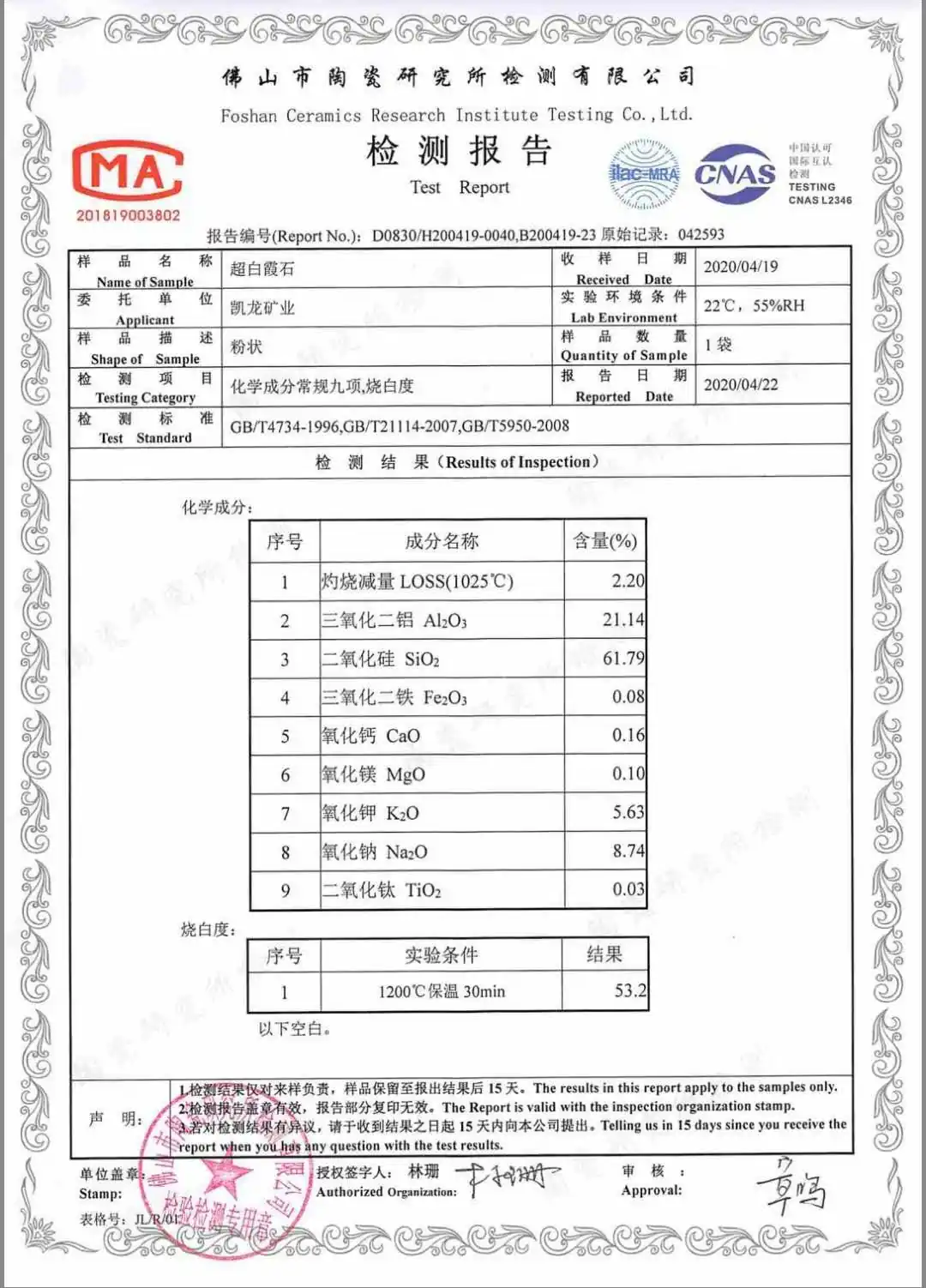
Step 3 — Account for clay contribution. Your clay also provides some flux (typically 1-3% alkali). Add this to the nepheline contribution. Step 4 — Adjust for firing temperature. Higher firing temperature requires less flux. Lower temperature requires more.
Our Products & Recommendation
As a rule of thumb, each 20 degree C decrease in firing temperature requires approximately 2-3% more nepheline in the body. Step 5 — Fine-tune experimentally. The calculation gives a starting point; laboratory trials with 3-5 formulations spanning plus/minus 5% nepheline will identify the optimum. Request our samples for your trial work..