Selecting Universal Joints For Multi Roll Tension Levelers
Torque calculation with the right service factor, and the articulation angle that decides fixed against plunging type.
Where The Joint Sits In The Drive
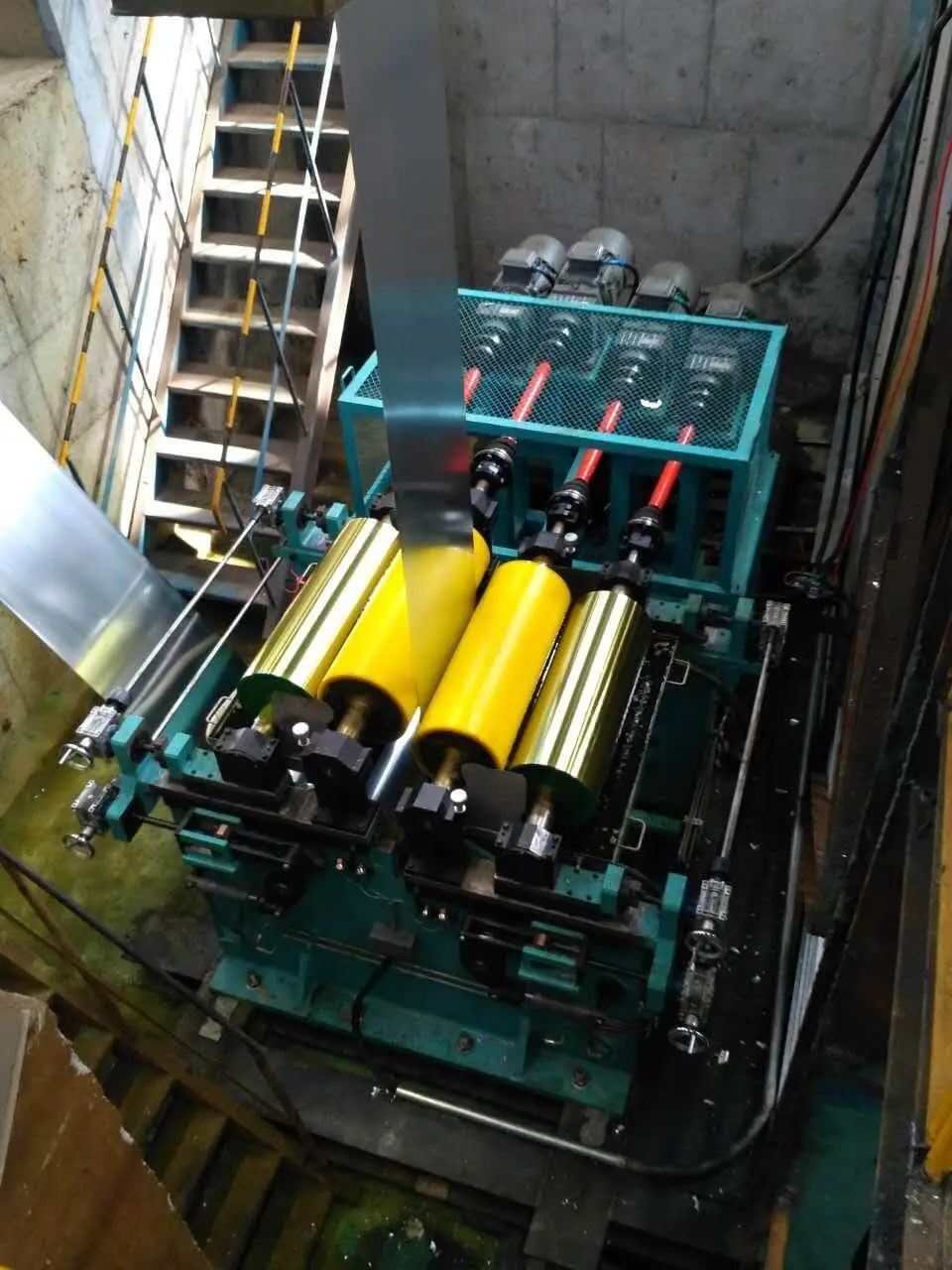
Multi roll tension levelers flatten coil and sheet by passing strip through staggered rolls that impose repeated bending, eliminating residual stress and shape defects. At the heart of the drive train the universal joint connects the gearbox to each leveling roll, transmitting torque while accommodating shaft misalignment.
Sizing comes down to two parameters. Torque value and articulation angle. Everything else follows from those two.
Torque Calculation
Start from theoretical torque, T = 9550 × P / n, where P is drive power in kW and n is operating speed in r/min. That figure alone is not a selection.
Leveler duty involves severe shock loads, frequent reversals and peak torques that can instantaneously double the nominal value. Levelers fall under a heavy shock load category with a service factor K typically between 2 and 3, so the calculated torque Tc = T × K must not exceed the nominal torque rating Tn of the coupling.
- T = 9550 × P / n gives theoretical torque
- K between 2 and 3 for heavy shock leveler duty
- Selection is valid only when Tc = T × K stays below Tn
- Ball type CV joints carry 0.5 to 1 times more load than cross shaft joints at the same rotational diameter and angle

Articulation Angle Decides The Type
The second decisive factor is the angular offset between drive shaft and leveling roll. Roll gap adjustment, housing deflection and thermal expansion create continuous angular offsets in service.
Fixed type joints are used where no axial movement is required. Plunging or sliding types allow axial stroke during torque transmission, compensating for thermal expansion and roll adjustment. Get this wrong and the joint fights the machine instead of serving it.
The Model Families
Our range covers two families of constant velocity ball type joints, fixed and plunging, in model series including BJ, DOJ, BOS, BOJ and BC. Torque runs from 380 N·m up to 1,000,000 N·m with rotational diameters from 36 mm to 720 mm.
That spectrum covers light auxiliary drives through to the heaviest rolling mill applications, which is why the calculation matters more than the catalogue. The same physical envelope can be specified several ways.
Products Mentioned In This Article
Ball Cage CV Universal Joints for Heavy Industry
Fixed and plunging ball cage CV joints from 380 N·m to 1,000,000 N·m, working angles to 75 degrees.
View Details
Ball Cage Constant Velocity Universal Coupling
Fixed and sliding CV couplings, 380 N·m to 1,000,000 N·m, swing diameter 36-725 mm.
View Details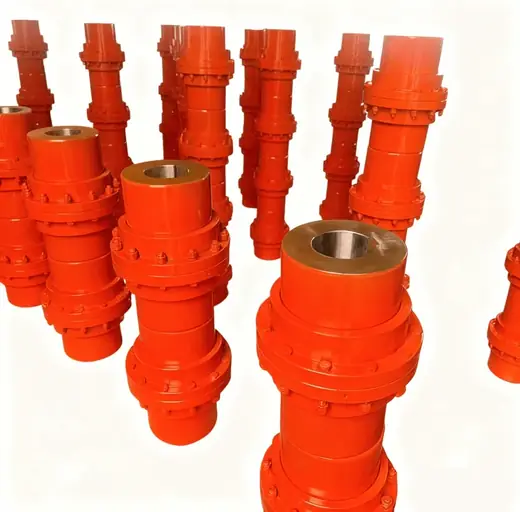
Heavy Duty Universal Joints
High strength joints for continuous casters, rolling mills and heavy duty conveyors.
View Details
Ball Cage CV Joints for Metallurgical Drives
BJ, DOJ and BC series six ball CV joints with IT4 grade raceways for metallurgical drive lines.
View DetailsReader Questions
What service factor should we use?
For leveler duty, between 2 and 3. Levelers are classed as heavy shock load applications because of reversals and instantaneous peak torque.
How do I know whether we need a plunging type?
If thermal expansion or roll gap adjustment changes the distance between gearbox and roll during operation, you need a plunging type. If the distance is fixed, a fixed type is correct.
How much more capacity does a ball type joint give?
At the same rotational diameter and angle, load carrying capacity can be 0.5 to 1 times higher than a traditional cross shaft universal joint.
What do you need from us to select a joint?
Drive power and speed, the working angle range, the installed length and whether axial movement occurs during operation.
Size A Joint For Your Leveler
Send drive power, speed and working angle and we return the model and torque check.