
Cutting The Spare Parts Budget Without Cutting Line Stability
What actually differentiates consumable roll suppliers, and how to qualify one without betting the line on it.
The Real Cost Pressure
For metallurgical plants and processing lines, consumable rolls carry material, apply pressure and protect surfaces. They are irreplaceable and they are bought continuously, which is why they dominate the spare parts budget.
Procurement cost, long delivery lead times and complicated after sales channels are what push purchasing managers to reconsider a long standing source. The question is never whether a cheaper roll exists. It is whether an alternative can be qualified without risking production stability.
Where Quality Actually Differs
Within any supplier market the variation between manufacturers is wider than the variation between countries. On covered rolls, for example, the bonding performance between the covering and the steel core determines the whole service cycle, and that comes down to shot blasting pretreatment, primer specification and process control.
On steel rolls, the equivalents are hardened layer depth, hardness uniformity, plating thickness and grinding accuracy. None of those is visible on a purchase order, which is why documentation matters.
How To Qualify Without Risk
Start with a first article. Order one set produced against your drawing with full inspection records, and verify hardness, geometry and fit before committing annual volume.
Then check the records against the performance you observe on the line. If a supplier can repeat the same specification set after set, the drawing stays on file and the risk disappears. If they cannot, you found out on one set rather than on a year of supply.
- Order a first article set with full inspection records
- Verify hardness, dimensions and fit before committing volume
- Compare observed service life against the incumbent
- Require the drawing to be held on file for identical repeat sets
- Plan delivery against tonnage rather than ordering after a failure
What You Should Not Compromise
Cost reduction that removes documentation is not cost reduction. Without hardness and dimensional records you cannot tell a good set from a bad one until the line tells you.
The same applies to lead time. A cheaper roll that arrives after the line stops has cost more than the expensive one, which is why consumption planning belongs in the sourcing decision rather than after it.
Products Mentioned In This Article
Premium Back Up Rolls for Leveling Machines
Deep heat treated and precision ground back up rolls, roundness held to 0.005 mm class.
View Details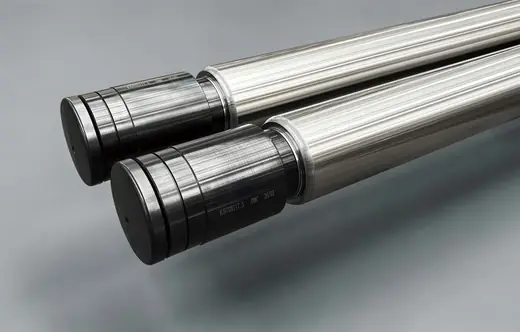
Leveller Rolls for Leveling Lines
Support rolls in stainless or carbon steel preventing work roll deflection on leveling lines.
View Details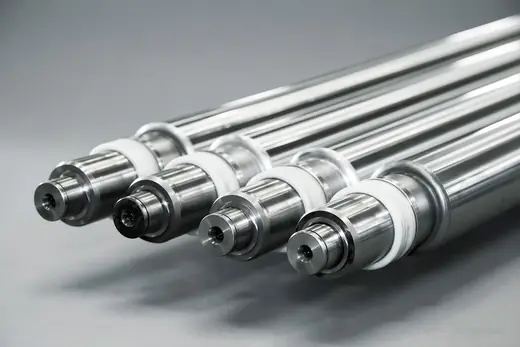
Precision Leveling Line Rolls
Leveling line rolls with uniform high hardness and a deep integral hardened layer.
View Details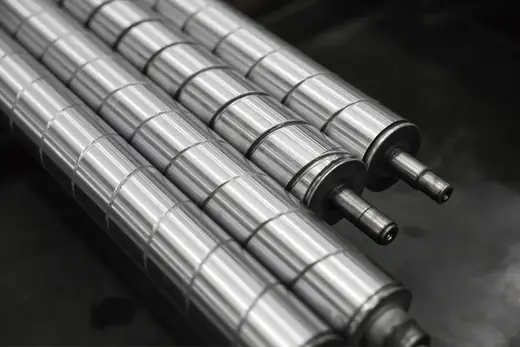
Intermediate Roll for Tension Levelers
Consumable intermediate rolls ground to 0.006 mm class geometry and 0.2 micron finish.
View DetailsReader Questions
How do we compare two roll suppliers objectively?
On documented hardness, hardened layer depth, plating thickness and grinding accuracy, plus observed service life for the same duty. Price alone tells you nothing about any of them.
What is a first article order?
One set produced to your drawing with full inspection records, so you can verify the specification and the fit before committing annual volume.
Will repeat sets be identical?
They will if the supplier keeps your drawing on file and produces to it. Ask for that commitment explicitly.
How do we avoid emergency orders?
Plan delivery against tonnage so the next set is produced before the current one reaches its regrind limit, rather than ordering after a problem appears.
Qualify Us With One Set
Send one drawing and we produce a first article with full inspection records before you commit volume.