
Manganese Steel Grades For Crusher Wear Parts Explained
Mn13 through Mn22Cr3 — what the manganese and chromium content actually changes, and how to pick a grade from your feed rather than from a catalogue.
Why Manganese At All
Austenitic manganese steel has an unusual property: it arrives soft and hardens in service. The crushing action itself transforms the surface layer, so the working face becomes hard while the body of the casting stays tough. That combination is why it has remained the default crusher wear material for well over a century.
The consequence matters for procurement. A manganese liner delivered at low hardness is not a defect — it is the material behaving as designed. Hardness readings taken on arrival are not a measure of how the part will perform.
What The Grade Numbers Mean
The number in Mn13, Mn18 or Mn22 is the nominal manganese percentage. Higher manganese generally raises the rate at which the surface work hardens, which suits more abrasive feed. A Cr suffix — Mn13Cr2, Mn18Cr2, Mn22Cr3 — indicates added chromium, which raises the yield strength and further increases the work hardening rate.
Carbon sits between 1.00% and 1.45% across the range and is what makes the work hardening possible at all. Phosphorus is held below 0.06% and sulphur below 0.04% in every grade, because both promote cracking in a casting that is expected to deform rather than break.
Choosing A Grade
- Mn13 and Mn13Cr2 cover general aggregate work — quarried rock of moderate abrasiveness, normal tonnages.
- Mn18 and Mn18Cr2 are the usual step up for harder feed and for recycled material, where the surface needs to keep hardening further before it deforms.
- Mn20Cr3, Mn22Cr2 and Mn22Cr3 are for the most abrasive duties. On a Pegson 1100 × 800 swing jaw destined for West Africa we supplied Mn22Cr2 for exactly this reason.
- Mn13-22CrMo adds molybdenum and is available where the application calls for it.
| Material | Mn % | C % | Si % | P % | S % | Cr % |
|---|---|---|---|---|---|---|
| Mn13 | 11-14 | 1.00-1.45 | 0.3-1.0 | < 0.06 | < 0.04 | — |
| Mn13Cr2 | 11-14 | 1.15-1.25 | 0.3-0.8 | < 0.06 | < 0.04 | 1.5-2.5 |
| Mn18 | 17-19 | 1.2-1.3 | 0.3-0.8 | < 0.06 | < 0.04 | — |
| Mn18Cr2 | 17-19 | 1.2-1.3 | 0.4-0.9 | < 0.06 | < 0.04 | 1.5-2.5 |
| Mn20Cr3 | 19-21 | 1.2-1.3 | 0.3-0.8 | < 0.06 | < 0.04 | 2.5-3 |
| Mn22Cr2 | 21-23 | 1.1-1.4 | 0.3-0.8 | < 0.06 | < 0.04 | 1.5-2.5 |
| Mn22Cr3 | 21-23 | 1.1-1.4 | 0.3-0.8 | < 0.06 | < 0.04 | 2.5-3 |
What Does Not Work
Manganese is a poor choice where abrasion dominates and there is no impact to harden the surface — a VSI rotor tip, for example, is far better served by high chromium white iron.
Equally, high chromium in a duty where tramp steel reaches the wear face will crack. The material decision follows the feed, not the part.
Verification
Every heat here is sampled during melting, the analysis verified against the specified grade and adjusted if necessary before pouring. Those samples are retained for at least three years, so a grade claim made on an order two years ago can still be checked.
Parts This Guide Applies To
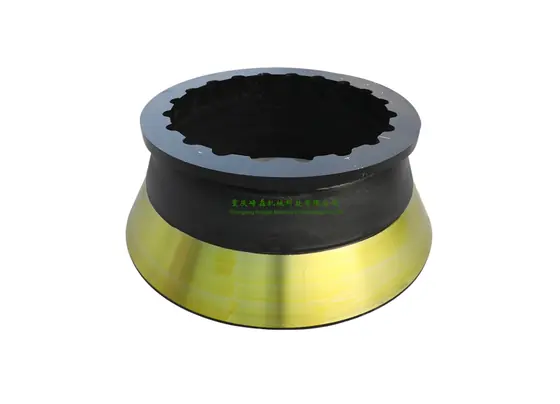
Bowl Liner And Concave
The fixed half of the cone crushing chamber, cast in seven manganese grades
View Part →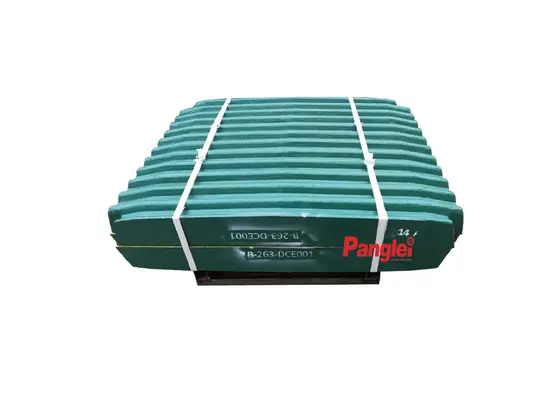
Swing Jaw Plate
Movable jaw dies cast to the same profile and heat as the fixed half
View Part →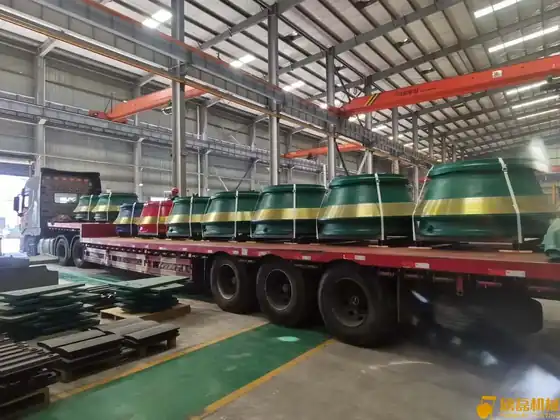
Mill Liner
Mill liners in manganese and high chromium for grinding circuits
View Part →Other Reading In The Knowledge Centre
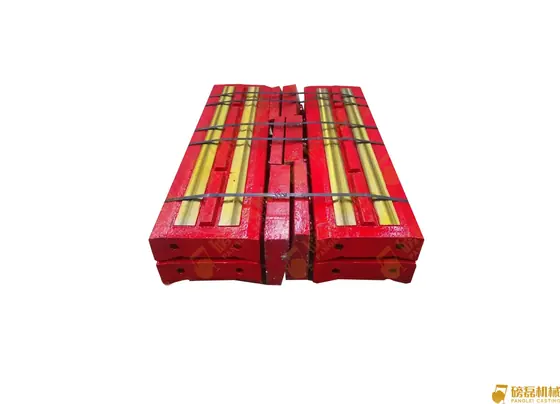
How To Choose Blow Bar Material For An Impact Crusher
Manganese, 20% chrome, 26% chrome, ceramic inserts or TIC — a decision that comes down to one question about your feed.
Read Guide →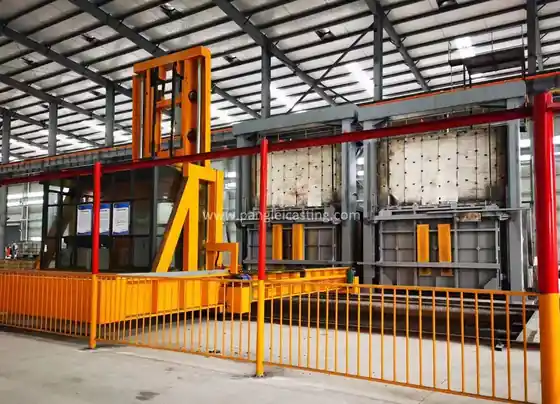
Heat Treatment Of Crusher Wear Castings And Why 30 Seconds Matters
Solution treatment and quenching decide whether a manganese casting is tough or brittle. The controls that make the difference are simple and unforgiving.
Read Guide →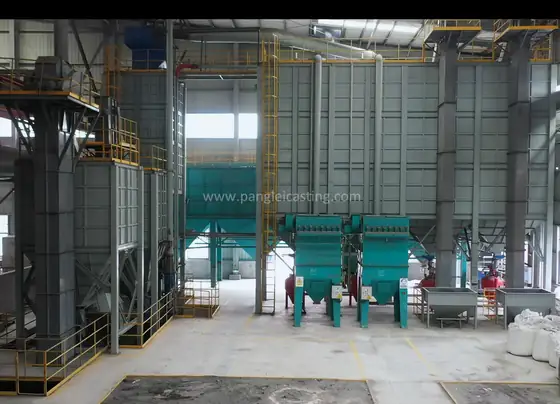
What Casting Process Simulation Changes Before The Mould Is Made
CPSS runs before sand is packed. It is the cheapest opportunity to find a shrinkage cavity — on screen rather than in a finished casting.
Read Guide →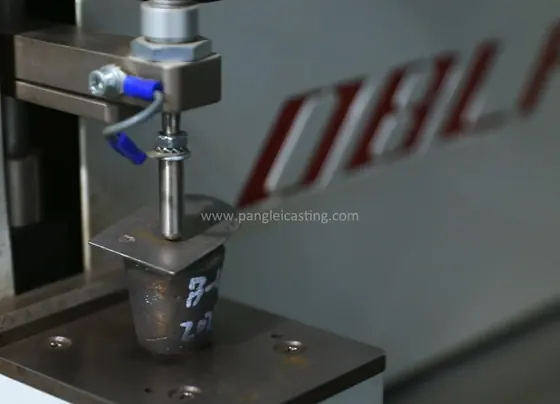
The Inspection Procedures Behind A Crusher Wear Casting
Which tests are standard, which are on request, and what each one actually tells you about the part you are buying.
Read Guide →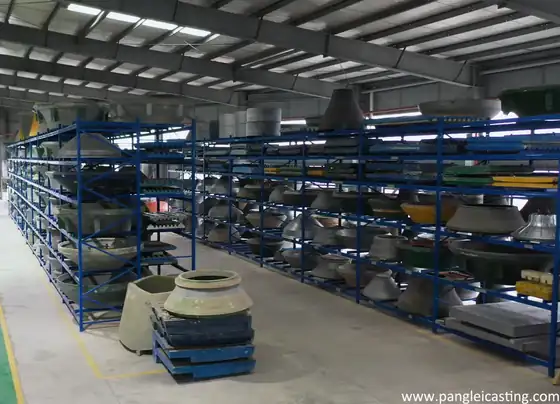
Reducing Crusher Downtime With Ready Made Patterns And Stocked Parts
Lead time on a wear part is mostly pattern time and scheduling. Both can be removed, and the difference is measured in days rather than weeks.
Read Guide →Questions About This Guide
Is a softer manganese casting a sign of poor quality?
No. Austenitic manganese steel is delivered soft and hardens in service. Hardness measured on arrival tells you very little about how the part will wear.
Does more manganese always mean longer life?
Only where the feed is abrasive enough to work harden the surface. In a low-impact duty a higher grade brings no benefit and high chromium may be the better answer.
What is the chromium actually doing?
Raising the yield strength and the work hardening rate. It is why Mn18Cr2 outperforms plain Mn18 on abrasive feed.
Apply This To Your Own Machines
Send the machine, the feed description and the wear life you get now, and we will make a specific recommendation rather than a general one.