Why Multi-Pair Still Exists
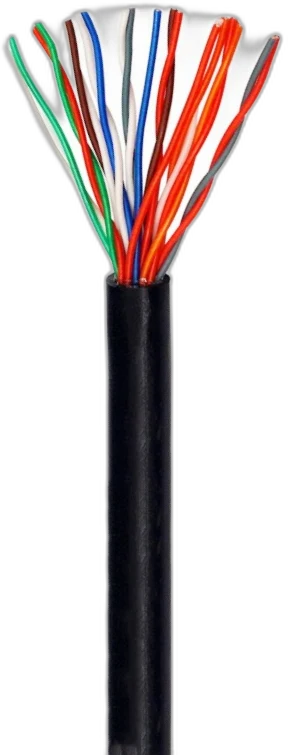
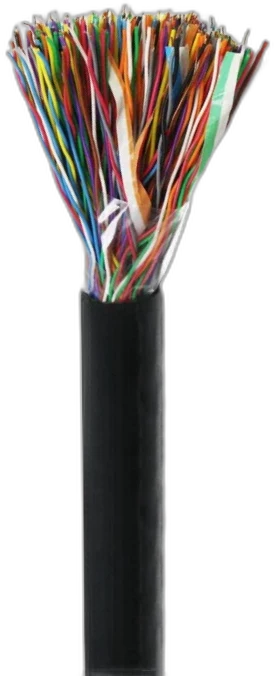
When a riser has to deliver sixty voice pairs to a floor, sixty individual cables is not an engineering option. Multi-pair puts them in one sheath with a consistent colour code, one pull and one termination point.
Ethernet took over the data side long ago. Voice distribution, door entry, intercom, lift phones and low-speed signalling did not follow, which is why CAT3 multi-pair is still specified on live projects.
Choosing A Pair Count
Allow spare pairs. Pair count is fixed the moment the cable is in the riser, and the cost difference between 50 and 100 pair is far smaller than the cost of a second pull.
| Pair count | Typical application |
|---|---|
| 2 pair | Single voice point, door entry, signalling |
| 10-25 pair | Small riser, apartment block distribution |
| 30-50 pair | Floor distribution in a commercial building |
| 100 pair | Building backbone, MDF to floor cabinets |
Indoor PVC Or Outdoor PE
PVC for internal risers and containment. PE for anything in a duct, on a pole, or otherwise exposed — PVC will chalk and split under sustained UV and let water track into the core.
Outdoor multi-pair ships on wooden drums; indoor bulk is available on 1000 ft spools and 305 m drums.
Termination Practice
- Follow the pair colour code consistently from end to end
- Keep the sheath on as far into the termination as possible
- Record pair allocation at both ends before closing the cabinet
- Leave a service loop at each termination for future re-work
Applying this to a live project? Send the specification and we will tell you how it lands for your case — multi-pair telephone cable — a practical guide is exactly the kind of question we answer whether or not there is an order attached.