
What The Cable Is Doing Electrically
Speaker cable sits in series with the loudspeaker. Its resistance forms a divider with the speaker impedance, so some of the amplifier's output is dissipated in the cable rather than the driver.
The second effect matters more than the level loss: series resistance reduces the amplifier's control over cone movement — the damping factor — which shows up as loose, imprecise bass.
The Two Variables That Matter
- Run length — resistance is proportional to the total conductor length, which is twice the cable run
- Speaker impedance — a 4 ohm load is twice as sensitive to cable resistance as an 8 ohm load
- Conductor cross-section — the only variable you control at order time
- Conductor material — bare copper has lower resistance than CCA at the same cross-section
A Working Rule
Keep total cable resistance below roughly 5% of the speaker impedance and the loss is inaudible in a typical installed system. That means short runs to 8 ohm ceiling speakers tolerate thin cable, and long runs to 4 ohm loads need noticeably more copper.
Send us the run length and the load impedance with your enquiry and we will confirm which stocked cross-section fits, rather than guessing from a chart.
Profile And Conductor Count
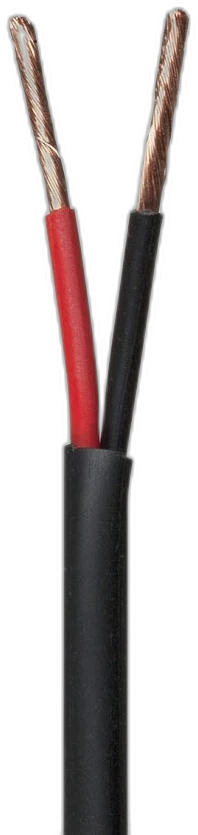
Flat figure-8 hides under carpet grippers and behind skirting. Round pulls more easily through conduit and over ceiling grids. Neither performs better electrically at the same cross-section.
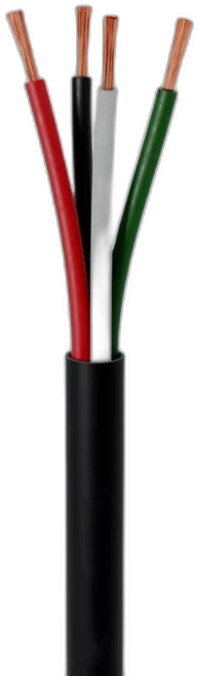
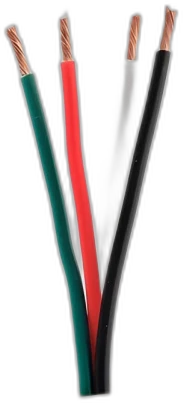
4-conductor cable halves the number of pulls for bi-wire runs and for stereo pairs fed from a single amplifier position.
Applying this to a live project? Send the specification and we will tell you how it lands for your case — speaker cable gauge and run length is exactly the kind of question we answer whether or not there is an order attached.