The Short Answer
CAT5e carries gigabit to a desk and is still the volume choice where cost per drop dominates. CAT6 is the default for new structured cabling. CAT6A is what you specify when 10 Gb has to run the full 100 m channel. CAT7 is for electrically hostile buildings where every pair needs its own screen.
The mistake buyers make is treating this as a single ladder where more is always better. Each step up costs money, containment space and installation time, and two of those are harder to recover than the first.
Bandwidth And Conductor Size
The conductor size matters as much as the bandwidth figure. 23 AWG has measurably lower DC resistance than 24 AWG, which is what decides how much PoE power survives a 90 m run and how hot a fully loaded bundle gets.
| Specification | Bandwidth | Typical conductor | Usual application |
|---|---|---|---|
| CAT5e | 100 MHz | 24 AWG | 1 Gb desk and device drops |
| CAT6 | 250 MHz | 23 AWG | New horizontal cabling, PoE devices |
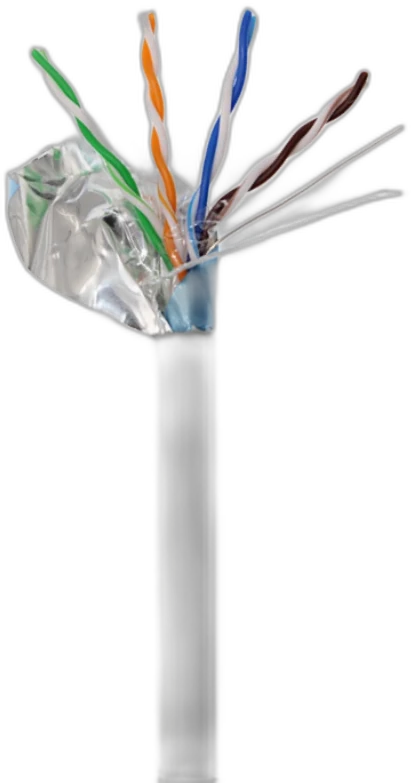
| CAT6A | 500 MHz | 23 AWG shielded | 10 Gb over full-length channels |
| CAT7 | 600 MHz | 23 AWG SFTP | High-interference environments |
Where PoE Changes The Decision
Power over Ethernet turned a data question into an electrical one. A camera or access point at the end of a long run is fed through the same pairs that carry the data, and every ohm of conductor resistance is voltage the device never sees.
If the design includes PoE++ devices, high-power lighting, or dense bundles in warm ceiling voids, specify 23 AWG bare copper. This is also the point at which copper-clad aluminium stops being a saving and starts being a support ticket.
When Screening Is Worth It
A screen only helps if it is bonded correctly at both ends of the channel, which means shielded panels, shielded cords and a defined earth path. A shielded cable terminated into unshielded hardware performs no better than UTP and costs more.
Specify screening where cable runs parallel to power for a long distance, passes through plant rooms, or where the installation standard requires it. In a conventional office, UTP is the correct choice.
How To Choose In Practice
- Gigabit desks, cost-sensitive, no PoE beyond phones — CAT5e
- New build, PoE cameras and access points, 10-year horizon — CAT6
- Wi-Fi 6E or Wi-Fi 7 uplinks, 10 Gb design target, dense bundles — CAT6A
- Industrial plant, imaging equipment, broadcast — CAT7
Applying this to a live project? Send the specification and we will tell you how it lands for your case — cat5e vs cat6 vs cat6a vs cat7 — which to specify is exactly the kind of question we answer whether or not there is an order attached.