The hidden process steps
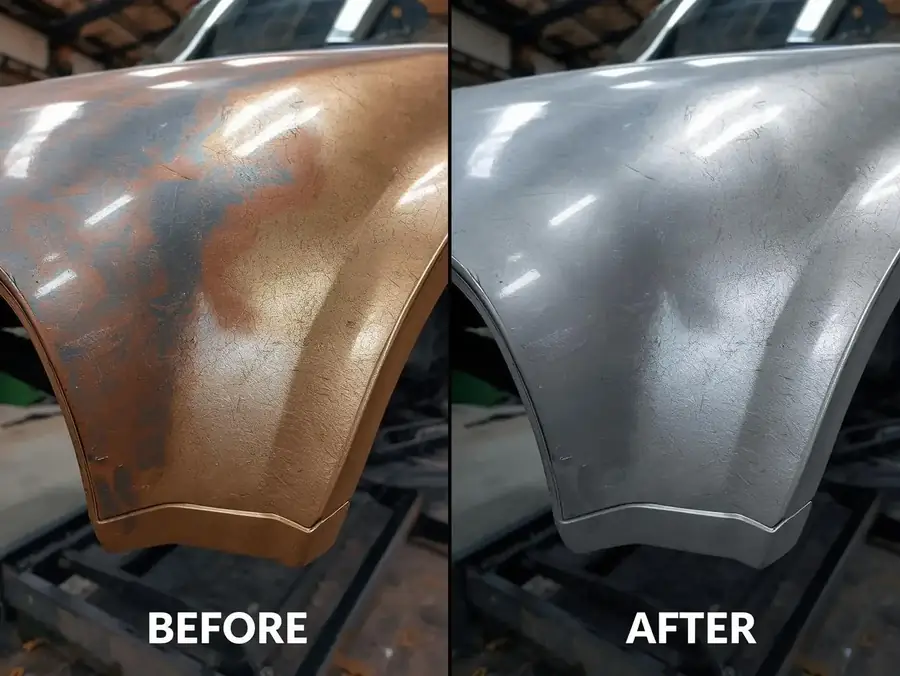
A chemical strip is rarely one step. There is masking, dwell time, mechanical removal of softened coating, neutralising, rinsing and drying before the part can be primed. A laser strip is one pass, dry, and the surface is ready immediately — which is why the time saving is usually larger than the cleaning time alone suggests.
Residue and adhesion
Incomplete rinsing leaves chemistry in seams, threads and porosity, and that is a common root cause of coating failures traced back to preparation. A dry process leaves nothing to rinse out.
Waste and exposure
Spent stripper is hazardous waste with a disposal cost and a paper trail, and the fumes are an exposure that has to be controlled. Laser cleaning removes the waste stream entirely; what remains is particulate extraction at the head.
Selectivity
Chemicals attack whatever they are formulated to attack, wherever they reach. A laser removes only where the beam is pointed, which is what makes selective stripping — one coating layer, one area of a part, around a fitted component — a normal job rather than a special one.
Where chemistry still wins
Complex internal geometries the beam cannot reach, and very large batches of small parts that can be dipped. For those, chemistry remains practical.