Grinding machine manufacturer in Shenzhen since 2012 [email protected] +86 137 2585 290709:00 - 18:00 GMT+8
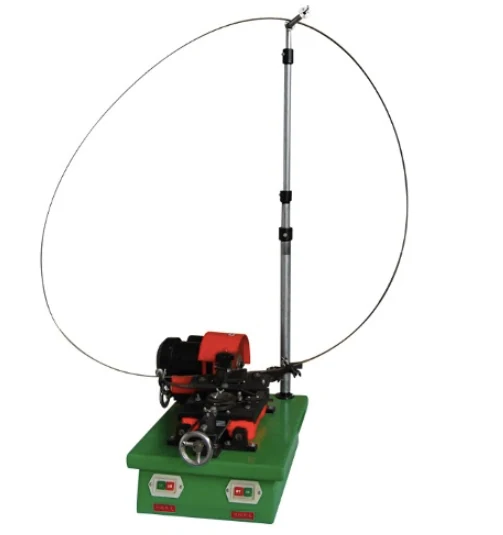
Band saw blade grinder with the blade guide and grinding head visible
Comparison Article

Circular and Band Saw Sharpening Are Different Jobs

Same idea, different machine. A blade rack with both needs both.

People occasionally ask whether one machine can sharpen circular and band blades. It cannot, and the reason is mechanical rather than commercial: the two blade types are indexed and supported in completely different ways.

Circular Blades Rotate Around a Fixed Centre

A circular blade is mounted on an arbor and indexed tooth by tooth as it rotates. The machine has to support the blade concentrically, index by pitch and present the tooth at a set angle. Machine capacity is expressed as diameter range, bore size, pitch and thickness.

Band Blades Travel in a Straight Line

A band blade is fed through guides in a straight line, with a feed pawl indexing one tooth per stroke. Capacity is expressed as blade width, pitch and thickness. Nothing about this mechanism transfers to a circular blade.

What Each Machine Costs to Own

The difference in scale is substantial, which is what makes covering both practical for most shops.

  • WK1170 band blade grinder: 32 kg, 250 W, 220 V single phase
  • WK450 circular blade grinder: 130 kg, 1/2 HP, 3 phase 380 V
  • WK026 circular blade grinder: 900 kg, PLC control, hydraulic at 4.0 MPa

Choosing Where to Start

Start with whichever blade type stops production most often. For metal cutting workshops that is usually band blades, and a WK1170 on a bench solves it for very little. For mills and panel plants it is usually circular blades, where the WK450 covers most racks and the WK026 covers the rest.

Both Machines Share the Same Principles

Set the geometry deliberately, take minimum stock, keep the wheel dressed, and sharpen on an interval rather than on failure. The mechanism differs, the discipline does not.

Power Supply Often Decides the Order of Purchase

The WK1170 runs from an ordinary 220 V single phase socket, which matters in workshops where a 380 V supply would need an electrician and a wait. The WK450 needs 3 phase 380 V at 50 Hz. Confirm your supply with us before ordering and we configure the machine accordingly.

Machines in This Guide

Models Referenced Above

WK1170 band saw blade grinder for band blades from 15 to 50 mm wide
Saw Blade Resharpener

WK1170 Band Saw Blade Grinder

A 32 kg bench machine that puts band blade sharpening next to the saw.

  • Grinding range of width15 to 50 mm
  • Blade pitch2 to 25 mm
View Specifications
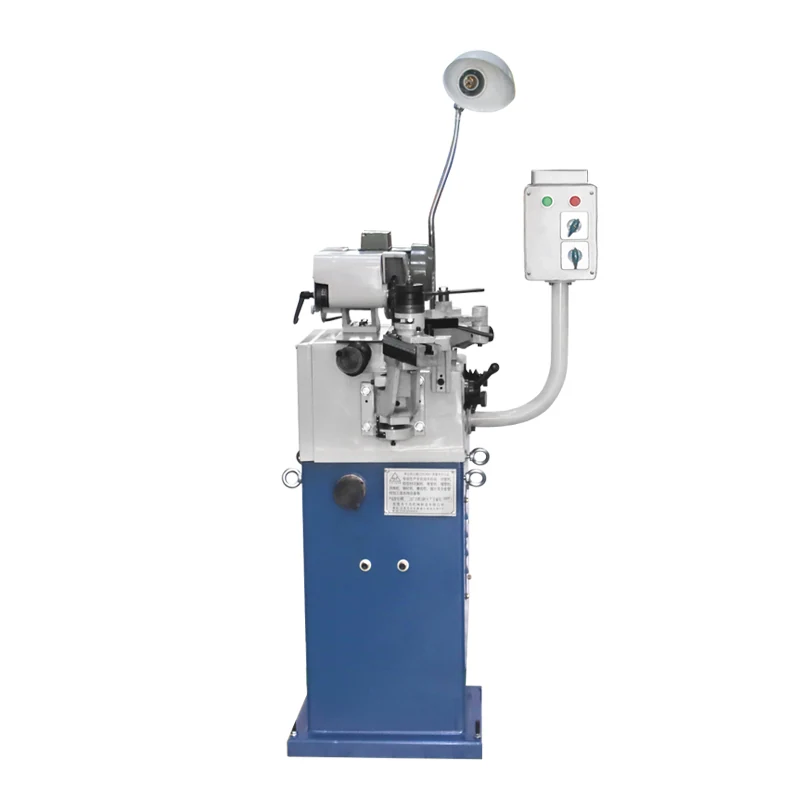
WK450 automatic circular saw blade grinder with adjustable tooth angle head
Saw Blade Resharpener

WK450 Automatic Circular Saw Blade Grinder

A 130 kg workshop machine that resharpens blades up to 450 mm in minutes.

  • Grinding diameter range50 to 450 mm
  • Teeth pitch (max)25 mm
View Specifications
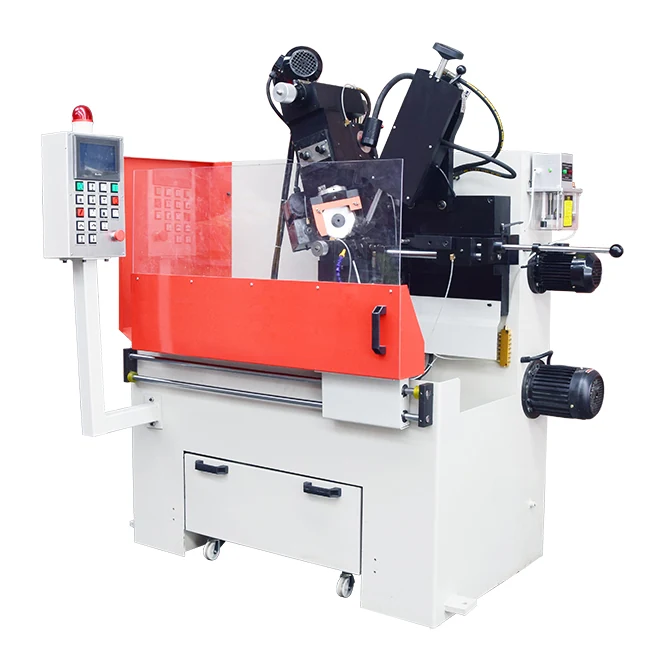
WK026 automatic saw blade grinding machine with PLC control and hydraulic system
Saw Blade Resharpener

WK026 Automatic Saw Blade Grinding Machine

PLC controlled resharpening for circular blades from 80 mm up to 800 mm.

  • Grinding diameter range80 to 800 mm
  • Teeth distance (pitch)7 to 100 mm
View Specifications
Questions

Questions From This Guide

Can one machine sharpen both circular and band blades?

No. The two blade types are supported and indexed in fundamentally different ways, so they need different machines.

Which should I buy first?

Whichever blade type stops production most often. In metal cutting workshops that is usually band blades.

Does the band blade machine need three phase power?

No. The WK1170 runs on 220 V single phase at 250 W.

What blade widths does the band machine cover?

15 to 50 mm wide, 2 to 25 mm pitch and up to 8 mm thick.

Talk to an Engineer

Still Not Sure Which Way to Go

Send the part, the problem or the photograph. A specific question gets a specific answer, usually the same working day.

Karen | +86 137 2585 2907 [email protected]Monday to Saturday, 09:00 - 18:00 (GMT+8)