
How to Understand the Specifications and Construction of Wire Rope?
Wire rope specifications are not a single number but a system of interlocking choices: strand type, core type, and wire tensile grade. This guide breaks down each component, explains how they affect performance, and shows how to read a specification correctly to avoid mismatched assemblies.
What Wire Rope Specifications Actually Mean
A wire rope specification is not a single rating but a combination of three key elements: strand type, core type, and wire tensile grade. The strand type defines how wires are arranged in the rope, the core type determines the internal support and flexibility, and the tensile grade sets the strength level of the individual wires. Misunderstanding any one of these can lead to an assembly that fails under load, even if the working load limit appears correct on paper. The specification must be read as a whole, not as isolated numbers.
Strand Types and Their Use Cases
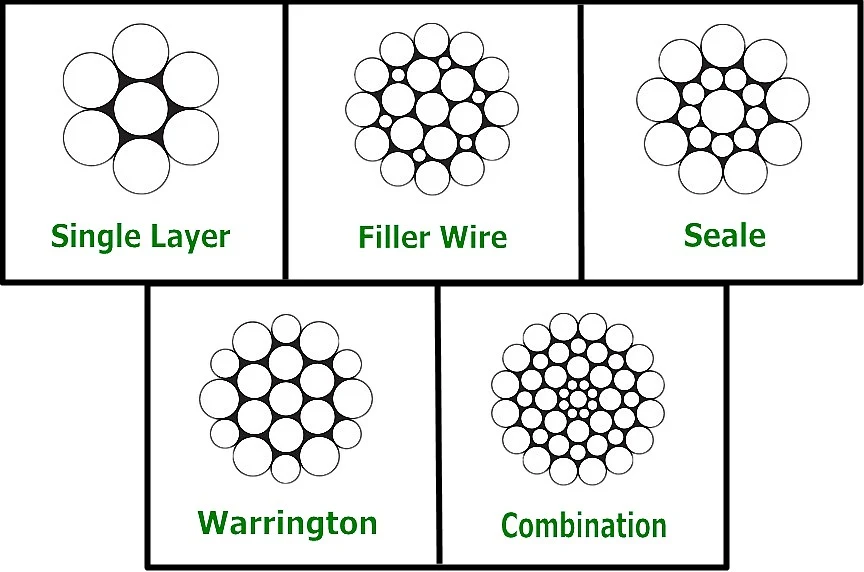
The five basic strand types-Single Layer, Filler Wire, Seale, Warrington, and Combination-each serve different purposes. Single Layer (e.g. 7x1) offers high flexibility and is common in hoisting. Filler Wire increases surface contact and wear resistance, ideal for sheave applications. Seale provides high strength and good fatigue resistance, used in cranes and lifting. Warrington balances strength and flexibility, suited for dynamic loads. Combination strands are built for specific duties, like high abrasion or high load cycles. Choosing the right strand depends on the application's movement, load type, and contact with sheaves or drums.
Core Types and Environmental Suitability
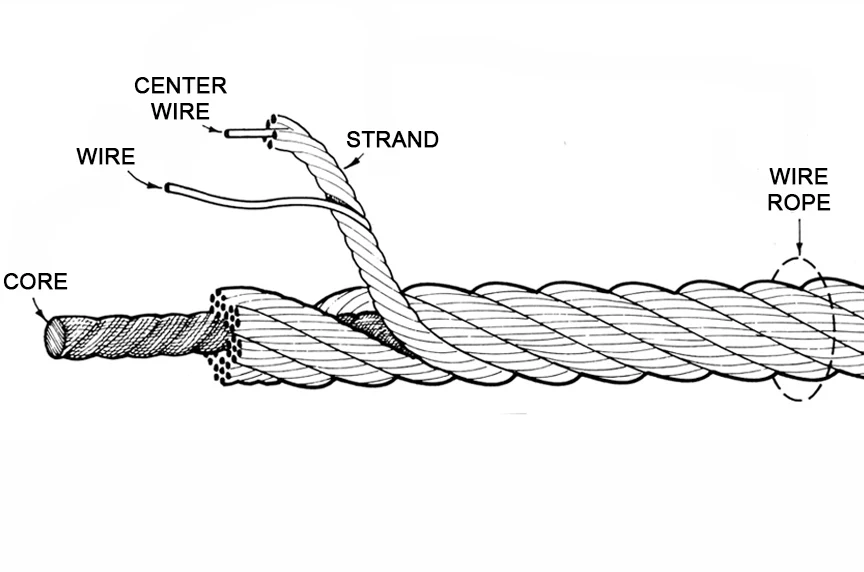
The core supports the strand and affects flexibility, strength, and temperature resistance. Fiber core (FC) offers greater elasticity and is lighter, but it cannot withstand high temperatures above 180° F and is more prone to damage from crushing. Synthetic FC (SFC) is more durable than natural FC. Steel core (WSC or IWRC) provides higher strength and better heat resistance, making it suitable for high-temperature environments and applications with high bending stress. Steel core is also more resistant to crushing and is used in overhead lifting and heavy-duty hoisting.
Understanding Wire Tensile Grade and Rope Grade
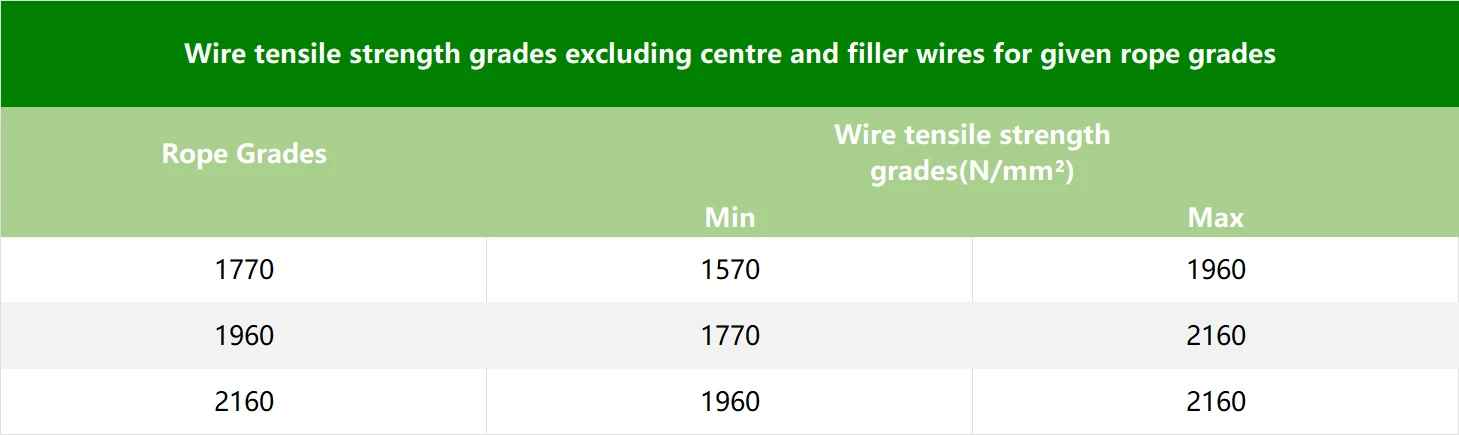
Wire tensile grade (R) refers to the minimum tensile strength of the individual wires, designated by a number such as 1770, 1960, or 2160 MPa. Rope grade (Rr), as defined in EN 12385, is the overall breaking force level of the rope, derived from the wire tensile grade and the rope's construction. A higher Rr value means a higher minimum breaking force. The grade is not a standalone number-it must be matched with the correct strand and core to achieve the intended performance. Using a high Rr rope with a low-grade wire or an unsuitable core can result in premature failure.
How to Read a Wire Rope Specification
A complete specification includes the strand type, core type, wire tensile grade, and rope grade. For example, a 6x36 IWRC 1960 Rr 2160 rope means six strands, 36 wires per strand, independent wire rope core, wire tensile grade of 1960 MPa, and rope grade of 2160. The specification must be verified against the application's load, environment, and duty cycle. A specification that looks correct on paper may not be suitable if the core is wrong for the temperature or the strand type is not rated for repeated bending.
Common Errors in Wire Rope Selection
The most frequent error is selecting a rope based on a single number-like a working load limit-without checking the full specification. Another is using a fiber core in a high-temperature environment, which leads to rapid degradation. A third is mixing a high-grade wire with a low-grade core, which reduces the rope's effective strength. These mismatches are not always visible during inspection. The only way to avoid them is to confirm the full specification, including the core and strand type, before ordering.
How to Confirm a Rope is Built to Spec
When receiving a wire rope, check the marking on the rope itself-most manufacturers stamp the specification, including the tensile grade and rope grade. Ask for the Material Test Certificate to confirm the wire tensile strength. Verify that the core type matches the intended use: steel core for high heat or high load, fiber core for flexibility and lighter weight. If the rope is part of a larger assembly, ensure the sheaves, drums, and fittings are compatible with the rope's diameter and stiffness.
Matching Rope to Application and Duty
For overhead lifting, use a steel core with a high tensile grade and a Seale or Warrington strand for fatigue resistance. For marine winches, a Warrington strand with a fiber core offers flexibility and resistance to saltwater corrosion. For high-temperature environments, always select a steel core and a wire tensile grade that supports the expected stress. For general rigging, a Single Layer or Filler Wire strand with a fiber core may be sufficient. The key is to match the rope's construction to the load, movement, and environment.
Ordering note. Wire rope specifications include strand type, core type, and wire tensile grade—each must be matched to the application Fiber core (FC) offers flexibility but fails above 180° F; steel core (IWRC or WSC) is better for high temperature and high load Wire tensile grade (R) is the minimum strength of the wire; rope grade (Rr) is the overall breaking force of the rope A mismatched core or strand type