
6x19 vs 6x19W vs 6x19S Steel Wire Rope
6x19, 6x19W, and 6x19S steel wire ropes look similar at a glance but differ in construction, performance, and application. This guide explains how to choose the right one based on bending cycles, abrasion exposure, and load type, with no assumptions about strength differences.
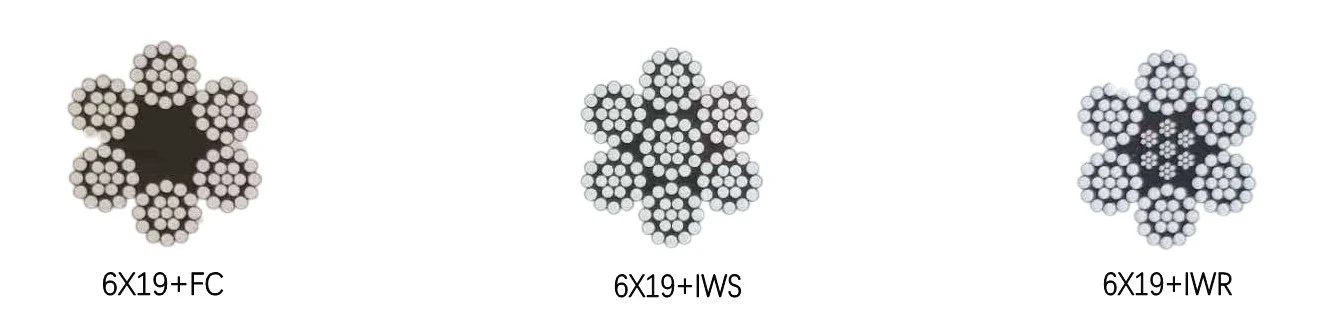
What 6x19 6x19W and 6x19S Actually Mean
The designation 6x19 refers to a rope with six strands, each containing about 19 wires. The actual construction varies significantly. 6x19W uses a Warrington pattern with alternating large and small wires in the outer layer. 6x19S uses a Seale pattern with uniformly sized outer wires. The generic 6x19 is typically a filler wire construction, which balances flexibility and wear. These are not interchangeable in performance, even if they share the same nominal diameter and grade. The letter suffix reveals the real structural difference, not just a product code.
When to Choose 6x19W (warrington Construction)
Choose 6x19W when the rope will undergo repeated bending cycles, such as over sheaves, drums, or in hoisting systems with frequent start-stop motion. The alternating wire sizes in the outer layer reduce stress concentration and improve fatigue resistance. This makes it ideal for crane operations, winch systems, and applications where the rope is constantly flexed. It offers better long-term life under dynamic loading than standard 6x19, though it may not be as resistant to surface wear.
Steel Cable Fasteners Wire Rope Clamp &Thimble & Sleeve Set- Customizable Packaging
When to Choose 6x19S (seale Construction)
Choose 6x19S when the rope is exposed to high abrasion, such as dragging over rough surfaces, running through chafing points, or in contact with sharp edges. The outer layer of uniformly sized large wires provides superior resistance to surface wear and crushing. It is commonly used in winch drums, hoists, and applications where the rope rubs against metal or concrete. Its construction maintains integrity under heavy contact, making it a preferred choice in mining, construction, and marine environments.
Steel Cable Fasteners Wire Rope Clamp &Thimble & Sleeve Set- Customizable Packaging
When to Choose 6x19 (filler Wire Construction)
Choose the generic 6x19 filler wire rope when you need a balanced performance across flexibility, wear, and cost. It is typically the most economical option and suitable for general-purpose use where neither extreme fatigue nor high abrasion is expected. Common applications include temporary rigging, light lifting, and fixed installations. It is often used in industrial settings where the rope is not subjected to high stress cycles or abrasive conditions, and where budget is a key factor.
Wire Rope Clamp And Thimble Set Customizable Packaging
Breaking Load and Strength Comparison
For the same diameter, steel grade, and core type (FC or IWRC), the nominal minimum breaking force is very similar across 6x19, 6x19W, and 6x19S. The differences are small and within standard tolerances. 6x19S and 6x19W have slightly higher breaking load factors than standard 6x19, but this is not a significant performance gap. The real distinction lies in how the rope behaves under service conditions, not in its rated strength. Do not assume one is stronger than another based on the construction alone.
Wire Rope Clamp And Thimble Set Customizable Packaging
How to Identify the Construction on Arrival
The construction is not visible from the outside alone. Look for the marking on the rope or the supplier's documentation. 6x19W will have a W in the designation, 6x19S will have an S, and 6x19 will be listed without a suffix. If the marking is missing, request the technical specification sheet. The core type (FC or IWRC) and steel grade (e.g., Grade 1770) must also be confirmed. Never assume the construction based on appearance or price.
Wire Rope Clamp And Thimble Set Customizable Packaging
Matching the Rope to the Application
A rope's performance depends on how it is used. Use 6x19W for systems with frequent bending, 6x19S for high-abrasion environments, and 6x19 filler wire for general use. Mixing constructions in the same system is not recommended. If a winch uses 6x19S, do not substitute with 6x19W unless the application is known to be low-abrasion. Always match the rope to the duty cycle, not just the load weight. A mismatch can lead to premature failure even if the breaking strength is sufficient.
Fist Grip Clamp G-429 US Type Drop Forged Wire Rope Termination
How to Source the Right Rope as a Distributor
Stock 6x19W for crane and hoist suppliers, 6x19S for mining, marine, and construction equipment distributors, and 6x19 filler wire for general industrial and rental markets. Keep the core type and grade consistent across each line. Offer the rope in standard lengths and spools, and provide technical data sheets with each order. For customers with specific needs, confirm the application and recommend the construction that best matches their service environment, not just the load.
Fist Grip Clamp G-429 US Type Drop Forged Wire Rope Termination
What to Ask a Supplier Before You Order
Ask for the exact construction (W, S, or filler wire), the core type (FC or IWRC), the steel grade (e.g., Grade 1770), and the proof load test results. Confirm that the rope is stamped with the grade, diameter, and construction. Request a Material Test Certificate for the batch. Ask whether the supplier can provide a single quotation for rope, fittings, and end terminations to ensure compatibility. Do not accept a generic 6x19 without knowing the actual construction.
Fist Grip Clamp G-429 US Type Drop Forged Wire Rope Termination
Ordering note. 6x19W offers better fatigue resistance for repeated bending; use in cranes and hoists with frequent motion 6x19S provides superior abrasion and crushing resistance; ideal for winch drums and rough environments 6x19 filler wire construction gives balanced performance and is the most economical for general use Breaking strength is similar across all three types when diameter, grade, and core are the