
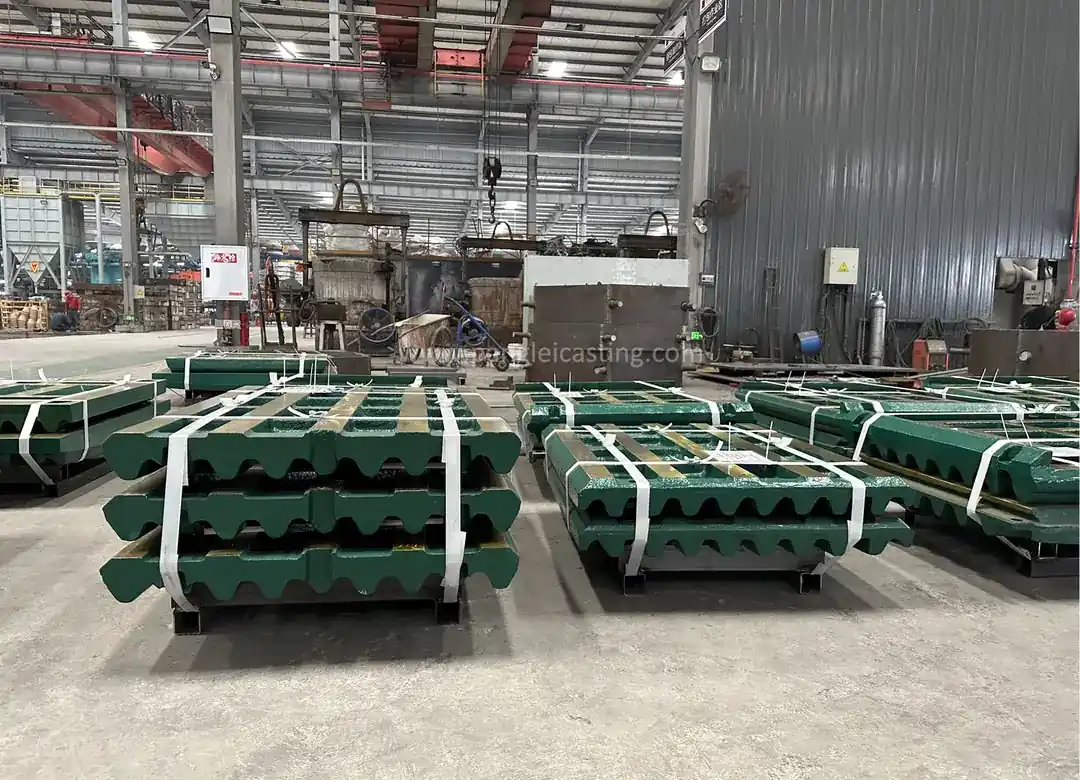
Fixed Jaw Plate
Stationary jaw dies in high manganese, from 600 × 400 machines up to a C200
What This Casting Does And Why It Matters
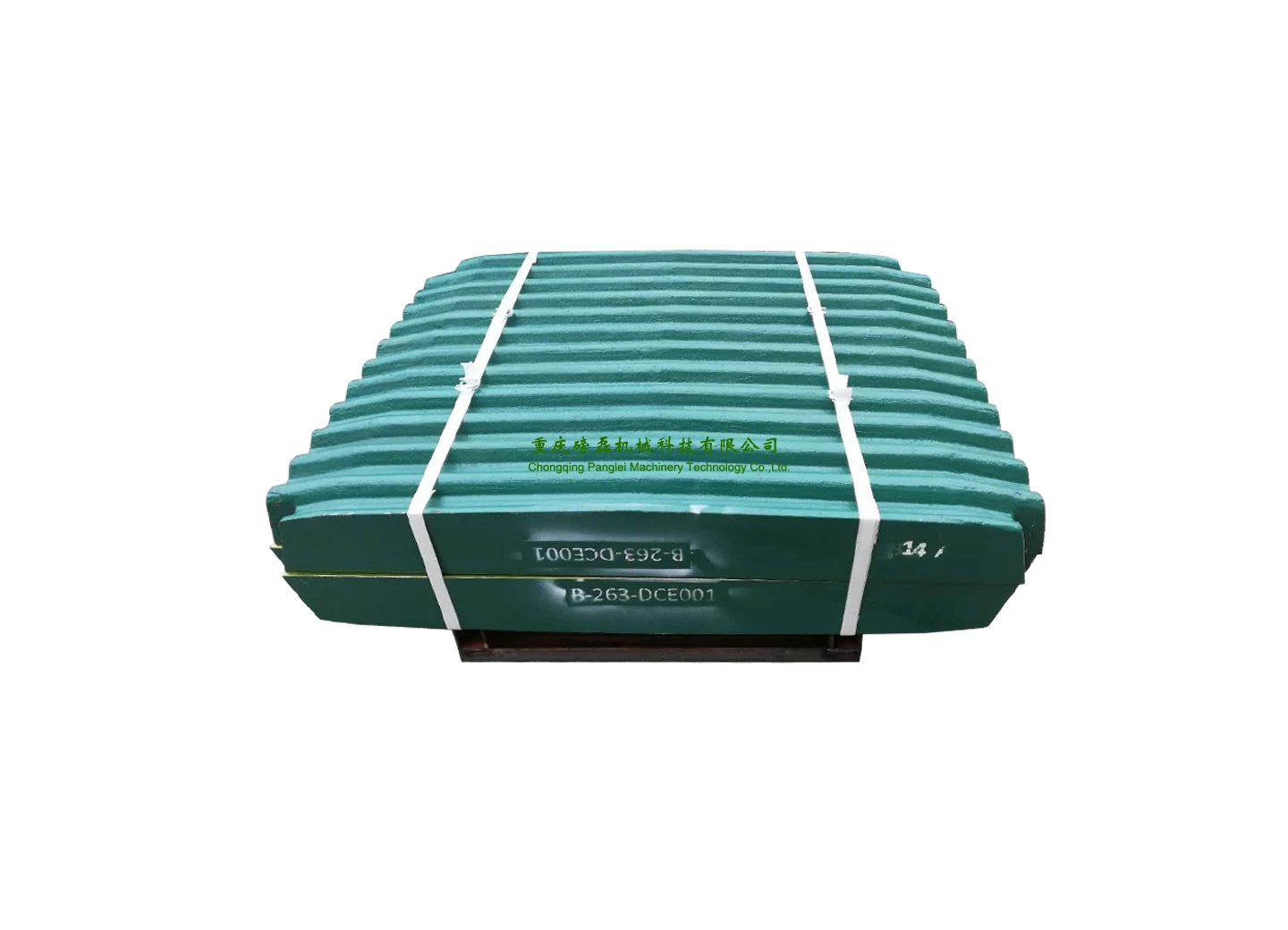
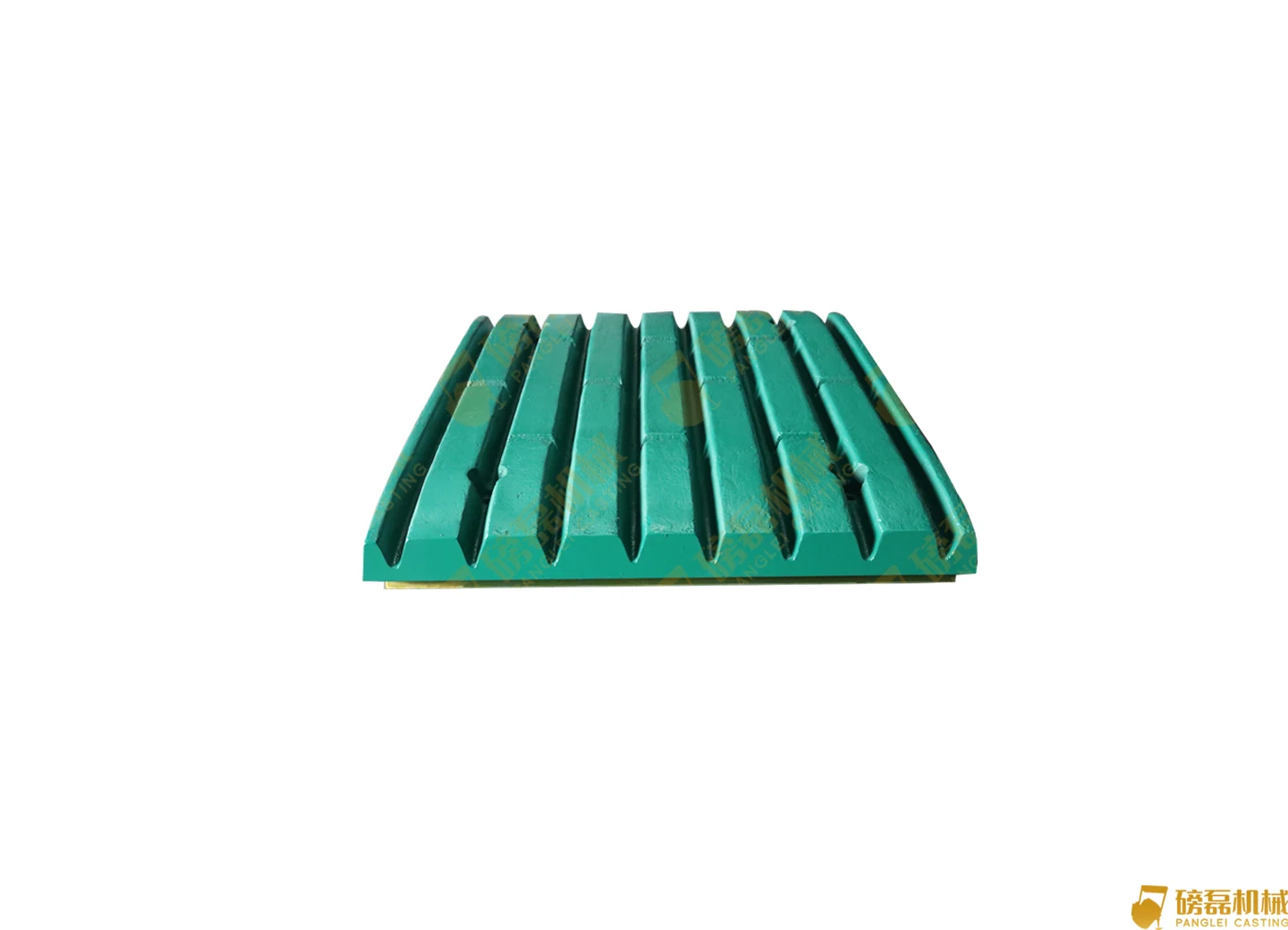
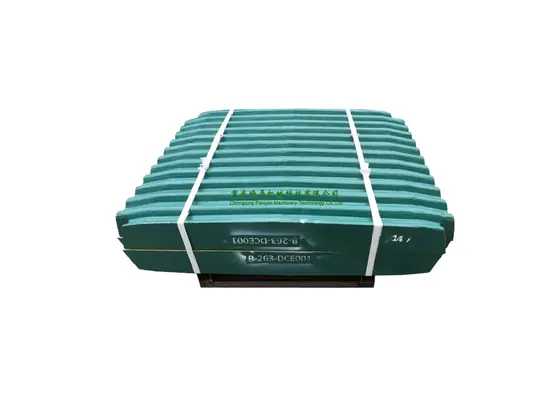
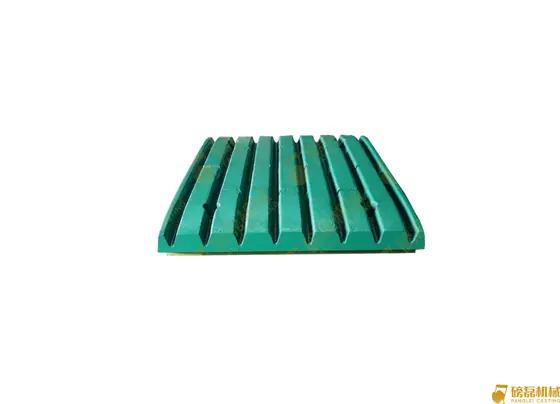
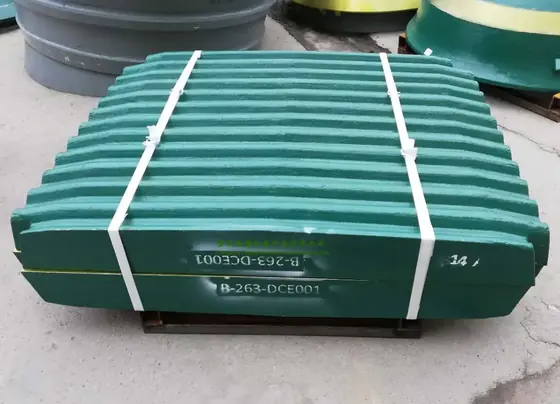
The fixed jaw plate is the stationary die bolted to the front frame of a jaw crusher. Its tooth profile and pitch set the nip angle and the product size, and its material decides how many tonnes pass before it is turned or changed. PangLei casts fixed and stationary jaw plates in the full high manganese range, in single and two-piece heavy duty configurations, for Metso C series, Sandvik JM series, Extec, Terex, Pegson and Powerscreen machines.
Technical Features
- Cast in Mn13, Mn13Cr2, Mn18, Mn18Cr2, Mn20Cr3, Mn22Cr2 or Mn22Cr3
- Single piece, two-piece and middle plate configurations
- Solution treated and water quenched within 30 seconds of withdrawal
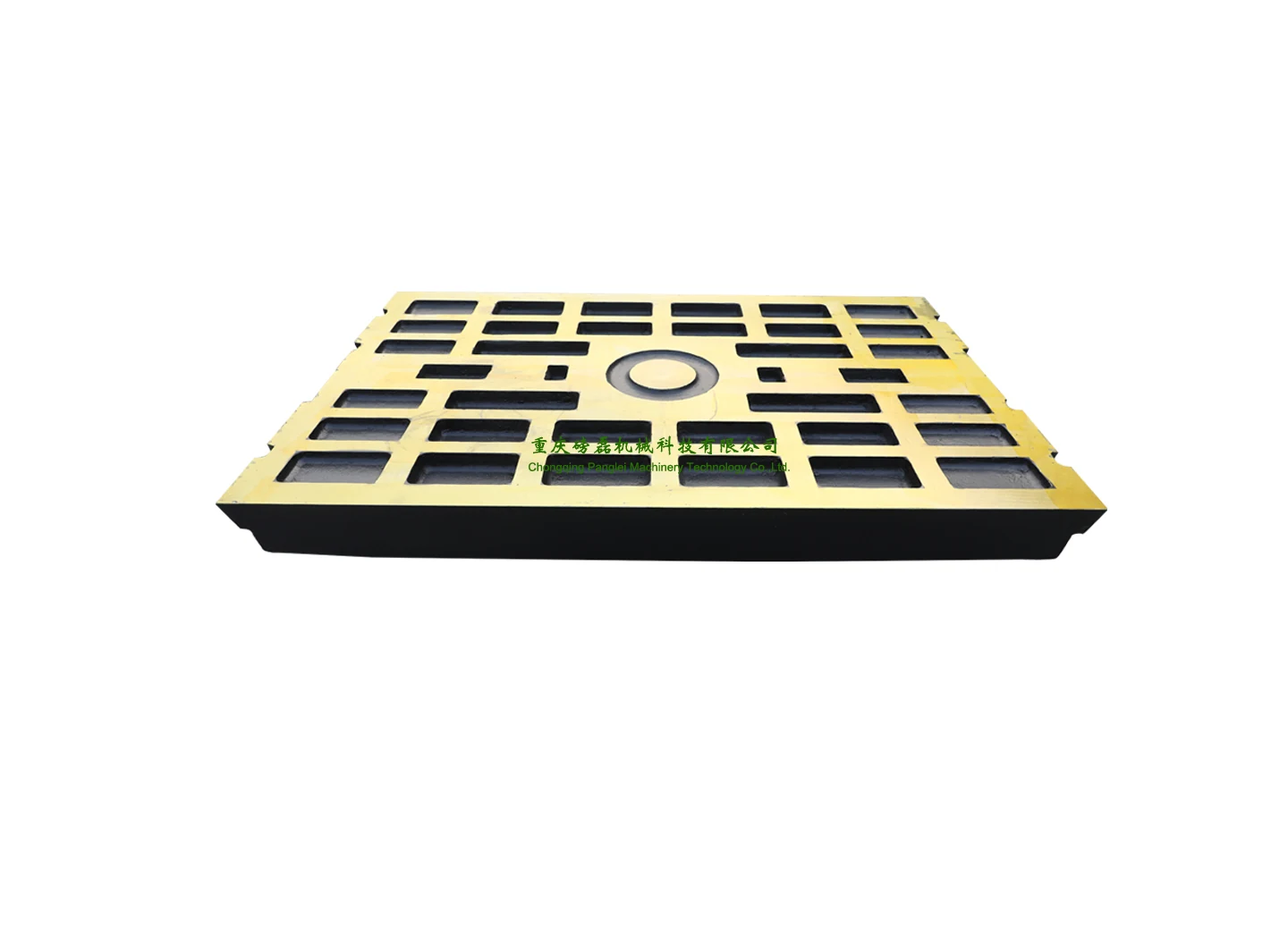
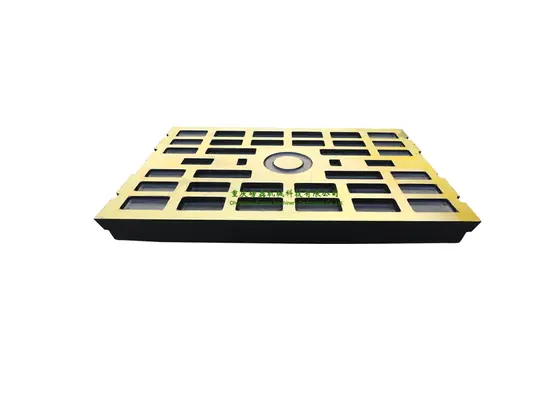
- Bolt holes and back face machined for correct seating
- Real supplied part numbers include 400.0473-002 and 400.0435-002
What You Get That You Would Not Get Elsewhere
Tooth profile and pitch reproduced from the original die, not approximated
Single piece and two-piece heavy duty sets from finished patterns
Mn22Cr2 and Mn22Cr3 available for abrasive recycled feed
Cast with the matching swing plate so both halves wear together
The Failures This Part Is Cast To Prevent
- Teeth flattening long before the planned change-out
- Plates that do not bed flat and hammer the frame
- Two-piece sets whose halves do not meet cleanly
- Long waits on a wear part changed several times a year
Who It Is For
- Primary crushing operations in quarries and mines
- Concrete and demolition recyclers
- Mobile jaw plant fleets
- Distributors stocking dies for mixed fleets
Application Scenarios
- Primary crushing of blasted hard rock
- Concrete recycling with rebar present
- Demolition waste processing
- Iron and copper ore primary reduction
Technical Data For Fixed Jaw Plate
Every figure here comes from our published foundry capability. Where a value depends on your machine it is confirmed at quotation rather than guessed.
| Specification | Detail |
|---|---|
| Part type | Fixed jaw plate, stationary jaw die |
| Material grades | Mn13, Mn13Cr2, Mn18, Mn18Cr2, Mn20Cr3, Mn22Cr2, Mn22Cr3 |
| Manganese content | 11-23% depending on grade |
| Carbon content | 1.00-1.45% depending on grade |
| Chromium content | 1.5-3% on Cr-bearing grades |
| Phosphorus | < 0.06% |
| Sulphur | < 0.04% |
| Configurations | Single piece, two-piece heavy duty, middle plate |
| Example part numbers supplied | 400.0473-002, 400.0435-002, J6920000 |
| Heat treatment | Water quenched, solution treated |
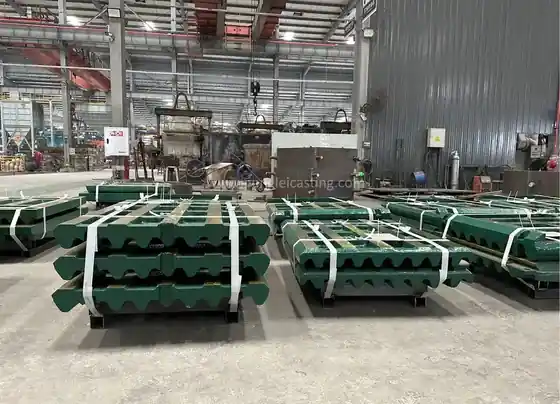
| Packing | Steel pallet |
Manganese Grades Available For This Part
| Material | Mn % | C % | Si % | P % | S % | Cr % |
|---|---|---|---|---|---|---|
| Mn13 | 11-14 | 1.00-1.45 | 0.3-1.0 | < 0.06 | < 0.04 | — |
| Mn13Cr2 | 11-14 | 1.15-1.25 | 0.3-0.8 | < 0.06 | < 0.04 | 1.5-2.5 |
| Mn18 | 17-19 | 1.2-1.3 | 0.3-0.8 | < 0.06 | < 0.04 | — |
| Mn18Cr2 | 17-19 | 1.2-1.3 | 0.4-0.9 | < 0.06 | < 0.04 | 1.5-2.5 |
| Mn20Cr3 | 19-21 | 1.2-1.3 | 0.3-0.8 | < 0.06 | < 0.04 | 2.5-3 |
| Mn22Cr2 | 21-23 | 1.1-1.4 | 0.3-0.8 | < 0.06 | < 0.04 | 1.5-2.5 |
| Mn22Cr3 | 21-23 | 1.1-1.4 | 0.3-0.8 | < 0.06 | < 0.04 | 2.5-3 |
How This Casting Is Made
Pattern Making
Once drawings are confirmed, pattern making starts immediately in our own pattern shop. Thousands of finished patterns are already on the shelf, so repeat parts skip this step entirely.
Sandbox Making
Casting Process Simulation System (CPSS) is run before the moulds are made. The cavity is kept as solid and as clean as possible so that inclusions have nowhere to start.
Melting And Pouring
Charge materials are bought to a high standard and temperature is controlled through the whole pour to achieve a fine grain structure. Samples are taken to verify the analysis and adjusted if needed, then kept for at least three years for traceability.
Sandbox Opening
Also called casting cleaning. After initial cooling the box is opened, risers and runners are removed and the casting is cleaned. Cooling time is set by casting size, not by the clock.
Heat Treatment
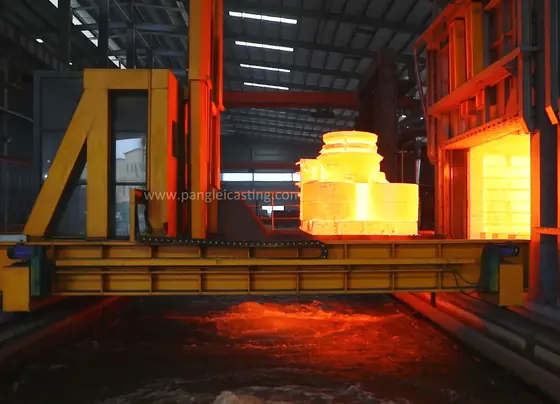
Heating temperature is strictly controlled and castings are spaced in the furnace so they heat uniformly and meet the water fully. Quenching begins within 30 seconds of withdrawal from the oven.
Machining
After rectifying and polishing, castings are machined strictly to drawing for correct fitment. QC then carries out dimensional inspection and issues the dimensional inspection report.
Inspection
Our own physical and chemical laboratory covers spectrometry, hardness, microstructure, dye penetrant and dimensional inspection on site rather than at a third party.
Packing And Delivery
Finished parts are packed on steel pallets for forklift handling, to international standards for road, rail, sea and air transport.
Inspection Supplied With This Part
Chemical analysis and a dimensional inspection report are standard on every order. The remaining procedures are carried out in our own physical and chemical laboratory when specified at order stage.
| Procedure | When |
|---|---|
| Chemical Analysis | standard on every heat |
| Dimensional Inspection Report | standard on every order |
| Hardness Testing | if specified |
| Tensile Testing | if specified |
| Microstructure Analysis | if specified |
| Magnetic Particle Testing | if specified |
| Dye Penetrant Testing | if specified |
| Ultrasonic Testing | if specified |
Laboratory Equipment
- German-made OBLF direct-reading spectrometer
- Hardness testing equipment
- Metallurgical microscope
- Dye penetrant inspection equipment
- Dimensional inspection equipment
How This Part Compares With The Alternatives
| Compared With | What Changes |
|---|---|
| The matching swing jaw plate | The fixed plate is stationary and generally wears more slowly; ordering both together keeps the chamber symmetrical. |
| An OEM die | Same profile, same manganese chemistry, cast and inspected in our own laboratory, without OEM lead time on a consumable. |
| A single piece plate versus two-piece | Two-piece heavy duty sets are easier to handle on large machines and allow the more worn half to be replaced on its own. |
If Your Part Is Not Standard
With our own pattern shop, a 3D scanner and Casting Process Simulation System, we work from your drawing, your worn sample, or a scan taken on your site. Material grade, profile and machining are all specified against your machine rather than against a catalogue.
- Reverse engineering from a worn part, with no drawing required
- On-site 3D scanning where the component cannot be removed
- Material grade selected against your feed rather than a default
- Pattern retained afterwards, so repeat orders skip pattern making
Fitting And Getting The Life Out Of It
- Check the frame seating face is clean and flat before fitting
- Fit wedges and bolts to the specified torque and re-check after running in
- Turn the plate end for end at the mid-point of its life where the design allows
- Change the fixed and swing plates as a pair wherever practical
- Record tonnage at change-out to refine the grade choice
Fixed Jaw Plate At The Foundry
Parts Usually Ordered Alongside This One
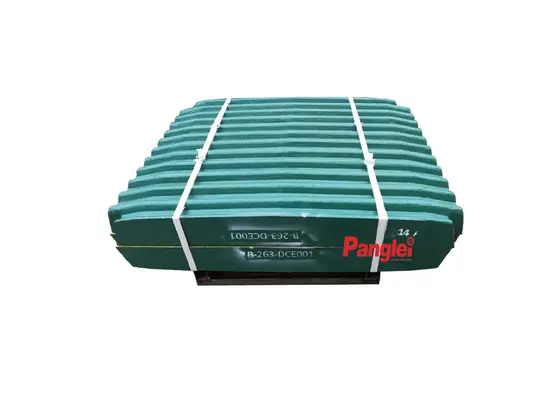
Swing Jaw Plate
Movable jaw dies cast to the same profile and heat as the fixed half
View Part →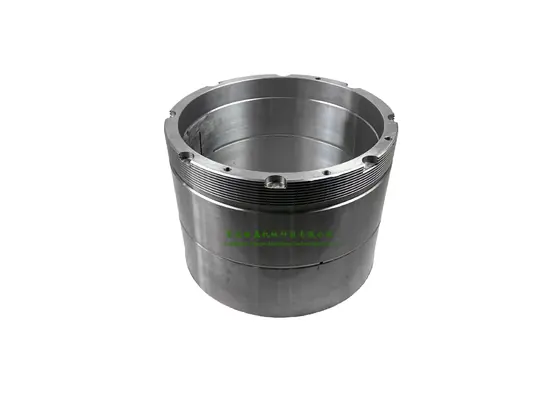
Jaw Crusher Cheek Plate
Side liners that keep the crushing chamber square and protect the frame
View Part →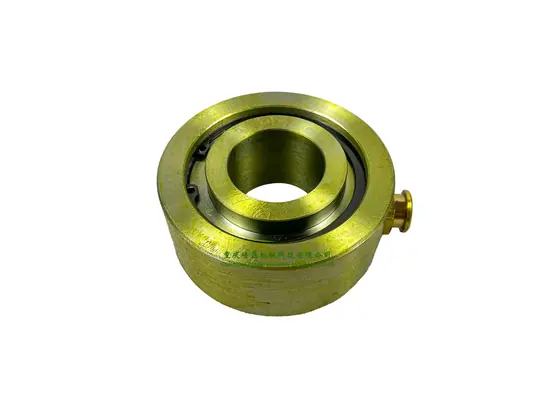
Jaw Crusher Toggle Plate
The designed weak point that protects the whole crusher from uncrushable feed
View Part →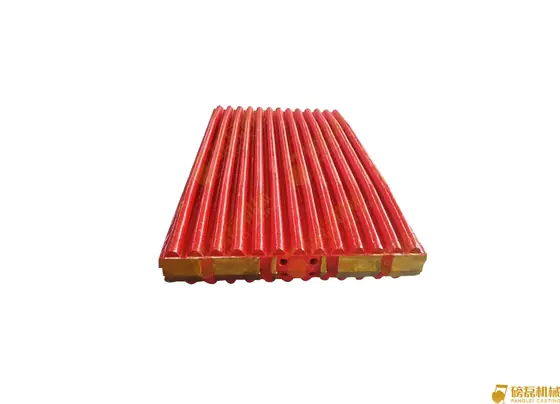
Jaw Wedges And Fixing Bolts
The clamping parts that decide whether a new die stays bedded
View Part →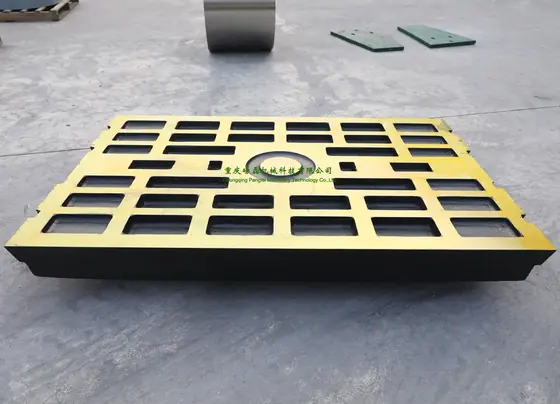
Fixed Jaw Plate Questions
Do you hold patterns for my machine?
We hold patterns for the Metso C series, Sandvik JM series, Extec C10 to C12+, and a long list of Terex, Pegson and Powerscreen sizes shown on the category page. For anything else we work from your part or drawing.
Which grade for concrete recycling?
Mn18Cr2 or Mn22Cr2. Recycled feed is abrasive and carries steel, and the higher manganese grades work harden further before they deform.
Can you supply the wedges and bolts too?
Yes. Jaw wedges, side plates and bolts are cast and supplied with the dies.
Are the plates machined?
The back face and bolt holes are machined so the plate beds flat against the frame, and a dimensional inspection report is issued.
Get A Price For Fixed Jaw Plate
Send the machine model, the part number if you have one, and the quantity. If you have neither, a photograph with the main dimensions is enough to start.