
Product Guide
Warp Knitting Machine Parts Explained
If you buy spare parts for a warp knitting machine without working on one daily, the part names are the hardest thing. This guide puts each family in the order the machine uses it.
The Loop Is Formed By Four Elements
Every course on a warp knitting machine is made by four things working in time. The needle rises and falls. The guide swings through the needle line and laps yarn around it. The sinker holds the fabric down so the old loop does not lift with the needle. The tongue, on a compound needle machine, closes the hook so the old loop can be cast off.
Everything else on the machine exists to position those four, drive them, lubricate them or pattern them.
Elements Are Supplied As Cast Units
A machine may carry several thousand guides. They are not fitted one at a time. They are cast into short units that bolt onto the bar, so a worn section is replaced as a block and the setting is preserved.
That is why this catalogue lists guide units, sinker units, tongue units, trick plate units and separators rather than individual guides and sinkers. Where a shop rebuilds its own units, the loose pins are listed separately under elements and pins.
The Parts That Hold The Setting
The trick plate carries the slots that fix needle spacing, so it physically sets the gauge. Separators keep neighbouring needles apart across the width. Needle covers hold the needles down in their slots. Long bars — needle, guide, knock-over and core needle — carry all of it across the working width.
When the fabric fault is a single vertical line, look at one element. When it is uneven across the whole width, look at these.
Drive, Lubrication And Patterning
The drive parts are flizers, sliders, connecting rods, rod bowls and the guide bar frames and ball bearings that carry the bar motion. The lubrication parts are the oil bellows in their one, three and five layer forms, with bases, locking rings, oil stoppers, shields, cups and window covers.
Patterning is either mechanical — pattern discs and chain links under a follower — or electrical, using piezo jacquard guides that deflect a guide blade with a voltage.
What Actually Wears
In rough order: sinkers, guides and tongues first, because they touch yarn on every course. Then the locating parts, as slots open up. Then the drive and lubrication parts. Piezo guides sit outside that order — they fail electrically rather than mechanically, and they fail without warning.
More Guides
Parts Discussed In This Guide
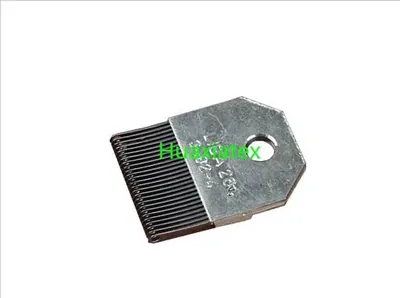
Guide Units
Cast guide units that lap the yarn around the needle.
52 parts listed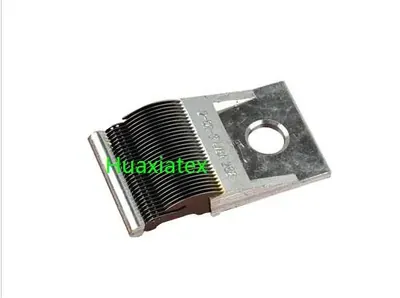
Sinker Units
Cast sinker units that hold the fabric during knock-over.
62 parts listed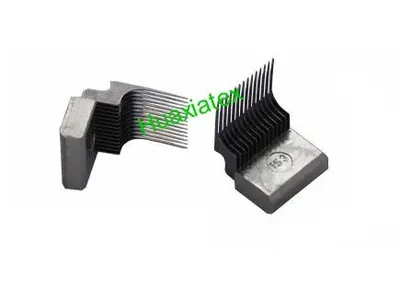
Tongue Units
Cast tongue units that close the needle hook.
30 parts listed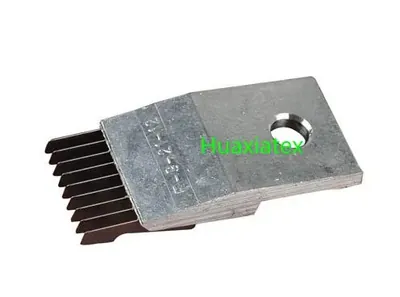
Trick Plate Units
Cast trick plate units that guide and space the needles.
19 parts listed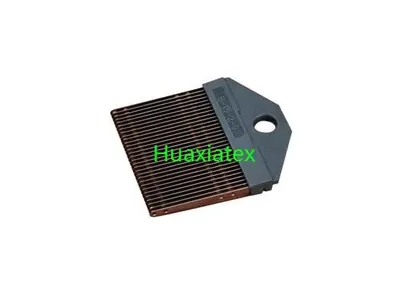
Separators
Separator units that keep needles apart across the width.
12 parts listedFrequently Asked Questions
What is the difference between a guide and a needle?
The needle forms the loop. The guide carries the warp yarn and laps it around the needle. They sit on different bars and move differently.
Why are elements sold as units rather than singly?
Because they are cast into short blocks that bolt to the bar. Replacing a block preserves the setting; replacing single elements does not.
A single vertical line has appeared in my fabric. Where do I look?
One element at that needle position, most often a guide with a worn or chipped eye.
Need One Of These Parts
Send the machine brand, machine type, gauge and a photograph of the worn part.