
Knowledge Center
What Is A Thermoelectric Module
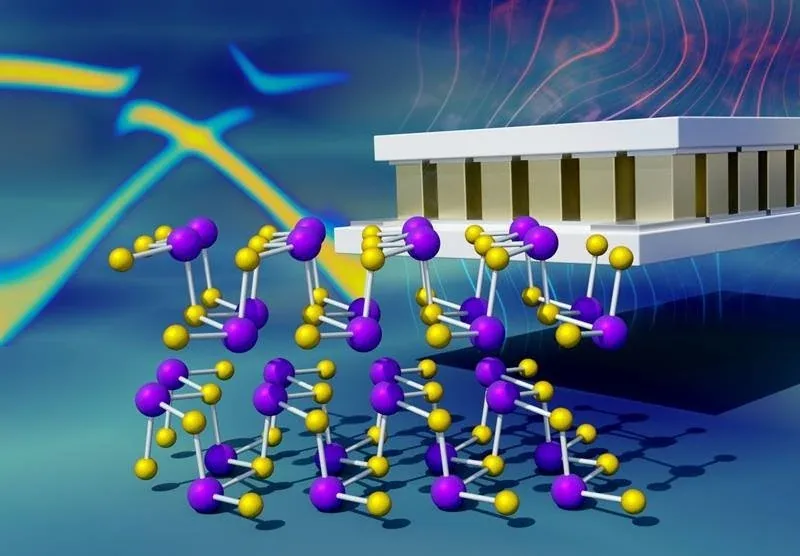
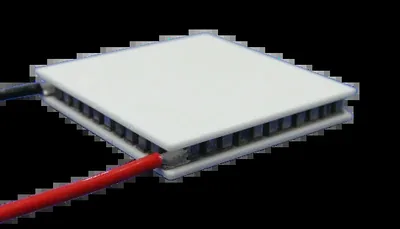
Thermoelectric modules, also called Seebeck or Peltier modules, are small solid state devices that function as coolers or as power generators. This guide explains what is inside one.
What Is Inside A Module
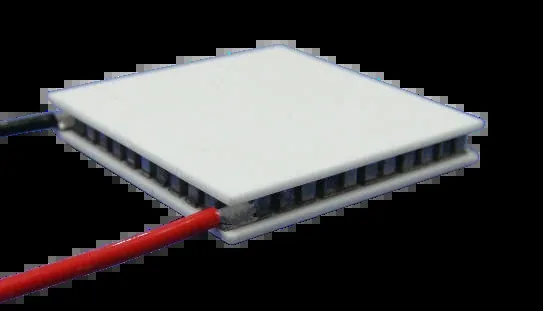
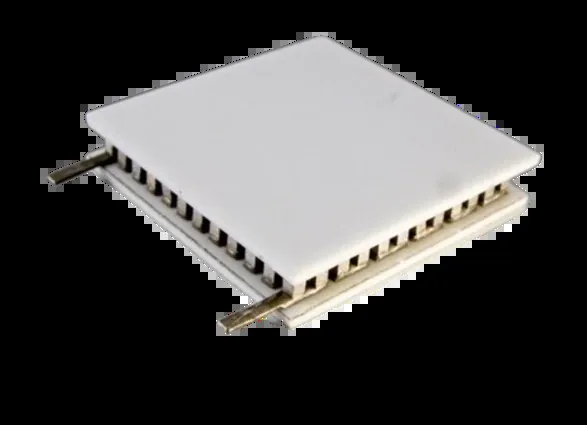
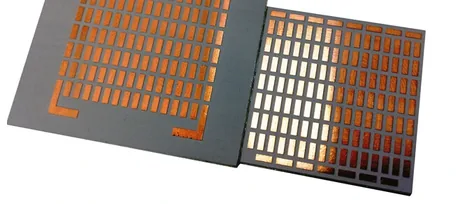
A typical unit is a few millimetres thick by a few millimetres to a few centimetres square. It is a sandwich formed by two ceramic plates with an array of P-type and N-type semiconductor materials, commonly bismuth telluride alloys, in between.
The pellets are connected electrically in series and thermally in parallel. Copper conductors soldered to the inner faces of the plates join a P pellet to an N pellet at the top, then the next N pellet to the next P pellet at the bottom, and so on across the whole array.
That arrangement is what lets a low voltage supply drive a large number of junctions, and it is why the number of couples in a module sets its Vmax while the pellet cross section sets its Imax.
The Peltier Effect, Used For Cooling
When direct current passes through the junction between two dissimilar semiconductors, heat is absorbed at one junction and released at the other. Reverse the current and the hot and cold faces swap.
That is the whole basis of thermoelectric cooling. The module does not create cold, it moves heat from one plate to the other. Everything the module consumes electrically also comes out of the hot side, so the hot side always has to reject more than the load.
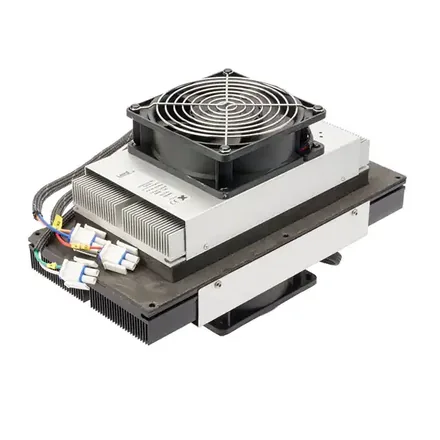
This is the single most important consequence for a designer: a thermoelectric cooler is only as good as its heat sink.
The Seebeck Effect, Used For Power Generation
Run the same physics backwards. Apply a temperature difference across the module instead of a current, and a DC voltage appears across the terminals. Connect a load and current flows.
This is what a thermoelectric generator does. It converts heat directly into electricity with no moving parts, no working fluid and no noise, which is why generators are used where reliability matters more than conversion efficiency.
Why Engineers Choose Thermoelectric
As solid state energy converters, thermoelectric modules have several advantages over competing technologies: high reliability potential, noise free operation, vibration free operation, scalability, orientation independence and compactness, meaning high energy density.
Based on those advantages, modules have come to dominate certain applications: temperature stabilisation, heat pumps for heating and cooling, large delta-T work and small scale power generation.
They are not a replacement for a large refrigeration plant. They are the right answer when a compressor cannot fit, cannot be heard, cannot be serviced, or cannot work in the orientation the product demands.
The Material Inside
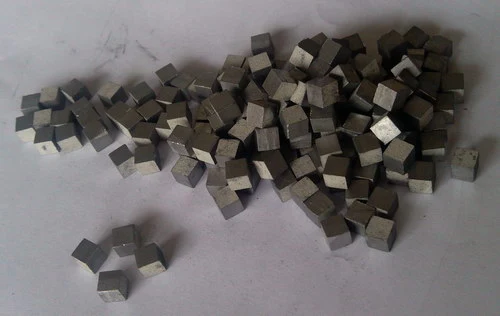
The pellets are bismuth telluride based alloys for cooling and low temperature generation, useful up to around 450 K, and lead telluride based alloys for intermediate temperature generation up to 850 K.
Material quality is where module consistency comes from. We grow our own Bi2Te3 and PbTe at 99.99 % purity, slice it, cut elements with wire electrical discharge machining, and grade pellets on Seebeck coefficient and resistivity before assembly.
The published figure of merit for our P-type Bi2Te3 material is Z 2.55 to 3.4 × 10⁻³ K⁻¹ with ZT ≥ 1.1 at 300 K, and for N-type Z 2.34 to 3.2 × 10⁻³ K⁻¹ with ZT ≥ 1.0 at 300 K.
How To Read The Catalogue Values
Four values define a cooling module, and all of them are measured with the hot side at 30 °C:
| Imax | Maximum input current in amperes at Qc = 0 and ΔTmax |
| Vmax | Maximum DC input voltage in volts at Qc = 0 and Imax |
| ΔTmax | Maximum temperature differential in °C at Qc = 0 and Imax |
| QcMax | Maximum heat pumping capacity in watts at Imax and ΔT = 0 |
Note the trap in those definitions. ΔTmax happens when the module pumps no heat, and Qmax happens when there is no temperature difference. Real operating points always sit between the two, which is why a module is normally chosen with Qmax around twice the working heat load.
Related Products
Parts Mentioned In This Guide
Keep Reading
Other Guides And Applications
FAQ
Frequently Asked Questions
Is a Peltier module the same as a thermoelectric module?
Yes. Peltier module usually refers to one used for cooling, Seebeck module to one used for generation, and thermoelectric module covers both. The underlying device is the same family.
Does a thermoelectric module create cold?
No, it moves heat. The heat removed from the cold side plus all the electrical power consumed by the module must leave through the hot side. That is why hot side design decides the result.
Why does the module have two plates?
The plates hold the pellet array, keep the copper conductors electrically isolated from your assembly and provide the flat mounting surfaces that the thermal interface needs.
Can one module be used both ways?
Physically the effect works in both directions, but a cooling module is not built for the hot side temperatures a generator sees. Use a TEG code for generation duty.
Have A Cooling Or Power Problem To Solve
Send the duty point and we will tell you which family fits, or that thermoelectric is the wrong tool.
No forms. Messages reach our engineering desk directly. Reply within 24 hours, Monday to Friday, 9:00 to 17:00 Beijing time.